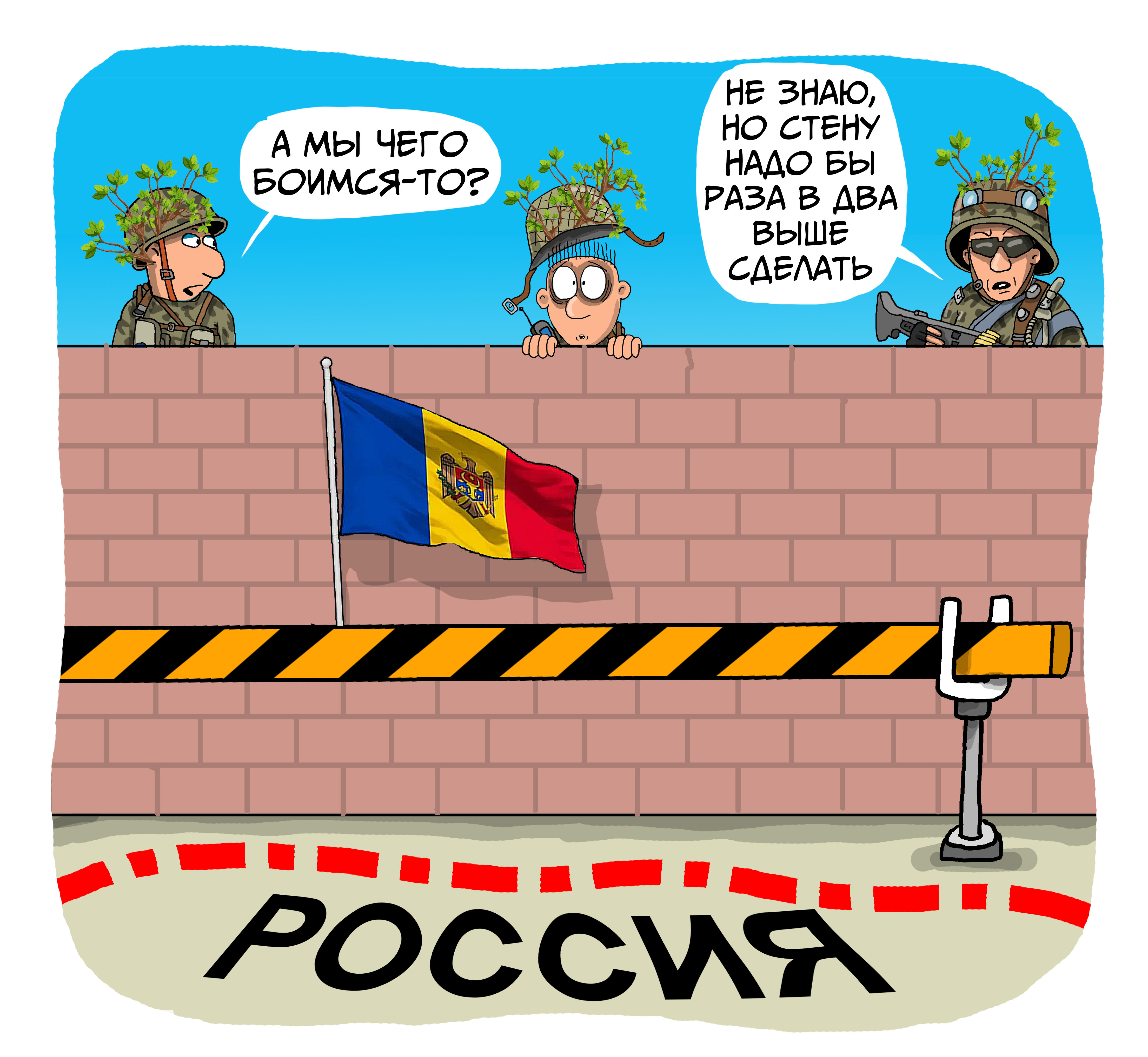
Visual affect: Moldova wants to abolish open borders with the Russian Federation


The Moldovan authorities are discussing the issue of breaking the visa-free regime with the Russian Federation, the republic's parliament told Izvestia. Chisinau is preparing to take this step for the sake of further rapprochement with the EU. However, the introduction of visas is fraught with logistical, social and diplomatic consequences for Moldovan citizens, since Moscow acts symmetrically in such cases. The Parliament is also currently discussing the basic agreement between the Russian Federation and the Republic of 2001. One of its points is Russia's recognition of Moldova's territorial integrity. In case of denunciation, the issue of Transnistria's joining the Russian Federation may become relevant again, experts say.
Moldova's possible exit from visa-free travel with Russia
Moldova is building its foreign policy in favor of the European Union. Chisinau is defiantly taking anti-Russian steps that violate all previous formats of cooperation. One of these signals was the beginning of the republic's withdrawal from the CIS. According to the country's Foreign Minister Mikhail Popshoy, Moldova will leave the commonwealth on April 8, 2027. The next step may be to cancel the visa-free regime with Russia. And this is already being discussed in parliament, Bogdan Tsyrdea, a deputy from the Party of Socialists, told Izvestia.
— The cancellation of visa-free travel is being discussed on the sidelines. And I think that's what it's all about," said Tsyrdea.
According to him, the ruling party is talking about this topic. Izvestia also sent a request to the Moldovan Foreign Ministry and the Action and Solidarity (PAS) faction.
Given that relations between Moldova and Russia are at a low point, such a decision may well be real, said Natalia Kharitonova, a researcher at the Russian State University of Economics. According to her, the republic is trying to prove its commitment to the EU with a policy aimed at destroying ties with Moscow.
However, such a measure will not seriously affect residents of the Russian Federation. Russians rarely visit the republic. For example, in 2025, according to tour operators, less than 1 thousand Russian citizens entered Moldova, whose share in the total tourist flow fell to insignificant figures (less than 1%). There has been no direct flight service between Russia and Moldova since 2022. You have to fly via Istanbul, Yerevan or Baku. The time is up to 15 hours, and the average price of a round-trip ticket is up to 120 thousand rubles. This is quite expensive for the former Soviet republic.

The republic's border Police applies an "in-depth control" procedure to Russian citizens. Upon arrival, Russians are required to show the hotel reservation, the availability of sufficient funds and, most importantly, to clearly justify the purpose of the visit. As a result, dozens of passengers with Russian passports are refused and sent back.
But even if you manage to get to Moldova, Russian bank cards do not work there. You can only arrive with cash. Many Russians who still physically enter the republic, for example, to visit relatives or travel to Transnistria, use a second passport for this purpose — Moldovan or a document from another country, which is why they are not automatically counted by national statistics as citizens of the Russian Federation.
If Moldova introduces visas for Russians, Moscow is likely to respond symmetrically, says Anastasia Gavrilova, an expert in international relations at the National Research University Higher School of Economics. Up to 500 thousand Moldovan citizens live in Russia. And according to the FSB border service, in 2025, more than 76 thousand residents of the republic visited Russia. The absolute majority of entries were for visits to relatives and labor migration.
This is especially sensitive for Moldova, because we are talking about a poor country where a significant part of families and the economy as a whole are supported by labor migration and money that people bring from Russia. The abolition of the visa-free regime will complicate trips to work, visits to relatives and money transfers, which means it will affect not only people, but also the internal economic stability of the republic.
The country's economy is critically dependent on diaspora money, which accounts for about 10-13% of Moldova's GDP. At the same time, a paradox has developed in the labor market. On paper, there are no problems with unemployment in the country — its official level is about 3.2%. At the same time, in Moldova, more than 1.1 million people over the age of 15 are considered "economically inactive." That is, four out of ten citizens work. And local companies are sorely short of builders, engineers, seamstresses, drivers and doctors: more than 12,000 vacancies have been opened on labor exchanges. In 2026, officials even began discussing attracting workers from Asian countries to cover the shortage.
The problem of Transnistria may become relevant again
By canceling visa-free travel with Russia, the republic's authorities will not take into account the interests of the Moldovan population, and the decision will become purely political, Kharitonova stressed. At the same time, it will have a painful effect on the residents of Transnistria.
The PMR, like Gagauzia, is traditionally oriented towards Moscow — the introduction of a visa regime will be like a closed "window to the world." More than 200 thousand citizens of the Russian Federation live in Transnistria. Some of them have Russian passports as the only document for traveling abroad, and not everyone has Moldovan citizenship. This is up to 50,000 people, or 10% of the population of Transnistria.
More than 20% of the male population of Gagauzia, which is over 28 thousand people, have been working abroad for decades, and in 80% of cases in Russia. The introduction of visas will deprive them of the opportunity to travel freely to earn money. Local pensioners and state employees receive payments on Russian Mir cards. The introduction of visas will greatly complicate, if not destroy, contacts between the autonomy and the regions of Russia with which it has signed agreements.

Meanwhile, Moldova may tear up another key document that directly affects the interests of Transnistria.
"We discussed that it would not hurt to denounce the 2001 Treaty of Friendship and Cooperation with the Russian Federation, in which the Republic of Moldova and Russia recognize each other as strategic partners," Tsyrdea added to Izvestia. — And I think that they are not just discussing, it will be done soon. One or two years, maximum, and they will denounce this agreement.
The possibility of breaking the agreement between the republic and the Russian Federation is a logical and consistent step of Moldova's course towards integration into the EU, Gavrilova noted. According to her, the republic's share in exports and imports of the Russian Federation is critically low, so the loss of the Moldovan market for the Russian economy will not be very noticeable.
Moldova accounts for less than 0.1% of Russia's total foreign trade. By the end of 2025, the trade turnover between the two countries fell to a historic low and amounted to about $400-450 million. Although the republic transferred more than 65% of its exports to the EU markets, Russia remained a critical sales channel for the key sector — fresh fruits and wine production, as European quotas are severely limited and standardization requirements are too high. Upon termination of the agreements, Moscow will automatically impose maximum import duties at WTO rates, which will raise the cost of Moldovan goods in the Russian Federation by 15-25% and make them completely uncompetitive.
The basic agreement also states that Russia recognizes the territorial integrity of Moldova. And this point is extremely important in the context of the Transnistrian conflict, Kharitonova noted. According to her, the republic fears that if the treaty is denounced, the Russian Federation will no longer consider itself bound by it.
Transnistria has been striving to become part of Russia for 20 years. And if we consider the hypothetical possibility of separating the PMR from Moldova and holding a referendum on joining the Russian Federation, the main problem is the territorial issue. After all, Russia and Transnistria are separated by the Mykolaiv and Odessa regions of Ukraine.
— Until recent years, there was a mechanism of economic subsidization of Pridnestrovie through intermediaries, including Ukraine. But when the latter finally cut off all supplies of Russian oil and gas, the economic situation of Transnistria began to deteriorate sharply," Sergei Tolkachev, a professor at the Financial University under the Government of the Russian Federation, told Izvestia.
If Moldova really goes for the abolition of visa-free travel and the denunciation of the basic agreement, economic and humanitarian ties between the two countries will begin to break. For Transnistria, taking into account the Ukrainian factor, the lack of direct access to the Russian Federation and Chisinau's unwillingness to let the region go, this all means isolation in an enemy environment and the likelihood of a conflict with Moldova reaching a new level. At the same time, it cannot be ruled out that the confrontation may end in a new armed conflict between Kishenev and the unrecognized republic, which the Russian Federation is unlikely to only observe from the sidelines.
Переведено сервисом «Яндекс Переводчик»
