
Contract time: deals worth 6.5 trillion may be concluded at SPIEF 2026

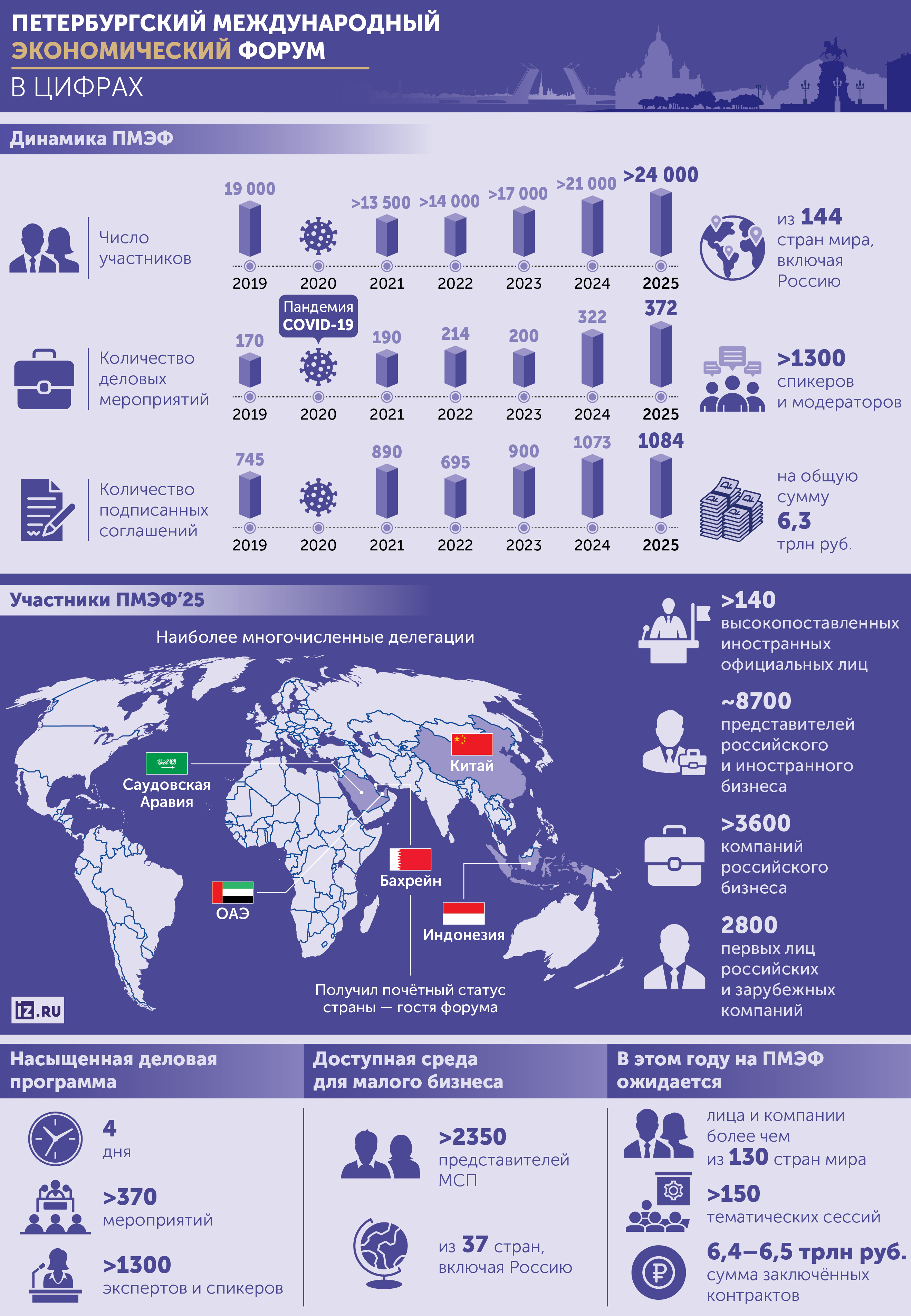
The amount of deals concluded at the St. Petersburg International Economic Forum in 2026 will amount to 6.4–6.5 trillion rubles, mainly contracts are expected in the fields of infrastructure, energy and artificial intelligence, experts interviewed by Izvestia believe. This is comparable to last year's figures. Volumes are unlikely to increase significantly amid high interest rates and economic uncertainty. Business development in these conditions will be the main topic of the forum. In addition, issues of international energy cooperation in connection with the closure of the Strait of Hormuz and the development of human capital in the age of AI are on the agenda. What else will be discussed at SPIEF 2026 and who will take part in it - in the Izvestia article.
Foreign guests of SPIEF 2026
The SPIEF in 2026 will be held for the 29th time. It will be held from 3 to 6 June at its traditional venue, the Expoforum. On June 3, the zero day, as in other years, the forum of small and medium—sized businesses will be held. The central event on June 4 will be a plenary economic session with the participation of Central Bank Governor Elvira Nabiullina and Finance Minister Anton Siluanov. On Friday, June 5, President Vladimir Putin will speak at the venue — as his press secretary Dmitry Peskov has already stated, the speech will be meaningful. Together with Putin, the leaders of Uzbekistan, Tanzania, the Deputy Chairman of the People's Republic of China and the Minister of Energy of Saudi Arabia will take part in the SPIEF plenary session.

Russian President Vladimir Putin at the plenary session of the XXVIII St. Petersburg International Economic Forum
The main theme of this year's SPIEF is: "Pragmatic dialogue is the way to a stable future." Cooperation with foreign colleagues will take a significant place: SPIEF 2026 will host the Business G20 forums, an important partner of the G20, SCO and BRICS. In addition, EAEU-ASEAN business dialogues are planned, as well as between Russia and a dozen of our most important partners: China, India, Azerbaijan, the United Arab Emirates, Cuba, and Kyrgyzstan. In addition, it is planned that business dialogues will take place with Germany and the United States. For the first time in many years, an official American delegation will take part in the SPIEF, headed by the head of the U.S. Commission on Fine Arts.
Saudi Arabia will be the guest of honor at the forum. This status symbolically coincides with the 100th anniversary of the establishment of diplomatic relations between the two countries. In addition, this is important against the background of the situation around the Strait of Hormuz. The ministers of energy, industry and investments of the kingdom will arrive at the site. A meeting with their participation will be held on the opening day.

The main topics of SPIEF 2026
According to Russian Presidential aide Yuri Ushakov, 20,000 people from more than 100 countries have confirmed their participation in the SPIEF. One of the main issues of this year's forum is how to return to the trajectory of sustainable economic growth in the face of global uncertainty. This is the name of the plenary discussion, which will be held on the main day of the forum — June 4. The moderator will traditionally be Andrei Makarov, head of the State Duma Committee on Budget and Taxes, and Central Bank Chairman Elvira Nabiullina, Deputy Head of the Presidential Administration Maxim Oreshkin, Economy Minister Maxim Reshetnikov and Finance Minister Anton Siluanov will take part in the session.

Artificial intelligence will occupy a significant place in the discussions on the site, and we are talking about completely different issues related to it.: from the labor market to business transformation and biotechnology. For example, discussions are planned on how AI is changing the energy landscape, what will happen to intellectual property in the context of the development of neural networks, and how to integrate high technologies into the development of industrial production.
It is also planned to discuss industry issues at the forum: the future of the domestic automotive industry, banks, marketplaces, and even the space sector and drones. A separate niche, as in previous years, will be occupied by regional projects and development issues of the constituent entities of the Russian Federation.

Most departments will be represented at the highest level. Energy Minister Sergey Tsivilev will take part in the session "The Nation's Engineering Code: restore or rewrite?", Transport Minister Andrey Nikitin will participate in the discussion "Entrepreneurship as a Service", and Head of the Ministry of Finance Maksut Shadaev will discuss the topic "Digital Future: common development vectors, challenges and solutions." The Minister of Health Mikhail Murashko and the Head of the Ministry of Sports Mikhail Degtyarev will also attend the forum.
One of the main topics of this year's SPIEF will be cooperation in the field of energy, which will primarily affect countries experiencing problems with transit restrictions through Hormuz, independent expert Andrei Barkhota believes. In addition, it is possible to consider the possibility of building new nuclear power plants.
— The main aspects of the forum will be three. The first is the signs of the global financial crisis in the context of the cooling of the Russian economy. The second is investments in human capital against the background of the development of AI. The third is the sovereign financial system: digital currency, tokens, CFA," believes Andrey Barkhota.

In addition, the government and business need to discuss global issues of our country's development: the return of the economy to more sustainable growth with expensive borrowed money, investments by entrepreneurs at a key rate of 14.5% per annum, cost reduction, combating staff shortages, increasing labor productivity and financing long-term projects, said Freedom Global analyst Vladimir Chernov. The most heated conversation between business and government is likely to revolve around the cost of bank loans, the tax burden, the predictability of regulation and access to government support.

Contracts for SPIEF 2026
One of the indicators of the investment mood of the domestic business is the amount of deals concluded at the main economic forum. According to experts interviewed by Izvestia, in 2026 it will be comparable to last year's and may amount to about 6.4–6.5 trillion rubles (last year — 6.3 trillion). We are talking not only about classic contracts, but also about agreements with a disclosed amount (for some of them, the figure is not reported, and some of them are not public at all).
A small, but still growing volume of contracts will be provided mainly by the state infrastructure, public-private partnerships and large corporate transactions, rather than a new influx of foreign capital, said Yaroslav Kabakov, Director of Strategy at Finam IC.

On the one hand, SPIEF remains the main platform for large investment applications from regions, state-owned companies, banks and infrastructure projects, added Vladimir Chernov from Freedom Finance Global. In addition, the nominal total amount of contracts is supported by inflation, rising costs of construction, equipment, and long-term projects. On the other hand, a high key interest rate, expensive debt and a tougher budget framework will deter businesses from taking on too large new obligations, he stressed.
— The main contracts will be concentrated in infrastructure, energy, transport, petrochemical, agro-industrial complex, and industry. The international circuit is shifted towards BRICS and the countries of Asia, the Middle East and Africa, the key partners are China, India, the United Arab Emirates, Saudi Arabia, and the EAEU countries; the western track will continue to be minimal," Yaroslav Kabakov noted.
In addition, Yulia Kovalenko, deputy head of the Higher School of Economics of Moscow, Plekhanov Russian University of Economics, added that many deals can be expected in the context of technological solutions, in particular, the introduction of AI into the activities of organizations of various kinds.
Переведено сервисом «Яндекс Переводчик»
