
Generation replacement: 5G in Russia may be launched in the summer

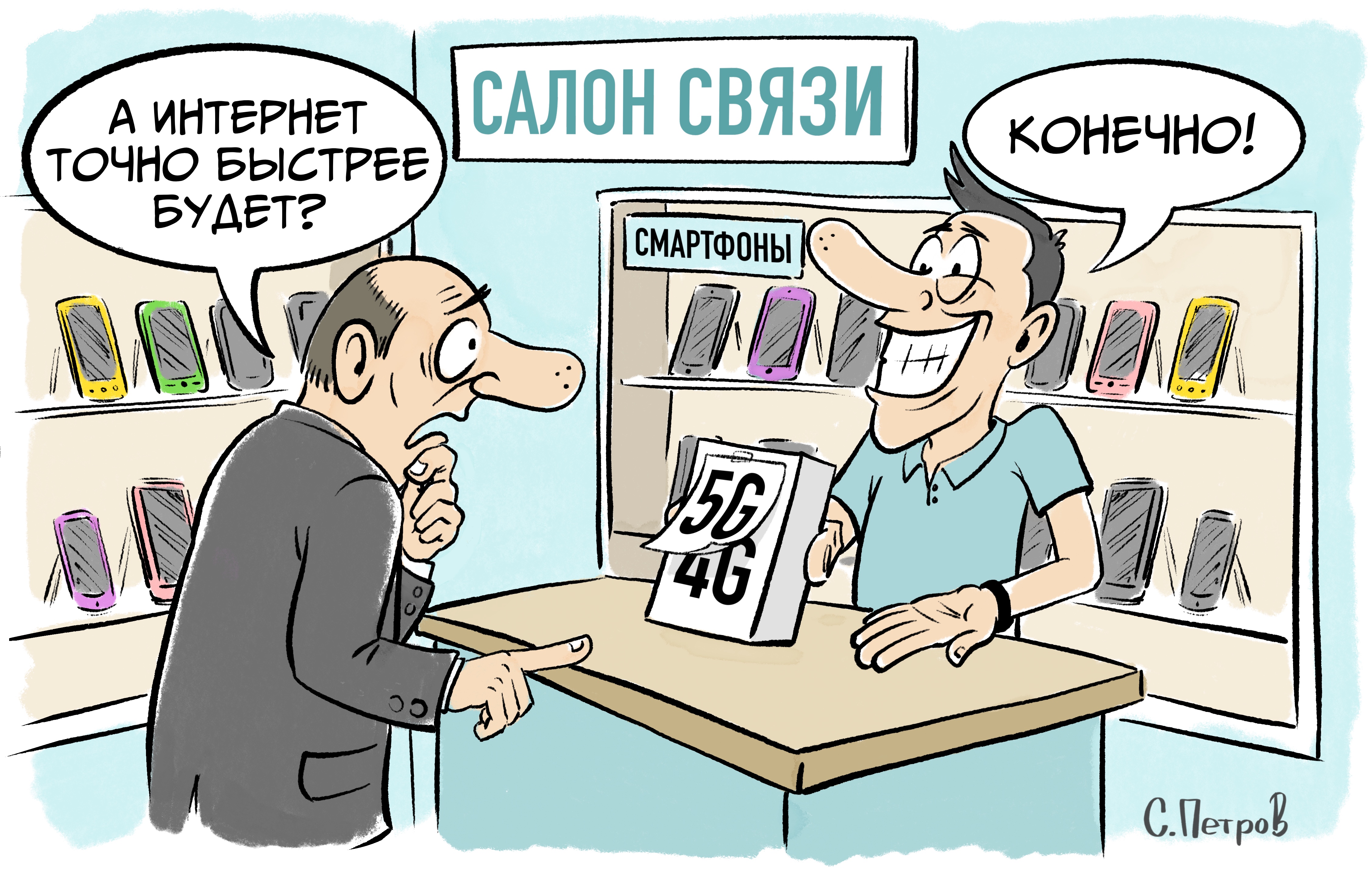
The launch of fifth–generation communication networks in Russia may take place as early as summer, but users will not feel it yet: operators do not yet have the equipment to operate in the allocated range of 4.63-4.99 GHz. As a result, a 5G icon may appear on subscribers' devices, but the actual data transfer rate will remain comparable to current figures. According to experts, in the coming years, full-fledged fifth-generation communications will be available mainly in the country's largest cities. Izvestia dealt with the problems that may arise in the development of 5G networks.
When will 5G become fast
Frequencies for Russian 5G networks, which officials and communications specialists have been trying to resolve since the late 2010s, may become available as early as next month. At the end of June, the government plans to allocate the 4.63–4.99 GHz band to Vimpelcom, MTS, MegaFon and T2, which will allow the deployment of fifth-generation networks in large cities. This follows from the materials of the State Commission on Radio Frequencies (GCRF), which were reviewed by Izvestia.

In addition, operators may be allowed to use frequencies previously allocated to 2G, 3G, and LTE networks — this is a matter of technological neutrality. According to the draft decision of the State Emergency Committee, the launch of communication services using radio-electronic means of the 5G/IMT-2020 standard in all cities with a population of more than 1 million people should take place no later than December 31, 2027.
At the same time, 5G services should be provided using Russian equipment, but the transition will be gradual. By the end of 2027, the share of domestic radio electronic assets in such networks should be at least 1%, by 2030 - at least 50%, and operators should fully switch to Russian equipment by the end of 2031.

In addition to launching networks in cities with a population of more than 1 million people, the project also provides for more detailed coverage requirements. So, by the end of this year, fifth—generation communications should appear in the first four regional centers, in the next - in 16. By 2030, the number of such cities should grow to 40, and by 2035 to 84, follows from the annex to the draft decision of the State Emergency Committee.
"The launch of commercial use of fifth—generation communication networks in Russia will begin after decisions are made on the terms of their implementation — they are currently being discussed with interested departments and businesses," the Ministry of Finance clarified to Izvestia. — The introduction of 5G will improve the quality of communication services and increase the speed of data transmission, deploy high-speed networks for industrial applications.

In addition, the development of fifth-generation communication networks will stimulate the production of Russian telecom equipment, the ministry added.
One of the radio frequency planning specialists reminded Izvestia that officials and businesses had been discussing the introduction of 5G in Russia for about eight years. During this time, fifth-generation communications managed to appear in the USA, China, the EU and a number of other countries, while in our country the launch was delayed due to the fact that operators for various reasons could not receive the necessary frequencies for mass coverage of large cities.
— In the technocrality mode, operators can launch fifth-generation networks within a few days after the decision of the State Emergency Committee and the formal receipt of assignments from Roskomnadzor. They don't even need to change the equipment — companies are already working on 5G Ready networks. But subscribers will not feel any breakthrough changes: the speed will increase slightly, data transmission delays will decrease slightly. Tangible changes will occur after the launch of networks at 4.63–4.99 GHz, which will increase speeds by 4-10 times compared to LTE," the source said.
At the same time, 5G networks in the coming years will be available mainly to residents of large cities if they have smartphones with support for the 4.63–4.99 GHz band, which is not present or activated in all device models, the expert said. As for network equipment, its large-scale production is only in the plans of manufacturers. The plans of the SCR take into account the industry's ability to saturate the market with such equipment, he added.

Much will depend on what additional conditions the state will offer to operators when approving the parameters for the implementation of fifth-generation networks, Vimpelcom noted.
"Using the equipment already installed on the network, we can launch 5G in the foreseeable future, since investments in infrastructure were initially carried out with the expectation of a new generation of communications and based on the industry strategy proposed by the regulator several years ago," the operator's press service told Izvestia. — As a result, today we have modern equipment that will not require replacement or major modernization for many years to come.

The company also stressed that the transition to 5G for subscribers will be as comfortable and almost imperceptible as possible, which has already been confirmed in the framework of the implemented pilot zones, as well as large-scale network readiness tests that started in mid-May.
Izvestia also sent inquiries to MTS, MegaFon and T2.
What difficulties may the development of 5G networks face?
5G will operate in Russia at frequencies other than those used in most developed countries, so there is virtually no mass—produced equipment for such networks right now - its large-scale production has yet to be established, said Denis Kuskov, CEO of TelecomDaily. According to him, a similar situation is developing with smartphones: many devices do not support the range of 4.63–4.99 GHz, and in a number of models where such an option is technically provided, it is blocked at the firmware level.

The first commercial 5G networks on these frequencies can be launched in Russia as early as the beginning of 2027, according to Oleg Yablokov, NTI expert on wireless communications. According to him, the main advantages of such communication for users will be a significant increase in data transfer speed (theoretically up to 10-25 Gbit/s) and a reduction in delays to 1-2 ms. These characteristics, combined with the use of new frequencies, will allow, in particular, to eliminate buffering when watching videos in 8K format, as well as ensure stable operation of online games and other services that are sensitive to signal delays.
"However, the key potential of the technology in the 4.63–4.99 GHz configuration will be revealed not so much in B2C as in B2B and industry — for the further development of smart cities, unmanned transport, tele- and industrial robotics," the expert added.
The wording of the GCR materials raises questions, one of the frequency planning specialists noted in a conversation with Izvestia. This applies, in particular, to the use of Russian and foreign equipment. According to him, the documents are drafted in such a way that operators will first have to launch 5G on imported equipment, then turn off the service and switch to Russian equipment. At the same time, the question remains whether it will be produced in sufficient quantities by 2031 and whether it will be possible to integrate it with existing LTE networks.

The chosen range of 4.8–4.99 GHz also cannot be called optimal, Oleg Yablokov believes. According to him, the signal at these frequencies fades faster and penetrates into buildings worse. This will require operators to build a significantly denser network of base stations, which will significantly increase capital costs and may cast doubt on the rapid payback of projects without government co-financing.
"These frequencies will be distributed free of charge, although back in 2025, the Ministry of Finance considered the possibility of holding an auction with an initial lot value of over 21 billion rubles," said Leonid Konik, a partner at ComNews Research. — At the same time, cellular companies will receive the right to technological neutrality for 5G networks. But there are also disadvantages: obligations to cover all million-plus cities with the necessary infrastructure and to use domestic base stations (BS).

According to him, 5G makes it possible to unload LTE networks in crowded areas. At the same time, for each operator, the set of territories where the existing infrastructure is already close to traffic congestion is individual, whereas the regulator offers a single list of such zones for all market participants.

In addition, many of the advantages of 5G — for example, the ability to connect a large number of devices to a single BS and minimal delays in data transmission — are primarily in demand by corporate customers, and their production facilities are often located outside cities with millions, the expert noted.
According to Leonid Konik, a more rational solution would be to leave it to operators to decide where and to what extent they and their B2B clients need 5G infrastructure.
Переведено сервисом «Яндекс Переводчик»
