Poisonous creatures: Snake bites have been recorded in 10 regions since the beginning of spring.
- Статьи
- Society
- Poisonous creatures: Snake bites have been recorded in 10 regions since the beginning of spring.


In Russia, snake attacks on people have been registered in at least ten regions since the beginning of spring, Izvestia found out. Such cases were reported, in particular, by the Ministry of Health of Kuzbass, Ivanovo, Kostroma, Yaroslavl, Saratov and several other regions. For one man in the Leningrad region, a meeting with a reptile ended tragically — he died in the hospital. According to biologists, snakes can be found more often this year due to the snowy winter and warm March, which contributed to their activity. The risk zone now includes the south of Russia and the North Caucasus, where the most dangerous snake in the country, gyurza, lives. How to avoid bites is in the Izvestia article.
Where snakes bite
Since the beginning of the year, at least 30 Russians have suffered from snake bites, Izvestia estimated based on data provided by the regional Ministry of Health and emergency medical services.
The largest number of appeals from among the subjects who responded to the publication's request was recorded in the Leningrad region, where nine people were injured in the first two weeks of May. One of the bitten could not be saved: he died in the hospital.
— Since May 1, we have had cases of bites: in the leg, in the fingers. There were calls to the lake — people were having a picnic, to private country houses, to the forest," the Leningrad Region ambulance service explained.
Six people were bitten in the Ivanovo region, and four were injured in the Saratov region. Since the beginning of the year, three snake bites have been registered in Karelia: one person was treated in a hospital, the other two in a polyclinic. Two more were bitten in the Krasnodar Territory.
One episode was recorded in Kuzbass, Adygea, Kostroma, Ulyanovsk and Yaroslavl regions. The Ministry of Health of the Orenburg region also confirmed isolated bites.
"Since the beginning of 2026, one case of a viper bite has been registered, which is significantly less than in the same period last year," the Ministry of Health of Chuvashia said. — There are few venomous snakes in the region, most often they are vipers. They live mainly in forest and meadow areas, especially along river floodplains.
In Moscow, for the third year now, there have been no cases of viper bites, the health department of the capital reported. However, residents affected by pets are being rescued in the region. So, since the beginning of the year, Moscow toxicologists have rescued two people bitten by a blue kuffia.
The activity of snakes was recorded in 19 more Russian regions, Izvestia found out based on media publications.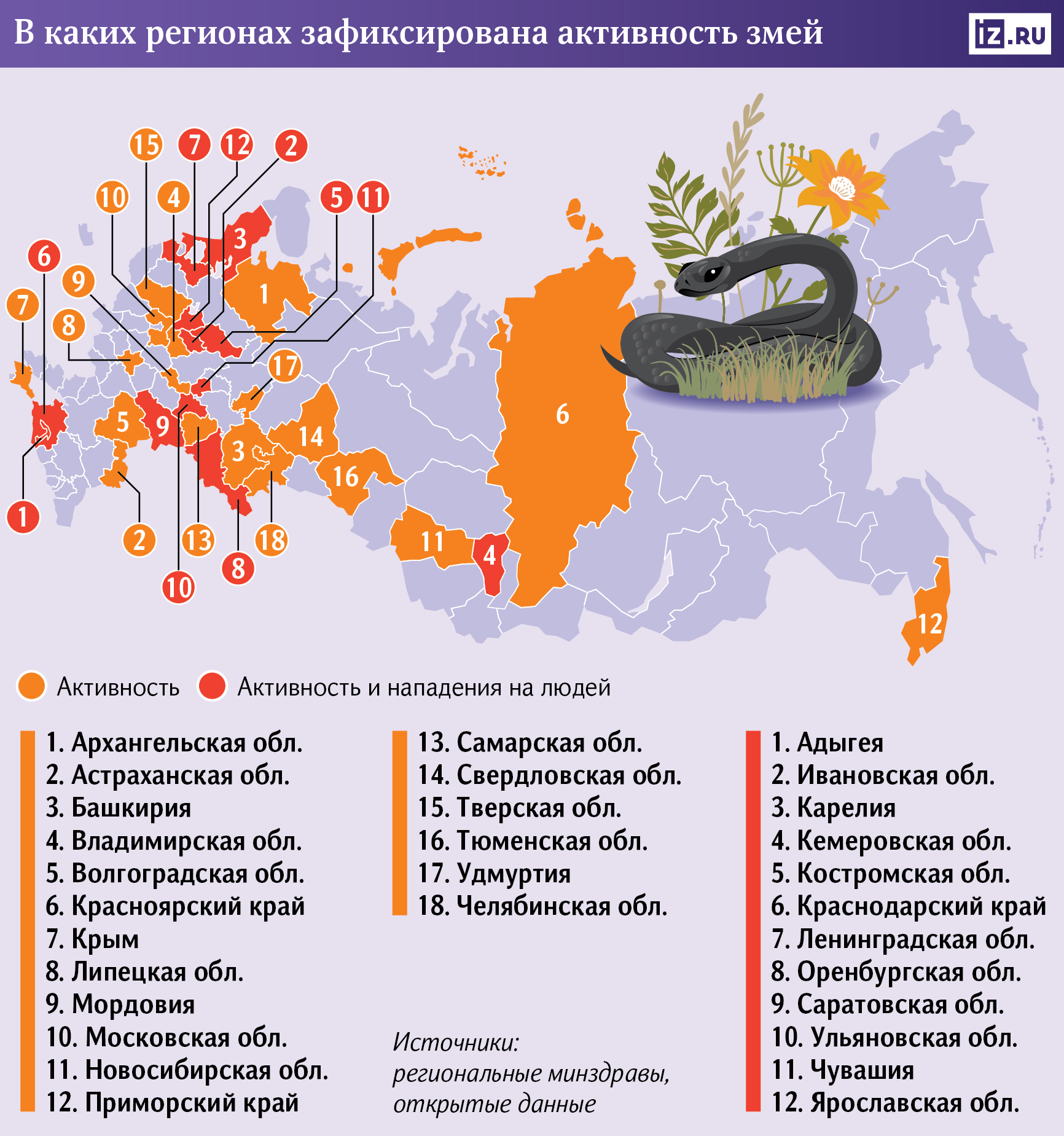
And there is no one to bite the residents of the Kamchatka Territory: there are no snakes in the region due to the harsh climate and prolonged winter, the regional Ministry of Health reported.
There are more snakes
A snowy winter, a warm March and an abundance of rodents have led to an increase in the snake population in Russia, biologist Dmitry Safonov confirmed to Izvestia.
— Their number has increased quite a lot in the Ryazan region, and a slight increase is observed in the Moscow region, — the expert noted.
The biologist explained that most snakes successfully survived the winter and came out of hibernation ahead of time. The frosts that were observed in Central Russia in April did not harm them in any way.
"They were only slightly frozen, they were sedentary and sluggish in April, but they didn't die," Dmitry Safonov said.
According to him, in May, most snakes in the middle lane, including vipers and grass snakes, began their mating season. At this time, meeting them can be dangerous.
— The greatest risk of snake bites is in the south of Russia and the North Caucasus, — Safonov noted. — There is the most dangerous snake in the country — gyurza. Unlike our viper, it does not crawl away at the sight of a person, but, on the contrary, prefers to hide and can attack.
The expert emphasized that large gyurza specimens reach 2 m.
— You can get very seriously hurt by the bite of this snake. There have been cases of amputation and even deaths," herpetologist Mark Pestov told Izvestia.
In total, about 40 species of snakes live in Russia, of which 12 belong to the venomous family of vipers, he stressed.
— There is only one species of venomous snake in most of European Russia, the common viper. The steppe viper is more common in the southern regions. There are several species of mountain vipers in the Caucasus," Pestov explained.
However, deaths from snake bites in Russia are extremely rare, the expert noted.
How to protect yourself from bites
The outcome of a snake bite can never be predicted, Dmitry Karpenko, associate professor of Polyclinic Therapy at Pirogov University of the Ministry of Health, told Izvestia.
"It depends on a cascade of factors, namely the type of snake, the amount of venom injected, the bite site, the age of the victim and his initial state of health," the doctor explained.
According to him, in Russia, the common viper can be found not only in the wild, but also in abandoned suburban areas.
— A snake doesn't attack for no reason: This is always a defensive reaction to a real or perceived threat — when a snake is stepped on or tried to catch it. To minimize risks, you should wear high rubber boots and tight trousers, as well as wool socks," he added.
According to Dmitry Karpenko, to avoid being bitten, you need to look at your feet, spread the grass with a long stick before you step out, and avoid thrusting your hands into holes and hollows.
"When you see a snake, you need to freeze and slowly step back, in no case trying to kill it or drive it away," he stressed. — If you are bitten, the main thing is to act without panic, but immediately. The first step is to move away from the snake to a safe distance and remember the time of the bite. Then you need to immediately call an ambulance or start transporting the victim to the nearest medical facility.
The sooner the anti-snake venom serum is administered, the better the prognosis, Dmitry Karpenko said. Before the arrival of doctors, the bitten limb must be immobilized by applying a splint from improvised means.
— Rings, watches, and tight clothing should be removed from the victim, since with the development of edema, they will compress tissues and disrupt blood circulation. The wound should be treated with an alcohol—free antiseptic, then a clean, dry bandage should be applied," the doctor added. — The victim is shown copious drinking to reduce the concentration of the poison and eliminate it as soon as possible.
At the same time, alcohol cannot be consumed by a bitten person, as it dilates blood vessels and greatly accelerates the absorption of venom, Dmitry Karpenko explained.
— It is strictly forbidden to apply a tourniquet, as this leads to tissue necrosis and gangrene. The poison spreads through the lymphatic vessels, so a tourniquet will not stop it, but it will cause tissue necrosis, which can lead to amputation of the limb," he explained.
It is useless and dangerous to suck the poison out with your mouth, especially if there is micro—damage to the mucous membrane of the person who provides assistance, as this will lead to poisoning. You can not make incisions on the wound, cauterize it.
Переведено сервисом «Яндекс Переводчик»
