Colors of life: what pictures are born under the shelling of Donbass


In Donetsk, a painter collects mosaics from fragments after shelling. Another, having lost a leg because of a petal mine, goes out against everything to paint city streets with an easel. And the main art museum reopens its halls after the art raids. While the city lives in the line of fire, they continue to write, hold exhibitions and save art. About how the main art museum of Donbass was revived, what it's like to exchange a camera for a machine gun, and what canvases are born under fire — in a special report by Izvestia.
The first nine halls
The Donetsk Republican Art Museum is a key exhibition site in the region and the main repository of paintings, graphics, and sculptures. He has 17,000 works in his collections, including such authors as Surikov, Shishkin, Vasnetsov, Aivazovsky, and Repin. After the start of the special operation, the museum fell into the epicenter of shelling three times. He worked online for four years, and the collection itself was moved to the storerooms. This year, its doors have opened again.

— We have carried out major repairs, some of the work is still ongoing, — says Ekaterina Kalinichenko, director of the museum. — Currently, nine halls are open. There are eight more to come. Among the exhibitions, for example, "Black Gold", which includes paintings by the artist Konstantin Dorokhov, who created a whole gallery of images of Donbass in the 30s of the XX century. The earliest work dedicated to our region was written by Nikolai Kasatkin in 1894, it is called "At the cage" and is also presented at the exhibition. I would like to note that we have changed the concept — if earlier, since the time of Ukraine, the exhibition opened with Western European art, now the first hall welcomes the works of Russian authors.

Ekaterina shares that the darkest page in the museum's history occurred in 1941. With the arrival of the Nazis, almost the entire collection was lost. Only a tiny fraction was saved — 11 paintings, including, for example, the amazing "Cup of Honey" by Makovsky. Local artist Evgeny Greilich managed to take them out and hide them.
In recent years, the museum's funds have been replenished with works by contemporaries. Among them is Vladimir Bauer, who wrote a poignant series of paintings about the present day, the heroes of which are both people and abandoned pets. Viktor Evdokimov — in 2023, he stepped on a petal mine, lost his leg, but did not stop working. Today he can often be seen in the city center with an easel and a brush, at the end of the year he turns 75 years old. People's Artist of Ukraine Vladimir Shendel, who has already died, created an engraving in which the hero of the Great Patriotic War covers up modern defenders of Donbass at his Grave in 2014.
Breaking the "blockade"
It is noteworthy that until 2014, Donbass was not oriented towards cooperation with Russia. There were no exhibitions dedicated to Russian culture — the topic was closed. A peculiar breakthrough of this "blockade" occurred in 2016, when another museum of the DPR, Art-Donbass, held an exhibition "Our Pushkin". It caused an unprecedented stir and became the largest in the entire wartime in Donetsk: in four months it was visited by 10,000 people.
In the following years, the museum organized several dozen exhibitions in Russian cities, including traveling ones, acting as a flagship for establishing cultural ties on the part of the then-unrecognized republic. Among the first are "Winds of Donbass", "Colors of Steppe Giants", "Chekhov's World".
The main mission of Donetsk residents, including Ekaterina Kalinichenko, who led Art Donbass in those years, was to introduce Russia to their region, to show that, despite the difficult situation, Donetsk artists did not give up, did not give up their brushes. And Donbass itself is full of different facets and colors, and they are not necessarily black.
A mosaic of shards
The artist Vladimir Bauer is known both in Russia and in Europe. His works are kept in the Tretyakov Gallery, in private collections and galleries around the world. The painter's style can be described as avant-garde. He says, "I started with realism. Then, in the 1970s, when I wanted to find my niche, in which I would feel as good as possible, I gradually came to the current visual language."
The workshop of the 77-year-old craftsman is located in the center of Donetsk, shells fell twice nearby. Looking at his paintings, you realize that you don't want to choose any words to describe the style and you don't need to, the paintings speak for themselves.

"The last cartridge" — in this painting, a mouse drags the same cartridge on its back to give it to a militia fighter. "Lord, save and preserve!" — it shows a dog with a lighted candle in his paws and with his mouth bared in crying and screaming, running and flying through an empty ghost town. "Phosphorus rain" — a man and a tailed friend look up at the sky at the luminous drops flying on their heads. "Refugees" are two bent figures made in a minimalistic manner: one has a teapot in his hands, the other has a bag of food, and it seems that nothing more is needed to clearly and fully tell about the fate that befell people who were forced to leave their homes. Nearby are laconic mosaics with the same stray dogs, made up of stone shards and fragments that the artist found on the streets after the shelling.
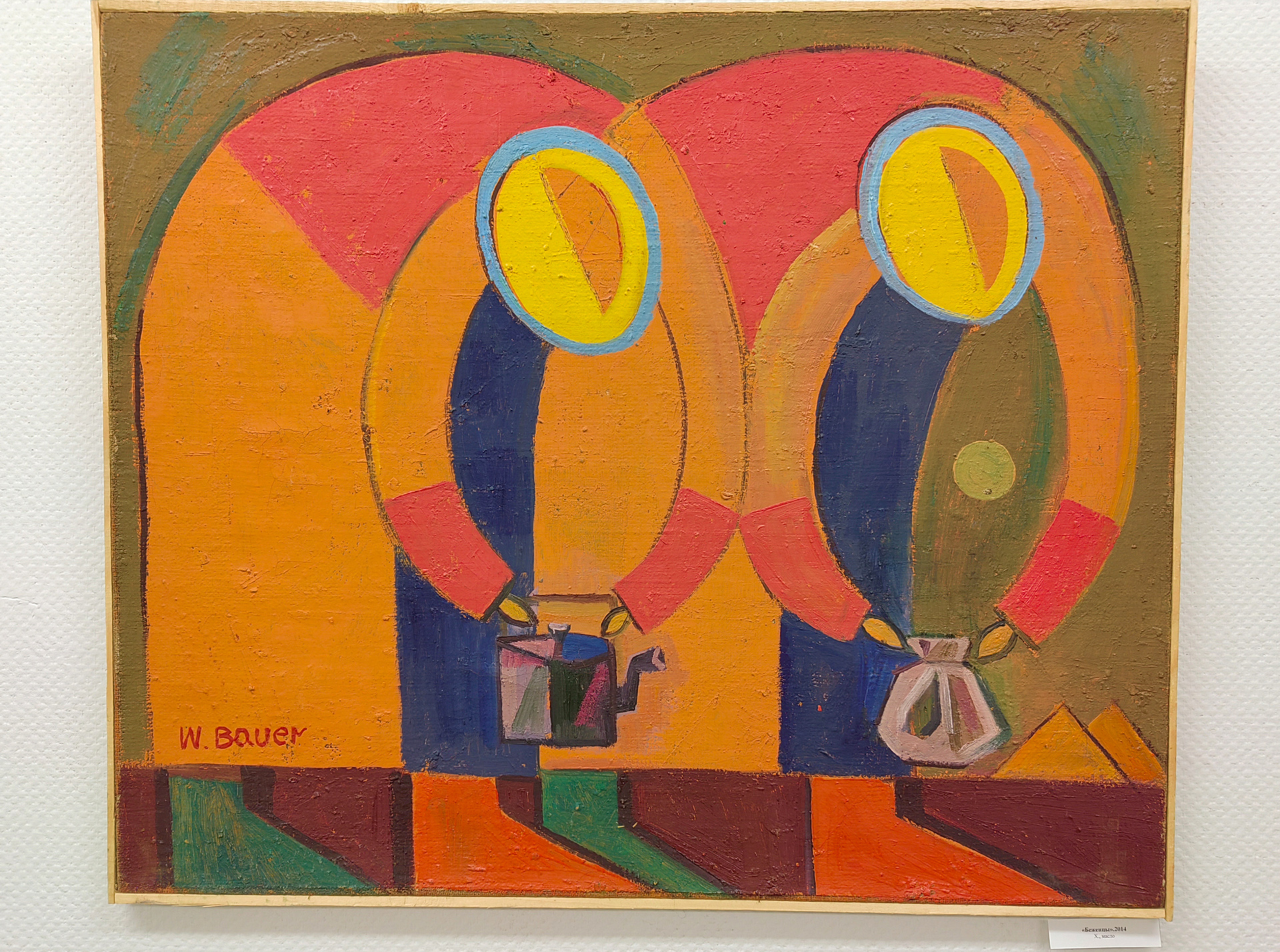
The mining theme occupies a special and, perhaps, the first place in Vladimir's work. Even in the workshop, next to the paints and solvents, on the windowsill he has, as he puts it, a "recharge" — a piece of anthracite coal, miner's lamps and helmets from the 1930s and 1950s, an old flask. At one time, he painted his native Dzerzhinsk a lot, the miners are the people he respects the most.

For the 70th anniversary of the artist, the Donbass Post has released a special postal set - an envelope and a stamp with his paintings and portrait.
Makeyevka – Baikal – Zaporizhia
Artyom Povarov is the chairman of the Union of Photo Artists of the DPR. One of those who was mobilized in February 2022.
— I was born in Makeyevka. I started shooting at the age of 12 with a Kiev camera during a school trip to Kiev," Artyom says about himself. — Graduated from Dnepropetrovsk Art College. He served for a year and a half in the Ukrainian army.

During the Maidan period, he was on tour with other photographers in Nepal, and there, according to him, for the first time he experienced undisguised aggression from those who supported the protesters.
In 2015, Artyom and his friends made a five-month trip across Russia — they drove an old Opel to Lake Baikal from Buryatia and back, covering 21 thousand km. We spent the night in tents. The creative result of the voyage was 150 landscapes. The task that the artist set for himself, among other things, was to "bring a piece of beauty, harmony and peace to the pain-ridden Donbass." Artyom's companion on the trip along with the camera was the DPR flag, which he did not hide, for which he was finally ranked among the "enemies" in Ukraine.
In February 2022, after the general mobilization was announced in the republic, Artyom appeared at the recruiting office on his own. A platoon was formed from the recruits. Of the 50 people, only two had military experience, including Povarov. He was appointed deputy commander, given a steel helmet and a submachine gun. And they were sent through Dzhankoy to the Zaporizhia region.
The guys were standing at roadblocks, building fortifications. Six months later, after several injuries, Artyom was admitted to the hospital. And soon they were charged. In 2023, he returned to work. He runs the union again.
However, the creative process is difficult, at least for him, the interlocutor admits. The military situation and everyday life are under pressure, and there has been no electricity in Makeyevka since morning due to shelling. I want to take a deep breath, immerse myself in my work, and experience a sense of freedom, as before, says Artyom. Moreover, there are many plans. One of them is to continue exploring Russia, to get to the Far East, to Kamchatka. And to share what I saw with my fellow countrymen again.
Modern Donbass is not only a frontline news, but also a cultural agenda. Somewhere it is intertwined with the theme of its own. And somewhere it breaks out of its framework, fitting into the elegant formula from the movie "Only old men go into battle": "War is coming, but music is eternal." A special role in this field is played by artists who, perhaps like no one else, are able to capture and reflect the essence of today.
Переведено сервисом «Яндекс Переводчик»
