Petri dishes: virtual laboratories will allow even a schoolboy to experiment with cells
- Статьи
- Science and technology
- Petri dishes: virtual laboratories will allow even a schoolboy to experiment with cells


Russia has created the first virtual cellular laboratories with microscopes, Petri dishes and other scientific instruments. Now schoolchildren and students will be able to hone their skills and even take exams in 3D format. To begin with, they will be offered to cultivate green monkey cells, which were used to create vaccines against coronavirus, rabies and tick-borne encephalitis. Digital tools will accelerate the training of personnel in the field of biotechnology, but they will not be able to completely replace the practice in a "live" laboratory, experts interviewed by Izvestia emphasized.
Cellular laboratories in a computer
A complete virtual simulation of laboratory work with cells was created by specialists of the Pharma-Premium Scientific and Educational Research Center of the A.P. Nelyubin Institute of Pharmacy of the First Moscow State Medical University. Now students of specialized universities and colleges will be able to consolidate their knowledge and even take exams in the 3D laboratory "Cell Culture Cultivation". The platform will also be useful for students interested in biology and medicine to prepare for the Olympics.
The digital laboratory allows you to learn the basics of cultivating adhesive mammalian cell lines in 3D format. These are cells that scientists grow in Petri dishes to test new drugs, as well as modify to produce certain substances or grow organs and tissues.
— In the developed program, students are taught how to cultivate Vero cells, a green monkey kidney cell line widely used in vaccine production. They have developed and tested drugs against various infections, including polio, rabies, tick-borne encephalitis, Japanese encephalitis, yellow fever, herpes simplex virus, as well as some vaccines against COVID—19," said Elena Bakhrushina, Professor of the Department of Pharmaceutical Technology at the A.P. Nelyubin Institute of Pharmacy, Doctor of Pharmacy.

The virtual environment accurately reproduces a real laboratory: students and schoolchildren can conduct experiments, create notes and perform the necessary calculations. The program includes a theoretical block, tests and a practical assignment. At all stages of the work, articles with detailed descriptions of actions are available to users. For the convenience of integration into the educational process, two modes are provided: training — to consolidate skills and examination — to control knowledge.
As the creators of the platform explained, this is the first program in Russia that teaches practical work with cells — the so-called wet biology.
Usually, special conditions are needed to conduct experiments with cells: equipped laboratories, laminar flow boxes and other expensive equipment, and live cell cultures.
"Our digital laboratory makes it possible for any student to master the required biotechnological skills, including in an online format,— emphasized Elena Bakhrushina.
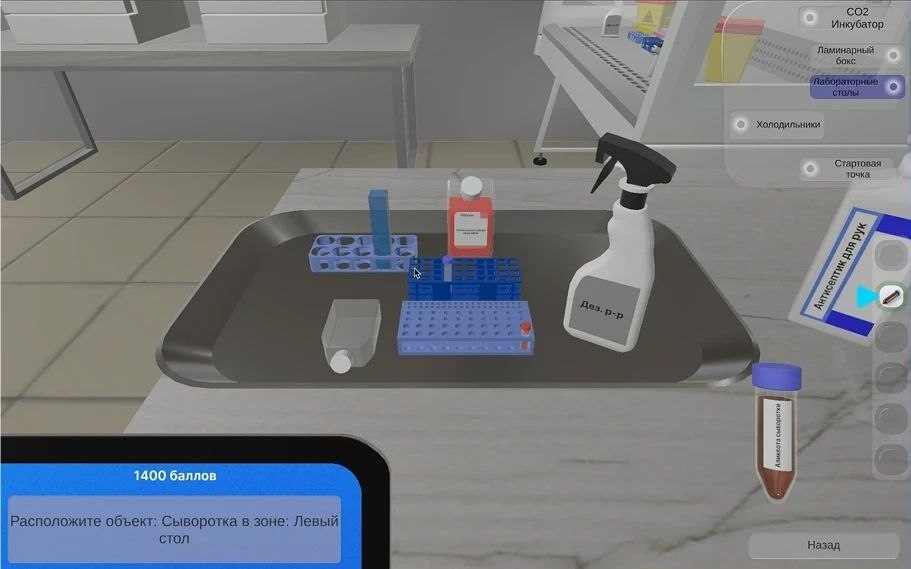
A certificate of registration has already been received for the program, and it is currently being tested among students in the fields of Pharmacy and Biotechnology. In September of this year, it is planned to introduce it into the educational process, and in the future — to scale it to other universities and colleges.
How virtual labs can help create medicines faster
The skill of working with cell lines will accelerate the learning process in the laboratory and ensure readiness to perform practical tasks with cell cultures in production, the developers said.
By removing dependence on expensive equipment and "live" materials, such tools allow a student or student to hone practical skills online, prepare for exams and Olympiads without the risk of mistakes and the cost of consumables, Associate Professor Inessa Yakimovich, Deputy Director of the Institute of Medicine and Medical Technologies at NSU, told Izvestia.
— In terms of the objectivity of knowledge control and the possibility of modeling non-standard situations, the virtual laboratory is not inferior to the traditional one, and in some aspects it surpasses it. This is a real mechanism for developing practical skills among future pharmacy and biotechnology specialists, which is especially relevant in regions with limited infrastructure," the expert said.
At the same time, the introduction of digital tools does not completely eliminate the practice in a "live" laboratory, but it allows to train much more qualified personnel at lower cost, increasing the accessibility, safety and objectivity of biotechnological education at all levels — from school to university, the specialist noted.
The advantages of virtual labs are obvious. First, they solve the problem of accessibility: not every university or college has expensive equipment: incubators, modern microscopes, and, most importantly, storage systems for living cell lines. The digital environment allows you to work out the sequence of operations without risking expensive equipment and biomaterials. Secondly, it is absolute safety — there is no risk of contamination, there is no work with dangerous agents, said Denis Alekseev, head of the Department of support for educational programs and scientific research at the Biotech Research Institute of the Russian Ministry of Health, Associate Professor, market expert at NTI Healthnet. Thirdly, it becomes possible to repeat complex experiments and manipulations many times without using consumables.
— Such a simulator is ideal for initial admission to a real laboratory: the student first proves his readiness in a virtual environment, and then proceeds to work with live cultures. In addition, the examination regime is an objective and reproducible control of knowledge, eliminating the subjectivity of the teacher," the specialist noted.
However, it is important to recognize that no amount of 3D simulation, even the most advanced, can replace real work with a microscope - the feeling of volume during pipetting, understanding of cellular environments, the behavior of living cultures and unexpected artifacts remain beyond its scope, the expert explained.
Therefore, scientists consider digital platforms as the first stage of training specialists, and not as an alternative to a traditional laboratory.
Переведено сервисом «Яндекс Переводчик»
