- Статьи
- Society
- Double entertainment: the Ukrainian model manufacturer finances both the Armed Forces of Ukraine and the Russian Army

Double entertainment: the Ukrainian model manufacturer finances both the Armed Forces of Ukraine and the Russian Army

ICM Holding, a large Ukrainian manufacturer of prefabricated models of military equipment, simultaneously finances both the Armed Forces of Ukraine and the Russian Army, Izvestia found out. After the start of the SVO, the holding did not leave Russia, but retained its subsidiary here, which is still 80% owned by citizens of Ukraine. This company conducts business with a turnover of tens of millions of rubles and has paid 9.6 million rubles to the Russian budget in the last four years alone, which means that it indirectly supports the Armed Forces of the Russian Federation. The same people in Ukraine pay a military fee, which is used to finance the Armed Forces of Ukraine. How businessmen put into production a line of models of the Brave Ukraine Armed Forces equipment with one hand, and with the other they ensure supplies to Russia through China and Japan — in the Izvestia article.
Big business on small models
Statements of support for the "defenders and defenders of Ukraine" from the Armed Forces of Ukraine, gratitude to "friends from all over the world" for helping the country, calls to fight the "old evil" represented by Russia — the website and social networks of the Ukrainian company ICM Holding are no different from hundreds and thousands of resources of other local companies. The same cannot be said about her activities — after all, she successfully works both in Ukraine and in Russia.
ICM Holding is a major manufacturer of prefabricated models (airplanes, tanks, armored personnel carriers, etc.). Prior to its launch, the company specialized in the production of kits with models of Soviet equipment, but then launched a line of models with the logo "Brave Ukraine", which is dedicated to personnel and equipment of the Armed Forces of Ukraine. For example, in 2024, ICM released a set of figurines of female servicemen of the Armed Forces of Ukraine with FPV drones, then models of the Marder infantry fighting vehicle, the Kozak armored personnel carrier and others in service with the Ukrainian army.

A composite model with figures of female soldiers of the Armed Forces of Ukraine with FPV drones on the ICM website
The company even participated in spreading a fake story about the "ghost of Kiev" — a pilot who allegedly shot down dozens of Russian planes and remained unharmed. In 2022, ICM applied for registration of the trademark "Ghost of Kiev" and released the eponymous Mig-29 model.
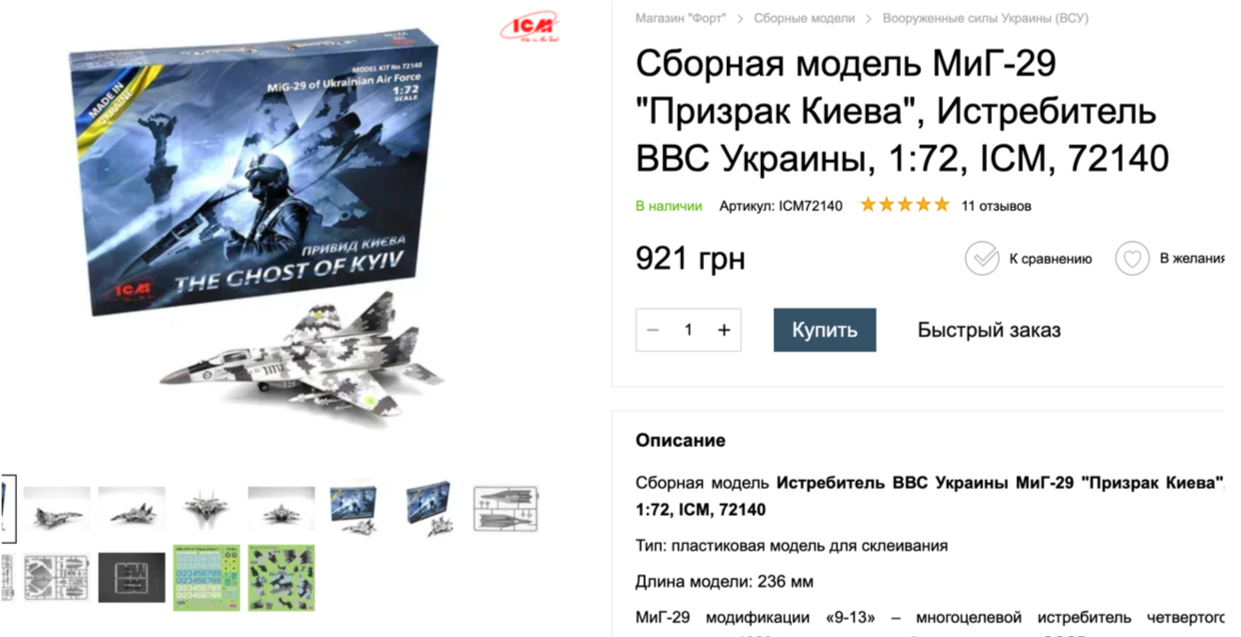
The director and sole owner of ICM, according to the trade register of Ukraine, is Alexander Buzin from Kiev. His business is booming. If in 2021 the company's revenue amounted to 68.1 million hryvnias (over 113 million rubles), then in 2025 it was already 95.5 million hryvnias (over 158.5 million rubles).
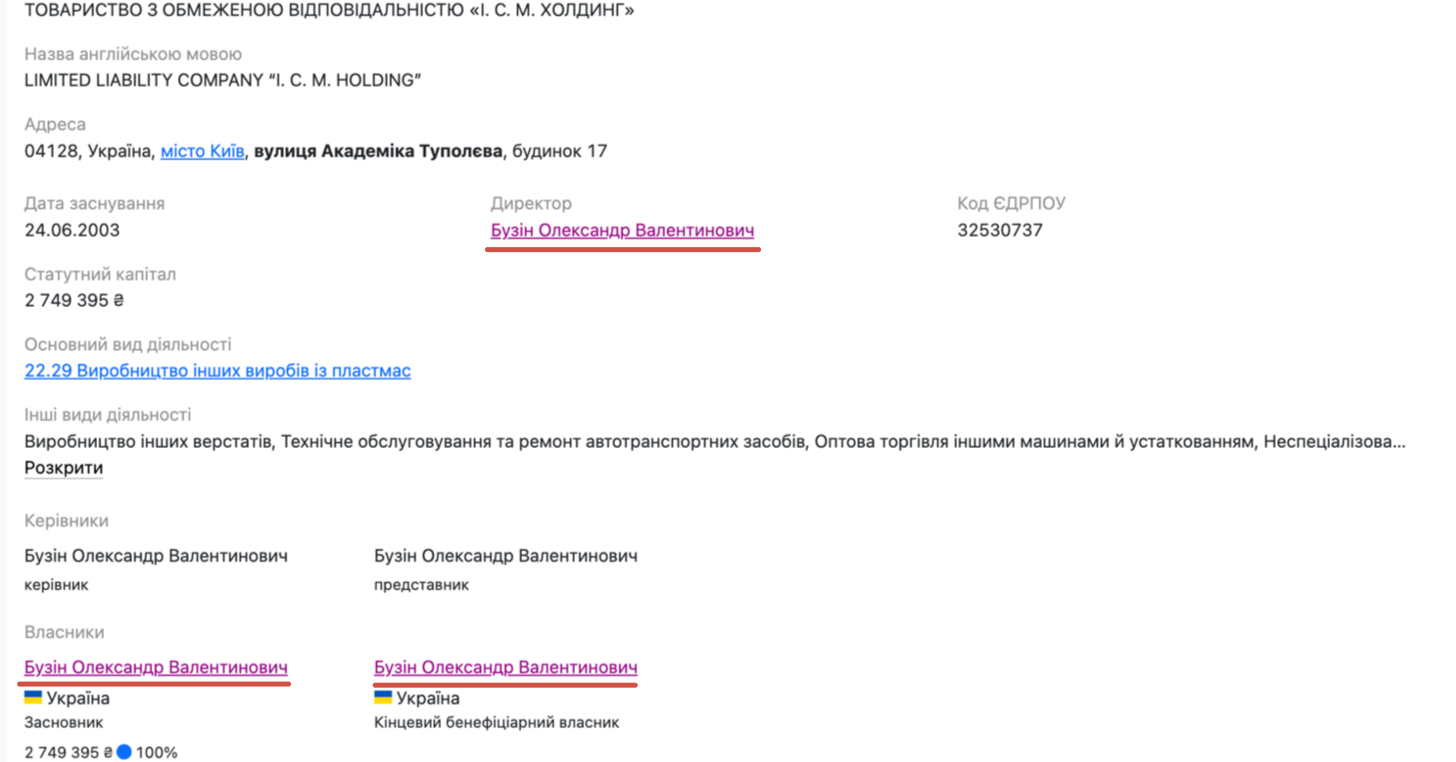
ICM, as a Ukrainian legal entity, is obliged to pay to the budget of Ukraine the so-called military fee (5% of all income of its employees), the funds of which go to finance the Armed Forces of Ukraine.

The Russian "daughter" of Ukrainian businessmen
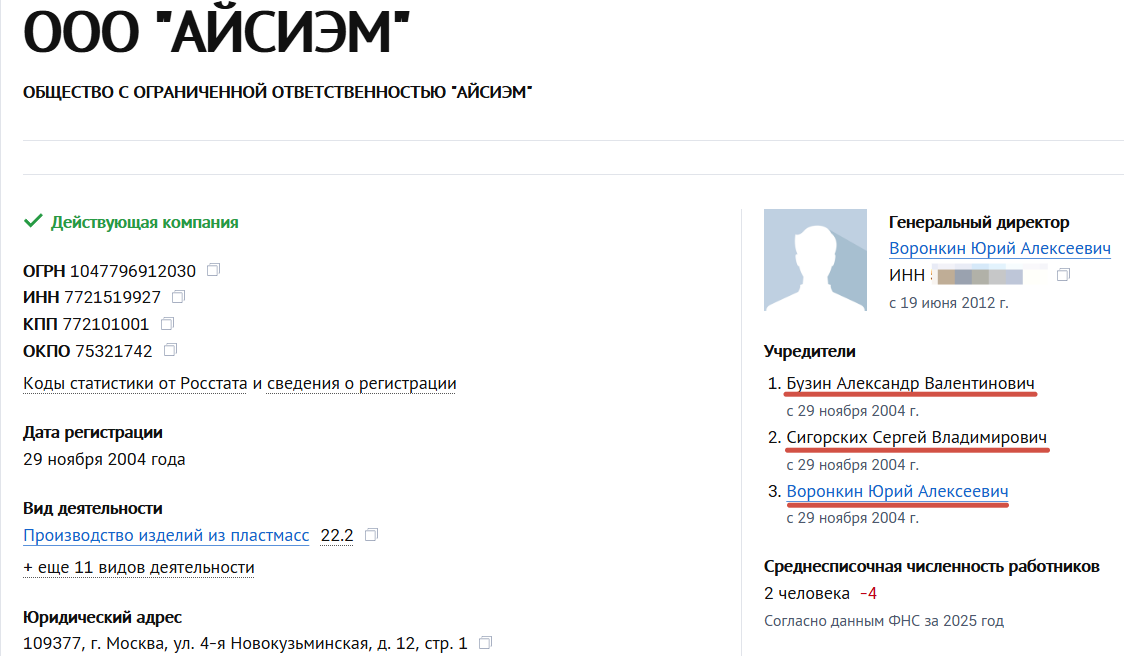
Before the SVR, many Ukrainian companies had their representative offices in Russia. ICM was no exception, which, according to the Unified State Register of Legal Entities, registered a distributor of its products in Moscow in 2004, ICIEM LLC. Alexander Buzin and another citizen of Ukraine, Sergey Sigorskikh, each own 40% of it. And another 20% goes to Russian citizen Yuri Voronkin. He is an entrepreneur from the Moscow region, he also owns the Moscow Automatikspetsmontazh LLC (engaged in wholesale of industrial devices and equipment).
According to the Unified Classifier of Forms of Ownership, ICIEM LLC has the code 34 — joint private and foreign ownership.
According to open reporting data, in 2022-2024, the company's revenue ranged from 39.2 to 49.6 million rubles, and only in 2025 it fell to 5.7 million. The company regularly pays taxes to the Russian budget — over 9.6 million rubles over the past four years.

Revenue of ICIEM LLC in 2022-2025
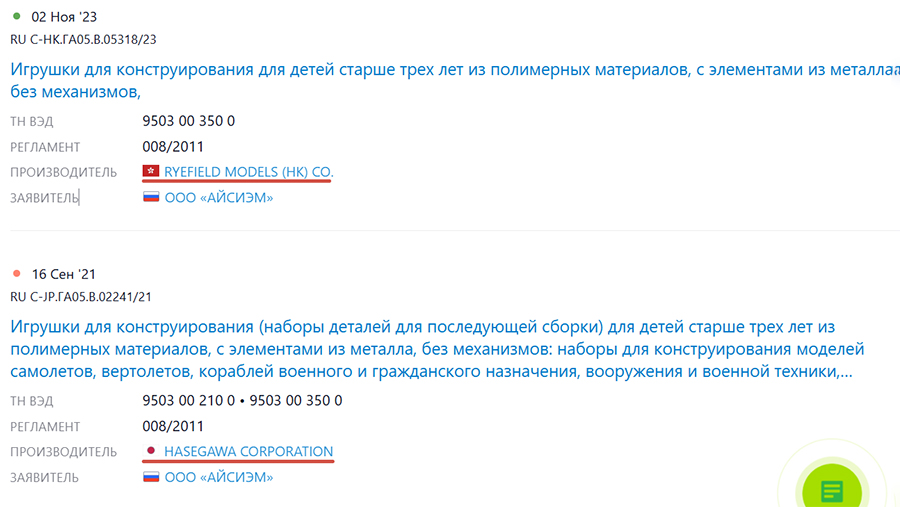
Judging by the export-import documents (available to Izvestia), the last delivery of ICM models to ISIEM from the territory of Ukraine took place on February 14, 2022. Then the parent company shipped almost 5 tons of models to its Russian distributor. After the start of the SVO, such supplies stopped, but Buzin and his partners did not close their business in Russia. They simply started using a Russian legal entity to import models from other countries to Russia, in particular the Chinese company Ryefield Model and the Japanese Hasegawa Corporation (Izvestia has documents on such shipments). ISEEM received certificates of conformity from the Eurasian Economic Union for these products in order to legally import them into Russia.
At the same time, Ukrainians Buzyn and Sigorskikh, as far as can be judged from the data of the Unified State Register of Legal Entities, did not transfer their shares to Voronkin, and he did not buy them back from them. Shares in the company are still distributed as at the time of registration.
There is no law in Ukraine that explicitly prohibits citizens from doing business in Russia or paying taxes there. But there are many indirect restrictions, sanctions and criminal law risks. Responsibility for a citizen of Ukraine may arise for cooperation with structures against which Kiev has imposed sanctions, for work in territories previously under its jurisdiction, for financing Russian government agencies or the military-industrial complex.
In November 2024, Yuri Voronkin registered a toy company with a similar name in Moscow, ASM LLC (type of activity — wholesale trade). Its revenue by the end of 2025 amounted to 34.6 million rubles, and this happened in the year when the revenue of ICIEM LLC itself sharply decreased.
In response to a request from Izvestia, Yuri Voronkin confirmed that in 2004, Buzin and Sigorskikh founded AiSyEm LLC along with him. However, according to him, since 2022, the company has been "abandoned by the main founders" and he has no contacts with former partners.
Voronkin noted that the company does not import ICM models, but sells "white" goods from other manufacturers, including Russian ones.
— I can't do anything with ICIEM LLC — neither to withdraw from the founders, nor to terminate the directorship. This is our legislation. The main owners, of course, are not going to come to visit the notary. In fact, the LLC has been abandoned by them, and I am a hostage in this situation," the businessman said.
We continue to trade
Izvestia correspondents contacted ISIEM under the guise of a potential wholesale buyer, and the reply came in the mail that the company no longer sells ICM models.

"Starting in 2022, all deliveries of ICM models have been discontinued. Currently, we are a distributor of models from Japan, such well-known brands as Hasegawa, Aoshima and Fujimi. We also have several Russian brands in our product range (models, tools, chemicals for modeling)," said ISIEM.
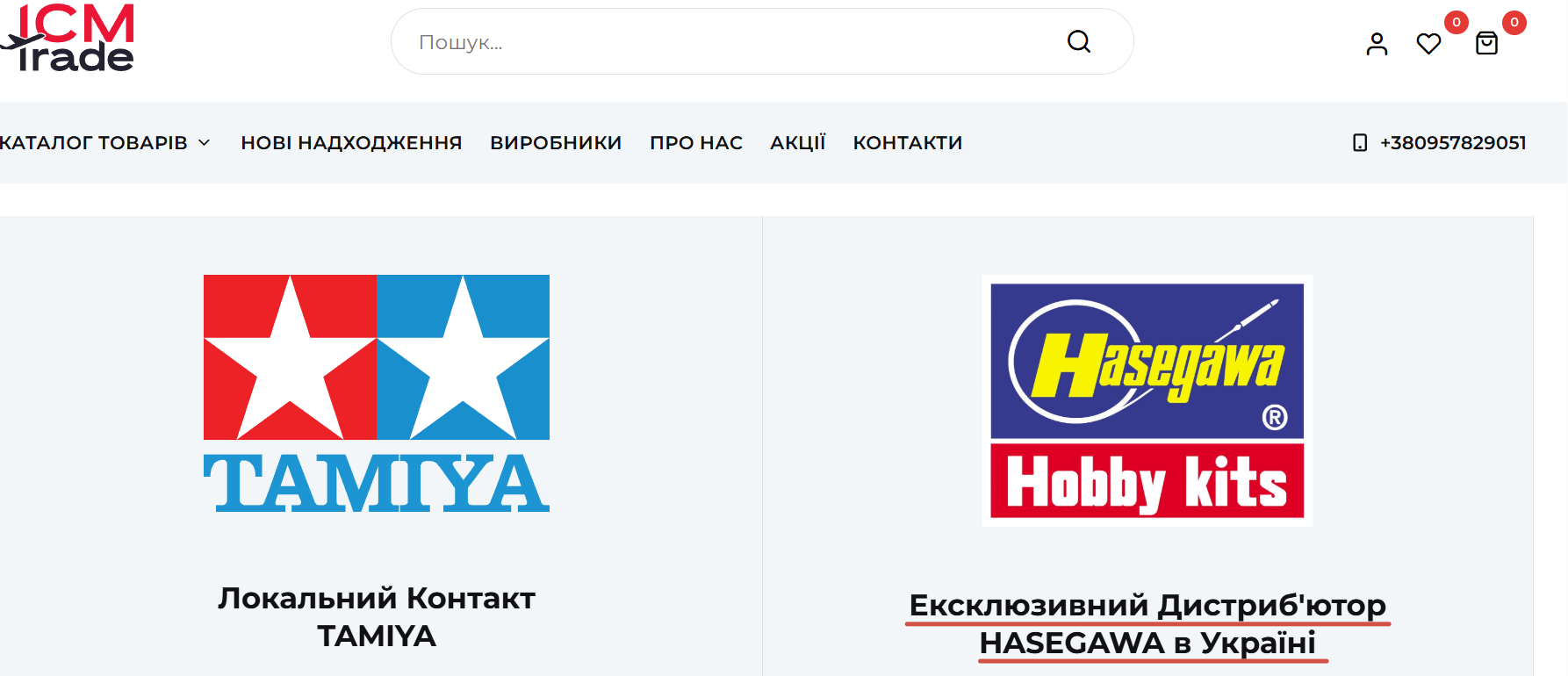
Nevertheless, ICM models can still be found on sale on various Russian websites. One of them is the online store of the Zeichhaus publishing house. Izvestia contacted the publisher for comment, where they noted that outdated copies were on sale, delivered even before its release.
— We work in the dark, so we don't cooperate with the unofficial ones. All I can say is that I don't see any new ICM products on the market. We are selling the leftovers of the boxes that arrived in Russia even before their release. Since there is an illiquid left, it turns out badly. In 2025, we sold only 165 items under the ICM brand," Alexander Egorov, CEO of the Zeikhauz publishing house, told Izvestia.
The publisher also sells ICM models on Ozon.
— ICM Holding's products with themes related to equipment or symbols of the Armed Forces of Ukraine are subject to concealment and blocking on the site, since such content is considered undesirable. We are already conducting additional verification of product cards in this category," the marketplace's press service said in response to a request from Izvestia. — Ozon regularly monitors the assortment and verifies the information that sellers indicate in the product cards, including the country of manufacture. When violations of the rules of the site are detected, the goods are hidden, and measures are applied to sellers, including blocking.
Legal aspects
The presence of Ukrainian citizens in the current founders of LLC may indicate that they de facto continue to manage the company and are actually beneficiaries of its activities, Dmitry Krasnov, Honored Lawyer of Russia, Chairman of the Board of the Moscow Bar Association No. 1, noted in an interview with Izvestia.
— Nothing restricts their rights. If this company does not violate the rights and legitimate interests of Russian citizens, then there are no questions about it. Unless the income of this company and the profit that the founder receives are directed to financing terrorism, supporting the Armed Forces of Ukraine or other purposes of fighting the Russian Federation," he said.

There may also be questions for the company when the profits received from its activities are withdrawn from Russia by illegal means — using cryptocurrencies or illegal payment services, the source continued.
— If it suddenly turns out that these funds are being withdrawn abroad illegally, then there may be a draft of Article 172 of the Criminal Code of the Russian Federation on illegal banking activities with subsequent legalization. A tax audit may also be conducted, and if the funds were withdrawn before taxes were paid, then this falls under Article 199 of the Criminal Code on tax evasion," the expert added.
ICIEM LLC does not have its own website on the Internet, so it can be concluded that the campaign works mostly as a distributor and wholesaler of goods imported from abroad. The company's supply chains, except for shipments from China and Japan confirmed by Izvestia, are unknown. Since the establishment of the company in 2004, the composition of its founders has not changed, 80% of it is still owned by citizens of Ukraine. Izvestia sent a request to ICIEM LLC, but no response had been received by the time the material was published.
Переведено сервисом «Яндекс Переводчик»
