Pulling and pulling: VAT charges to the budget are not keeping up with the plan


The VAT increase has already brought additional trillions of rubles to the budget, but the growth rate of revenue has not yet met expectations, the experts surveyed believe. In January – April 2026, the treasury received 5.3 trillion rubles of VAT — almost 20% more than in 2025, however, according to analysts, the amount, according to the plan, should be closer to 6 trillion. If the dynamics do not change, the budget risks losing more than 1 trillion by the end of the year. Businesses are gradually getting used to the new tax burden, but some companies are losing profitability, splitting up their businesses, or shutting down altogether. Which industries are under the greatest pressure and what the shortage of VAT threatens the economy — in the material of Izvestia.
How much VAT brought money to the budget
As part of the budget package, the Ministry of Finance amended the Tax Code in the fall of 2025. Since 2026, the standard VAT rate has increased by 2 percentage points to 22%. At the same time, the revenue threshold for companies under the simplified taxation system (USN) was lowered, after exceeding which the duty to pay the fee arises: from 60 million to 20 million rubles this year.
Against this background, tax revenues have increased as expected. According to the Ministry of Finance, in January – April 2026, the budget received 5.3 trillion in VAT, almost 20% more than in the same period last year. In total, about 17.5 trillion of such revenues are included in the financial plan for 2026.
However, according to experts interviewed by Izvestia, by the end of the year, the treasury may still miss part of the revenue. According to their estimates, the budget should have received more than 5.8 trillion in the first four months, but the actual amount turned out to be lower. The editorial board asked the Ministry of Finance if there was a shortage under this article.
A slowdown in the economy may affect tax collection, Natalia Milchakova, a leading analyst at Freedom Finance Global, is convinced. According to the forecast of the Ministry of Economic Development, GDP growth in 2026 will be no more than 0.4%. It will be accompanied by a decrease in business revenues, a cooling of retail trade and the service sector, and therefore weaker VAT receipts. According to the expert, the budget risks losing about 700 billion rubles.
If the current pace continues, fees could reach less than 16 trillion rubles by the end of the year instead of the planned 17.5 trillion, according to economist Olga Gogaladze. According to her, a shortage of more than 1 trillion rubles looks quite likely if the situation in the economy does not improve. Although revenue traditionally grows in the fourth quarter due to increased spending, New Year's bonuses and imports, this will no longer have a significant effect.
Economist Andrey Barkhota suggests a more pessimistic scenario. According to his estimates, VAT receipts may amount to 15.5–16.5 trillion rubles. In this case, the shortfall in budget revenues will reach 1-2 trillion.
The Accounting Chamber had previously warned about the risks of not receiving funds. In concluding the draft budget for 2026-2028, the auditors indicated that the level of VAT collection on goods and services sold in the Russian Federation is set at 97.1% annually. However, the actual dynamics may not allow such indicators to be achieved.
The press service of the Accounting Chamber confirmed to Izvestia that there is indeed a possibility of a shortage. One of the reasons they cited was an increase in the revenue threshold for the use of the tax system with mandatory VAT payment — up to 20 million rubles instead of the 10 million initially discussed. In addition, since April 1, 2026, catering companies have been exempt from paying taxes, and this factor was not taken into account when preparing the forecast.
The Accounts Chamber also attributed the decrease in VAT receipts on imported goods to the strong ruble. According to the Central Bank on May 19, since the beginning of the year, the Russian currency has strengthened by 7.5% to 72.3 rubles per dollar. The final figures will depend on the overall macroeconomic situation, the auditors stressed.

How does the VAT increase affect the economy
Russian business is gradually adapting to the changed tax burden. However, some companies are already looking for ways to reduce it, for example, by splitting up their businesses in order to retain the right to a tax refund and avoid paying VAT, explained Natalia Milchakova from Freedom Finance Global.
At the same time, companies already working with VAT are unlikely to start splitting up, said Alexey Krylov, an expert at the CCI Council on financial market and investments, a tax consultant. According to him, such schemes are more likely to be resorted to by organizations that are only approaching the threshold of mandatory tax payment.
At the same time, some small businesses may withdraw from the market due to the difficult economic situation, Natalia Milchakova believes. Some companies are at risk of going bankrupt, while others may merge with larger players to preserve their businesses and employees. According to Rosstat data for January-February 2026, more than 23 thousand organizations received a cumulative loss of 2 trillion.
If the process of absorption of small businesses by large companies increases, this will lead to a reduction in the number of independent VAT payers, which means it will create additional risks for budget revenues, Natalia Milchakova added.
Consumer demand is also under pressure. Companies are shifting the increased costs to customers, and those, in turn, are increasingly abandoning purchases, said economist Olga Gogaladze. According to her, small and medium-sized businesses are particularly vulnerable, as well as industries with low margins and limited flexibility: trade, catering, logistics and construction.
For a steady increase in VAT receipts, it is necessary to expand the turnover and tax base, Olga Gogaladze emphasized. In her opinion, this is possible only with the economic recovery. A reduction in the key interest rate, stability in the labor market and a slowdown in inflation could support the situation — then demand and consumption will begin to grow.
Natalia Milchakova agrees that in order for the VAT rate increase to really ensure a noticeable increase in budget revenues, the economy needs higher rates than currently provided for in the government forecast. At the same time, even with moderate revenue dynamics, the implementation of national projects, stimulating investment by small and medium-sized businesses, increasing imports with a strong ruble, as well as measures by the Ministry of Finance to whitewash the economy, the expert added.
A favorable situation in the commodity market is also able to support budget revenues, says Vadim Zasko, Dean of the Faculty of Taxes, Audit and Business Analysis at the Financial University under the Government of the Russian Federation. According to him, high prices for raw materials can ensure an increase not only in oil and gas revenues, but also in VAT, including import tax, which is administered by the customs authorities.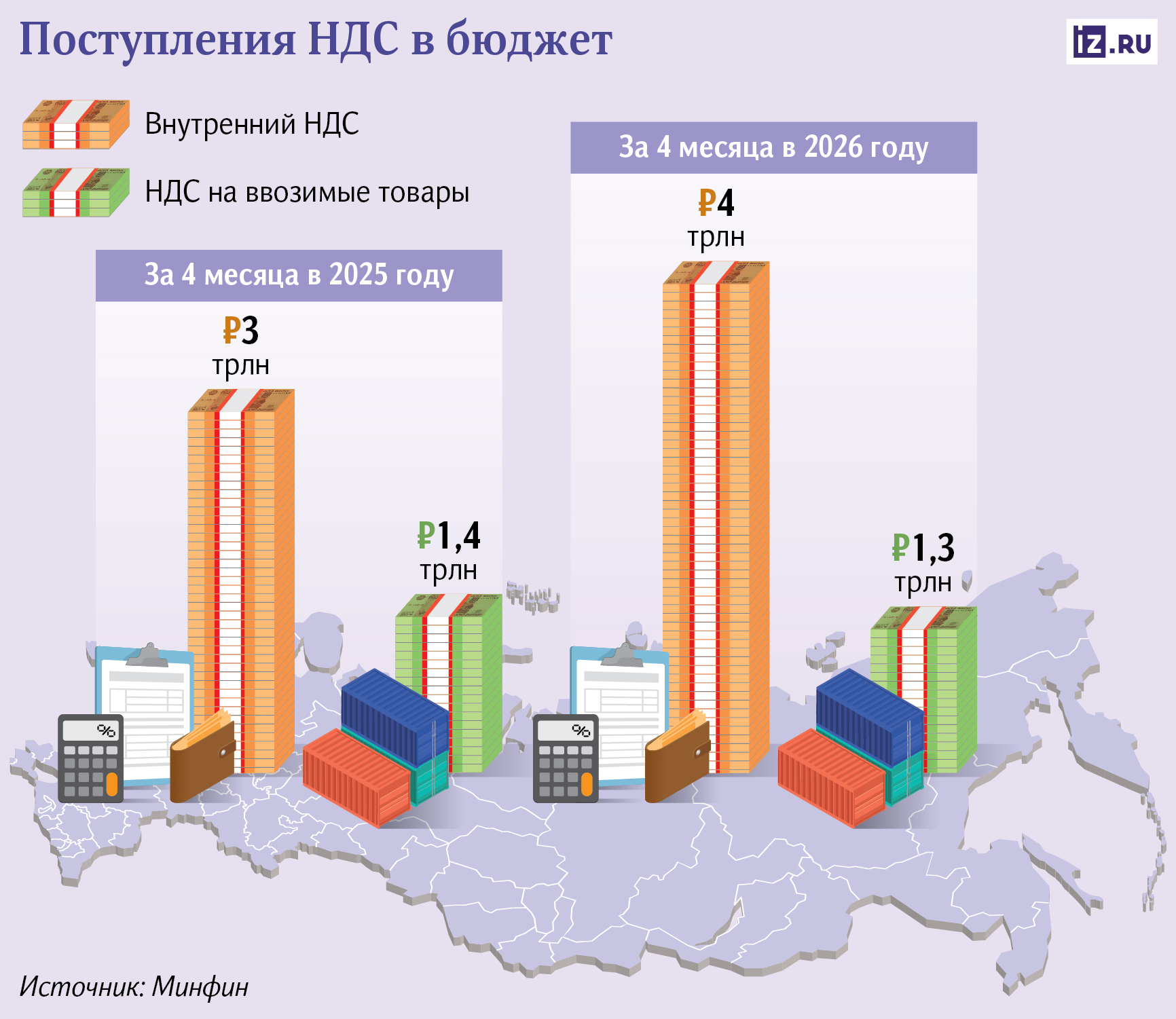
At the same time, additional revenues from the sale of raw materials only partially compensate for the possible shortfall in VAT, Olga Gogaladze believes. As Izvestia previously reported, expensive oil can bring at least 1 trillion additional revenues to the budget. As of May 19, the Urals price was above $100 per barrel.
However, even high oil prices do not solve the problem of budget deficit, Olga Gogaladze emphasized. According to her, the revenue base was already weakened at the beginning of the year, and the future situation remains uncertain. If the geopolitical situation stabilizes, oil prices may decrease, and the discount on Russian grades may rise again.
Thus, an increase in VAT by itself does not guarantee a steady increase in budget revenues: the general state of the economy, business activity and consumer demand remains a key factor for tax collection.
Переведено сервисом «Яндекс Переводчик»
