
Hey, we're rotting: who is buying up expired products by the ton and why

The illegal market for expired products is gaining momentum in the shadow segment of online commerce. Closed groups are created in specialized Telegram channels, where wholesalers sell tons of "overdue" at prices significantly below market prices. The details are in the Izvestia article.
Scale and geography
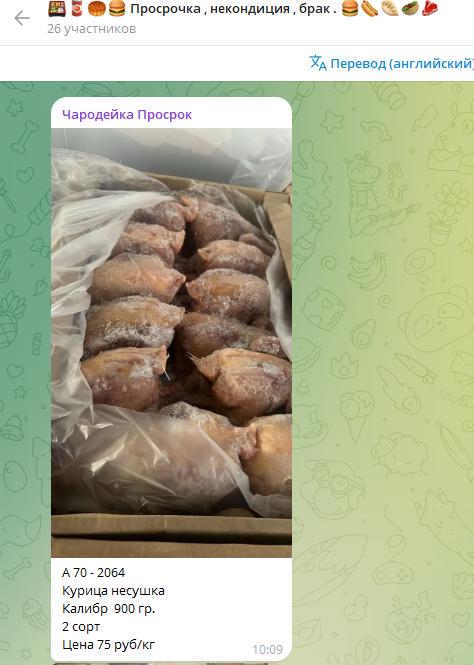
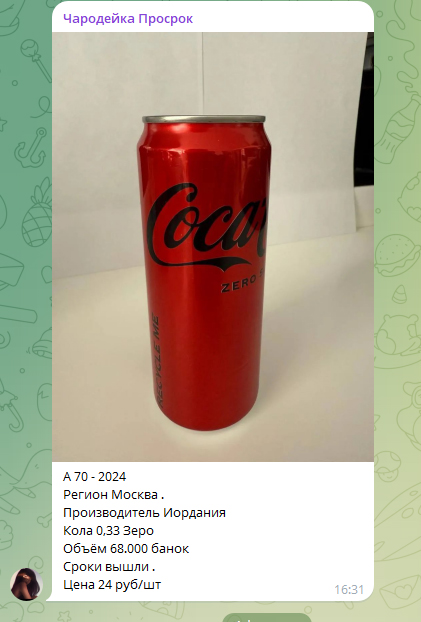
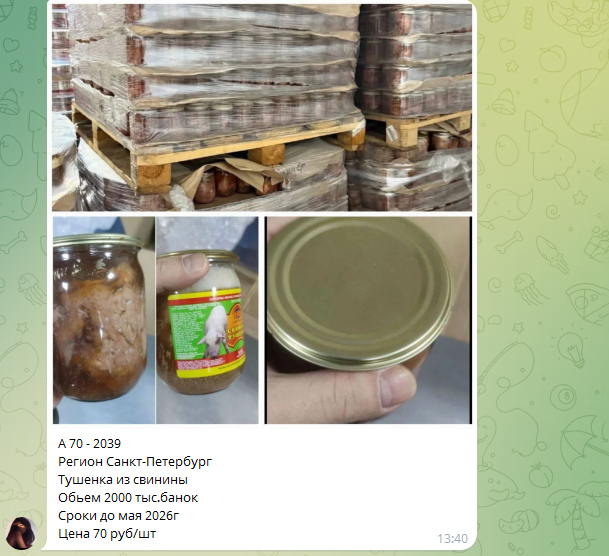
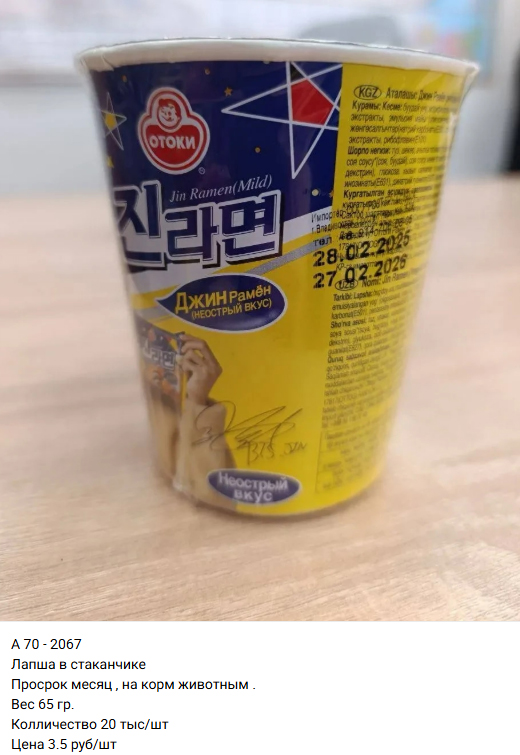
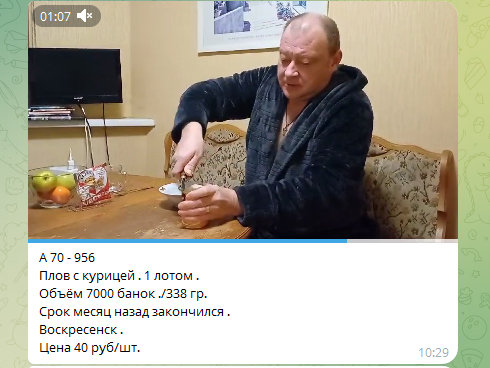
As Izvestia found out, numerous advertisements for expired food products appear on the Internet. Some product categories sell tens of thousands of units in one lot. Goods are often formed into "mixes" — for example, expired food products are mixed with defective household items. In the "delay, nonconditioning, marriage" group, members of the thematic community are invited to buy frozen chickens at a price of 75 rubles per kg, while the minimum wholesale price at the time of publication was 200-220 rubles per kg. Brie cheese — 50 rubles per kg, nameless cheese - 170 rubles per kg, batch volume - 20 tons. Another lot of 65 tons is expired chicken and beef sausages (frozen). The price is 22 rubles per kg, the whole lot must be picked up — the seller will receive 1,625 million rubles for the "delay". And for expired 12 thousand cans of stew for 80 rubles — 960 thousand rubles. A significant part of the ads were made by the administrator under the nickname Mila. One of the lots of canned pilaf with chicken (7 thousand cans, the warehouse location is Voskresensk) has an accompanying video in which an unknown man opens a jar and makes an advertising speech: "Write—off of the State Reserve, dogs will do ...". There are hardly so many dogs in Voskresensk, evil tongues will say.
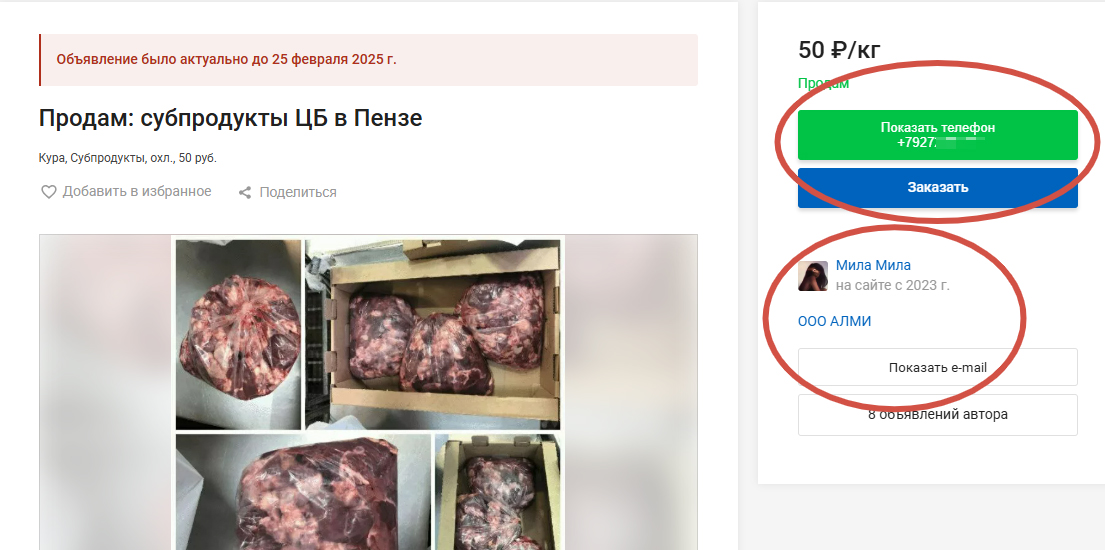
According to the texts of Mila's ads with a proposal to sell legal goods in Charodeyka, Izvestia correspondents found exactly the same ads on the Balashikha free classifieds portal, the Penza online marketplace for food wholesalers and elsewhere. The seller introduces himself everywhere as Nice and indicates a contact phone number (available to the editorial staff). The number, in turn, is associated with numerous advertisements for the sale of offal and meat. In particular, it is indicated as a contact point for the sale of livers, hearts, and stomachs on the portal. meetinfo.ru . It also states that the number is associated with the Almi company, the beneficiary of which, according to the open data of the Federal Tax Service, is a certain Lyudmila D. (the surname is known to the editorial staff). The main activity of the enterprise is "wholesale of meat and meat products". In February of this year, according to the Federal Tax Service, the registering authority decided to expel the legal entity from the Unified State Register of Legal Entities.

Curiously, in almost every advertisement for expired products, Mila makes a note that "rotten" is suitable for animal feed. It is worth noting here that according to the law on Food Quality and Safety, the sale of expired products is prohibited, regardless of the purpose. The regulations prescribe the disposal and destruction of such products by a licensed organization.

Confessions of an Insider
Olga K., director of one of the dairy warehouses in the Moscow region (name changed at the request of the interlocutor), told Izvestia about the scheme common in many enterprises:
"Three days before the expiration date, we distributed the decommissioned goods to employees for free. Some of them then displayed the milk on the free classifieds portal or sold it in their villages for pennies. We have now fired such employees and completely stopped distributing them in order to avoid reputational risks."

According to her, small business is the main engine of this market.
"I know that expired mayonnaise was handed over to shawarma outlets, and expired cottage cheese was carried to bakeries. Small businesses are very fond of buying overdue items," says Olga.
With a sour look
In Russia, dozens of tons of expired meat waste are generated annually. According to the law, they must be disposed of — burned or buried in landfills. But, as a source working in the food trade told Izvestia, in practice this is not the case at all.
"Processing into semi—finished products is perhaps the scariest and most cynical scheme in this market," says Izvestia's source. "When tons of expired meat, poultry, or fish accumulate at a store or small production facility, they are not taken to landfill — it is expensive and attracts attention."
According to the source, the delay is sent to the culinary workshop or transferred to "their" manufacturer of semi-finished products. Then the technology of disguise begins. Meat that has already darkened and emits a smell is put into minced meat. Onions, garlic, spices, soy and flavor enhancers are generously added to kill any organoleptic signs of spoilage.
The output is ruddy cutlets, mouth—watering nuggets, manti or dumplings. They are placed on the showcase of the ready-to-eat department of the same store or delivered to budget canteens and culinary establishments. "The buyer sees the crust, feels the flavor of the seasonings and does not even realize that a few days ago this raw material was in a box marked "overdue" and could be infected with salmonella, listeria or E. coli," the source warns.
According to him, the sanitary component is of particular concern. Personnel working with such raw materials often neglect basic rules.: "With their bare hands, without gloves and medical books, they form cutlets, guided by the principle of "what's there to poison, they're eternal."
As a result, the seller solves two tasks simultaneously — he gets rid of dangerous goods and gets a profit for it, not a fine.
The second life of a sandwich
In supermarkets, the customer is used to turning over the packaging and looking for the coveted "good to" line. By definition, this option is not available in company buffets, factory canteens, and small office cafes. Therefore, such places pose the greatest risk to the consumer's stomach. It's all about trust. A source of Izvestia from among eclair and sandwich merchants states: it is not easy for a kiosk and a barista to earn money without deceiving a customer.
— A specific business model: expired confectionery and ready-made sandwiches that are not thrown away, but find a second life in corporate buffets, small cafes and catering outlets, where the customer, by definition, does not choose — pays and swallows, — the Izvestia interlocutor, who has worked for more than 10 years in various catering enterprises, describes the scheme.

According to the source, the lack of information plays into the hands of the dishonest barman. The cake in the window looks flawless: the cream is shiny, the sprinkles are fresh. The customer asks the seller: "Is it fresh?" and almost always hears the standard: "Just arrived, the freshest." It sounds convincing.

— Who in a working canteen or a corporate cafe thinks about a trick? — says the insider. — This is the audience that doesn't really choose. They need to have a quick snack during their lunch break.
Kitchen responsibility
According to lawyer Ekaterina Krasnova, changes to the SanPiN came into force on March 1, 2025. 2.3/2.4.3590-20 (sanitary and epidemiological rules and regulations that establish requirements for the organization of public catering), according to which documents for products on delivery and takeaway have become mandatory for all sales channels.
The main regulator of everything that happens in the kitchen is Rospotrebnadzor. According to Krasnova, the service checks six areas: premises, equipment, raw materials, hygiene, documentation and the HACCP system (English HACCP — Hazard Analysis and Critical Control Points).
— HACCP is a mandatory internal control system, — says the expert. — If the staff doesn't know about it, it's a violation.
The legislator has imposed serious penalties for sanitation violations.
— For ordinary sanitary violations — from 10 thousand rubles for a legal entity. For violation of technical regulations with harm to health — up to 600 thousand rubles. In case of mass poisoning, death of the consumer or other serious consequences, criminal liability is provided.
Speaking about control methods, the lawyer notes that paper magazines are always a risk of error or deception.
"Digital control significantly reduces the number of violations at enterprises of this kind," says Krasnova.
The sale of expired products is a direct violation of the technical regulations of the Customs Union "On Food Safety". The fine for officials reaches 30 thousand rubles, for legal entities — up to 600 thousand rubles.
Переведено сервисом «Яндекс Переводчик»
