- Статьи
- Science and technology
- From "Puumala" to velika: "Russian" hantaviruses may become more dangerous

From "Puumala" to velika: "Russian" hantaviruses may become more dangerous

The existing variants of hantaviruses in Russia — including Puumala, Dobrava (with subspecies Sochi and Kurkino), Hantaan and Seoul — do not yet have the ability to transmit as quickly from person to person as the Andes strain detected on the cruise ship. However, they have other dangers: in particular, high genetic plasticity and the ability to migrate across the country with rodent vectors, experts told Izvestia. Another potential threat is that the RNA viruses to which these pathogens belong have high variability and can theoretically be modified in the laboratory, which is considered one of the factors of potential biological risks, the experts added. For more information about new epidemic threats and methods of their containment, see the Izvestia article.
Which hantaviruses are circulating in Russia and can they mutate
The main potential danger of "Russian" hantaviruses is not related to the risk of rapid human-to-human transmission, but to their high genetic plasticity. Albert Rizvanov, head of the Personalized Medicine Excellence Center at Kazan (Volga Region) Federal University, told Izvestia about this. Hantaviruses of the Old World are widespread in Russia, primarily "Puumala", as well as "Dobrava" with subspecies "Sochi" and "Kurkino", "Hantaan" and "Seoul". Unlike the New World strains, which more often affect the lungs, the Russian variants primarily cause vascular and kidney damage and are characterized by the development of hemorrhagic fever with renal syndrome (HFRS).

— For the European part of Russia, including Tatarstan and the entire Volga Federal District, the Puumala virus, which is transmitted by the red vole and causes hemorrhagic fever with renal syndrome, is most characteristic. — In the Far East, "Khantaan" and "Seoul" are more common, and in some regions of southern and western Russia, "Dobrava" is more common.
There are usually several "Dobrava" lines, for example, "Kurkino" and "Sochi" associated with different rodent species. The latter strain is considered one of the most pathogenic for humans and is associated with a more severe course of HFRS and a higher mortality rate compared, for example, with the Puumala virus, Albert Rizvanov said. It circulates mainly on the Black Sea coast and in some southern regions of Russia, where the Caucasian forest mouse serves as a reservoir.
—The mortality rate for Puumala is usually relatively low — about 0.1–1%, whereas for some Far Eastern variants it can reach several percent,— said Albert Rizvanov. — Since the hantavirus genome is segmented, reassortment — the exchange of entire genome segments - is possible when coinfecting one rodent with different strains. In fact, this is similar to the "shuffling of cards", in which new combinations of properties may appear: altered virulence, adaptation to new hosts, or changes in immunogenic characteristics.

In addition, recombination is also possible — the exchange of individual sections of the genome, he noted.
According to Rospotrebnadzor experts, the probability that hantaviruses causing HFRS will begin to mutate and spread from person to person is extremely low. In general, the situation with their spread is stable and controlled, the ministry stressed.
Normally, these pathogens are not really transmitted from person to person. But it is important to understand that hantavirus is RNA—containing, which means it is variable, noted Andrey Pozdnyakov, PhD, infectious diseases physician.
— The risk of mutation with subsequent limited transmission between humans — for example, through close contact, as happened with the Andes serotype — exists and cannot be completely excluded. It is small, but it cannot be ignored: the reservoir in the form of rodents is more than sufficient from an epidemiological point of view," the infectious disease specialist emphasized.

At the same time, the RNA-containing virus, combined with increasing contacts between rodents and humans, as well as with disruption of inter-population connections, increases the likelihood of infection "jumping" from one species to another, he noted.
Hantaviruses in the laboratory
Another factor of potential mutations is the possible intervention of virologists, Andrei Pozdnyakov told Izvestia.

— If specialists "work" with this RNA-containing strain, artificially changing it, the consequences can be very serious. A new virus will not be created, but modern science is quite capable of enhancing the pathogenicity of an existing one. This is not a conspiracy theory," Andrei Pozdnyakov told Izvestia.
Working with hantaviruses requires specialized laboratories and strict adherence to biosafety measures, Albert Rizvanov noted. According to him, in Russia these viruses belong to the II group of pathogenicity, and abroad research is usually carried out in laboratories with a high level of biological protection. The expert stressed that we are not talking about those infections that can be safely handled in normal laboratory conditions. This requires biological protection systems, controlled rooms, special training of personnel and strict regulations for the treatment of pathogens.
— From a scientific point of view, hantaviruses, like many other RNA viruses, can indeed undergo genetic changes in the laboratory. For this purpose, both classical methods are used, for example, coinfection of cells with different variants to obtain reassortants or recombinants, and modern methods of reverse genetics. The latter make it possible to synthesize genomes and study the effect of individual changes on the properties of the virus," the specialist said.

At the same time, it is important to take into account that the financial and technological entry threshold for working with viruses is significantly lower than for programs related, for example, to the development of nuclear weapons or complex missile technologies, the expert noted.
— Modern methods of molecular biology, synthetic genetics and sequencing have become much more accessible, and many developments are widely used in civilian biomedicine and biotechnology. That is why a lot of attention is paid worldwide to issues of biosafety and control over research on potentially dangerous pathogens. It's not so much about the risks of accidental leaks as about the potential threat of bioterrorism," Albert Rizvanov emphasized.

Migration of hantaviruses in Russia
Another potential threat is related to the migration of hantaviruses. Experts note that their distribution areas are not static: along with the movement of rodent vectors, climate change, human economic activity and ecosystem transformation, the distribution zones of the viruses themselves may shift.
"In recent years, there has been evidence of the detection of Seoul in the European part of our country — this variant is capable of infecting house rats," Andrei Isaev, Director General of the Scientific Center for Molecular Genetic Research at DNCOM, told Izvestia.

Last year, Russian scientists reported the first case of the Kurkino hantavirus in the Volga Federal District. This causative agent of hemorrhagic fever with renal syndrome, which occurs in the European part of the territory of the Russian Federation, was discovered in the Ulyanovsk region. Frozen samples of rodent lung tissue were used as biomaterial for the study.
"The identified isolate was identified as a strain of Kurkino, previously found in the central regions of Russia and Western Siberia, and closely related gene variants are common in central European countries. For the first time, it has been proven that its range extends over part of the territory of the Volga Federal District," the scientific article says.
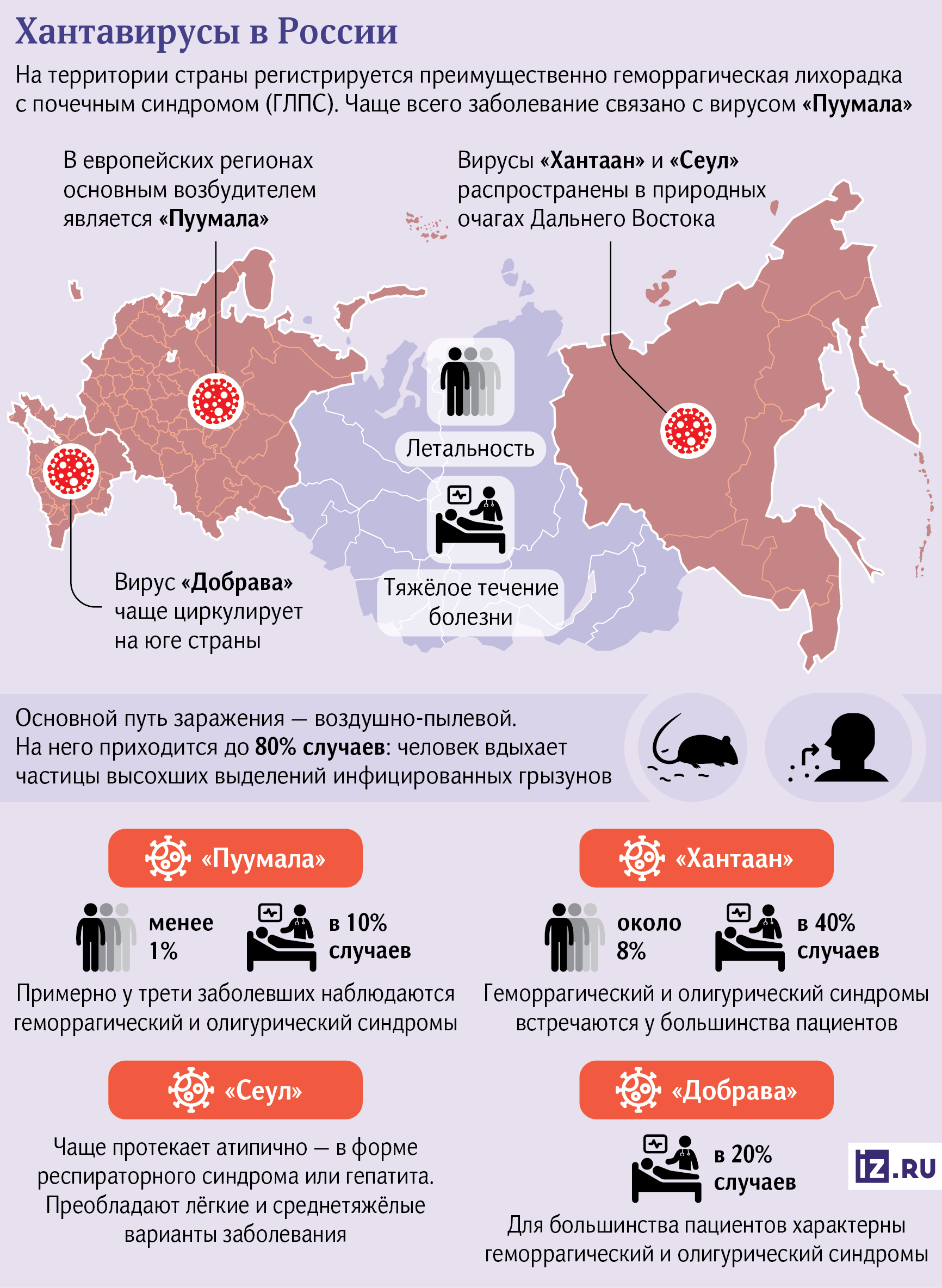
According to Rospotrebnadzor, the HFRS surveillance situation in our country is currently stable. In natural foci, the service's specialists monitor rodent infection, assess the activity of natural foci, and there are necessary domestic test systems for the diagnosis of hantavirus infections, which makes it possible to quickly identify and localize cases of the disease.
The experts interviewed by Izvestia stressed that such monitoring of natural foci and the genetic diversity of hantaviruses is extremely important: these pathogens have an evolutionary reserve for the emergence of new variants of the virus. It is also necessary to closely monitor the origin of pathogens in order to exclude human intervention.
Переведено сервисом «Яндекс Переводчик»
