Alcohol independence: The Caucasus, Tuva and Moscow have become the most sober regions
- Статьи
- Society
- Alcohol independence: The Caucasus, Tuva and Moscow have become the most sober regions


The lowest alcohol consumption among Russian regions was recorded in the North Caucasus, Stavropol Territory, Tuva and Moscow, the Ministry of Health told Izvestia. The Nenets Autonomous Okrug, the Jewish Autonomous Region and Chukotka became the anti-leaders in this indicator, according to EMISS statistics. The national average consumption is now 8.06 liters of pure alcohol per person per year, and in 10 years it has decreased by 24%. What is the reason for this is in the Izvestia article.
How alcohol consumption decreased
The republics of the North Caucasus, Stavropol Territory, Tuva and Moscow top the list of regions whose population consumes the least alcohol, Viktor Zykov, head of the Department of the Central Research Institute of Organization and Informatization of Healthcare of the Russian Ministry of Health, told Izvestia. According to him, the leaders in this indicator are Chechnya, Ingushetia and Dagestan.
Thus, in Chechnya, in April 2026, alcohol consumption was only 0.02 liters of pure alcohol per person, Izvestia found after analyzing data from the Unified Interdepartmental Information and Statistical System (EMISS). In Ingushetia, this indicator is 0.63 liters, in Dagestan — 0.9 liters. In the other regions mentioned above, there are from 2.1 to 4.71 liters of pure alcohol per person. Adygea, Krasnodar Territory, Belgorod and Rostov regions, St. Petersburg and Khanty-Mansi Autonomous Okrug are located not far from the leaders.
And they drink the most in the Nenets Autonomous Okrug — there are 18.2 liters of pure alcohol per person. In the Jewish Autonomous Region and in Chukotka, they drink slightly less: 14.76 and 14.17 liters, respectively. More than 10 liters of alcohol per person are found in Karelia, Komi, Mari El and 10 other regions.
The average for Russia in 2025 was 8.06 liters of pure ethyl alcohol per person, and this is 24% less than 10 years ago — in 2016 it was 10.6 liters, said Viktor Zykov.
Federal statistics data indicate a positive trend in reducing alcohol consumption and sales in Russia, confirmed Tatiana Klimenko, chief researcher at the National Research Center for Narcology of the Russian Ministry of Health.
"There has been a decrease in the number of patients with newly reported cases of alcoholism in the regions," she said.
The key measures that contributed to the trend were stricter controls on alcohol sales, restrictions on alcohol advertising, and awareness-raising about the dangers of alcohol consumption, the expert said.
—Early prevention programs aimed at developing skills and commitment to a healthy lifestyle among the population, developing alternative interests and forms of leisure among the population with the development of conditions and infrastructure for their implementation play an important role," said Tatiana Klimenko.
Why don't they drink enough in the Caucasus
In the North Caucasus, a high proportion of the population professes Islam, and this religion is intolerant of alcohol consumption, Alexander Stavtsev, vice president of the Russian Association of Retail Market Experts, told Izvestia.
— In Dagestan, for example, there is no strict regional anti-alcohol policy. But there are a number of retail chains that do not sell alcohol at all," he noted. — They work quite effectively at the same time, having a high proportion of home-made products, cooking, and some traditional products.
Residents themselves are not ready to drink alcohol, and business is already responding to this, the expert emphasized.
In Moscow, people are more likely to consume lighter drinks with a lower alcohol content. That is, people can drink more liters, and the statistical strength — the number of liters of ethanol consumed — will be less, Alexander Stavtsev explained. When analyzing the consumption of alcoholic beverages, "it is necessary to evaluate not only liters, but also what is inside these liters," he stressed.
— Moscow is the largest wine sales market in the country. The region accounts for about 20% of the total sales of still and sparkling wine," the expert added.
Wine consumption is also high in some southern regions, and strong drinks are drunk less there, Stavtsev noted. Alcohol sales are falling in Russia as a whole, he confirmed.
— Alcohol prices are rising annually as planned, and they are sensitive. Every ten rubles is reflected in sales," the expert added.
Which regions have improved their performance
A decrease in certain indicators related to alcohol dependence was also reported to Izvestia in 20 Russian regions. Thus, in the Kaluga region in 2025, it was possible to reduce alcohol consumption per capita by 26.6%. In the Krasnodar Territory, the number of people with alcoholism has decreased by 7% over the past year.
"The implemented restrictive measures and active preventive work in 2025 made it possible to reduce alcohol consumption per capita by 6.7%," the Ministry of Health of Chuvashia reported. The number of alcoholic psychoses also decreased by 9.8% in the region.
A decrease in the number of residents with alcoholism was also reported in Kuzbass. There, this figure decreased by 5.1% over the past year, and the number of acute poisonings decreased by 42.9%. In the Tula region, alcohol-related deaths decreased by 11% over the year. Residents of Yakutia began to consume alcoholic beverages by 20% less. In this region, the number of newly reported alcoholic psychoses decreased by 17.4%.
In Buryatia, the complex of anti-alcohol measures began to operate on March 1, 2025, Konstantin Erdineev, chief physician of the Republican Narcological Dispensary, told Izvestia. As a result, last year the rate of hospitalization of people with alcoholic psychosis decreased by 36.5%, and the death rate from alcohol poisoning — by 37.5%.
However, according to the doctor, an alarming trend remains: the rate of chronic alcoholism has increased. In 2022, it was 23.8 cases per 100,000 population, and in 2025 it was already 27.1.
— The number of "drunk" accidents remains high: 196 accidents involving drunk drivers in 2025, in which 63 people died, — he said.
In addition, the number of residents diagnosed with chronic alcoholism increased by 0.72%. Although in Ulan-Ude, this figure decreased by 5.2%.
Restrictive measures are effective in preventing acute alcohol conditions and reducing mortality, but they do not completely solve the problem of chronic alcohol dependence. This requires a comprehensive approach that includes not only prohibitive measures, but also changes in the culture of alcohol consumption, the development of rehabilitation programs and targeted work with people with alcohol dependence," said Konstantin Erdineev.
How much do Russians really drink
Veronika Gottlieb, a narcologist, also noticed a decrease in alcohol consumption among Moscow youth. However, the indicated consumption figures in liters, according to her, do not reflect the actual number of drinks consumed, because alcohol has different alcohol concentrations, she told Izvestia.
"A liter of 40—degree vodka contains about 400 ml of alcohol and 600 ml of water," she said.
Thus, after consuming a liter of vodka, a person will drink only 400 ml of pure alcohol. A glass of wine — 100 ml — contains about 12 ml of ethanol. That is, in order to reach the Russian average of 8.06 liters of ethanol per year, a person should drink about two bottles of wine or 200 grams of vodka per week, Izvestia calculated.
In Russia, the average per capita alcohol consumption is estimated, among other things, based on statistics on the retail sale of such products. According to Veronika Gottlieb, this indicator may decrease due to an increase in the number of residents leading a healthy lifestyle, as well as complicating the process of purchasing alcohol.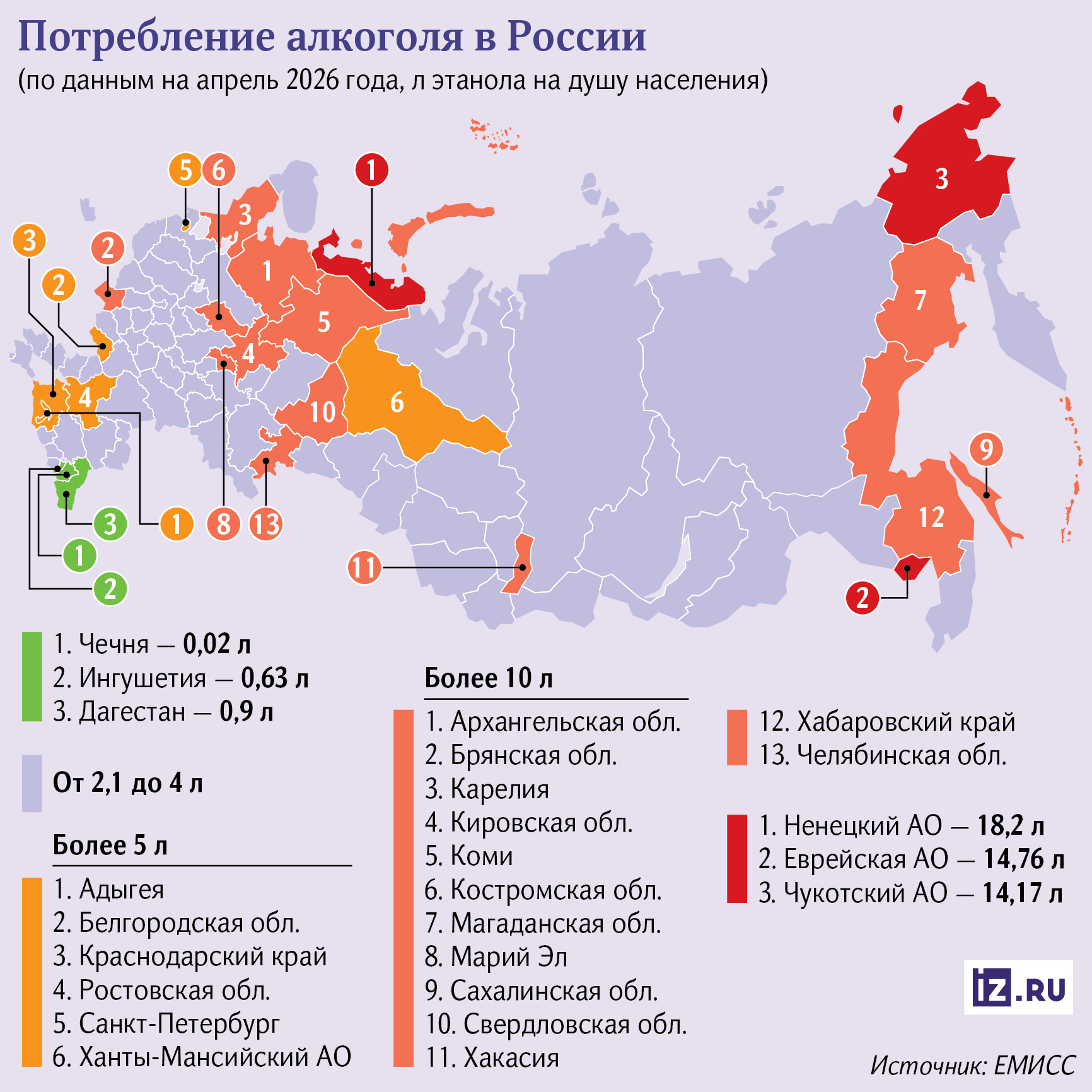
— If we talk about the number of psychoses, and this is a painful condition, then this indicator includes only people with a diagnosis of alcoholism. That is, it is impossible to assess whether people have started drinking more or less, but we can say whether the disease is more severe or easier," the doctor explained.
The number of people diagnosed with alcoholism for the first time began to decline in 2006, according to Rosstat data. So, in 2005, more than 209 thousand Russians were diagnosed, and in 2006, about 193 thousand. In 2005, Russia introduced a ban on the sale of strong alcoholic beverages in some public places, as well as temporary restrictions on the sale of alcoholic beverages, and then a series of restrictions.
Until 2020, the number of alcoholics in Russia was rapidly decreasing. There are 3.5 times fewer of them, Izvestia estimates. However, in 2021, growth began again — during the pandemic. For three years, the number remained more or less stable. The decline began only in 2024, when an action plan was approved to implement the Concept of reducing alcohol consumption in the Russian Federation for the period up to 2030 and beyond. Alcohol consumption in the country is expected to decrease to 7.8 liters per person per year by 2030.
Переведено сервисом «Яндекс Переводчик»
