
View vessels: how ships arriving from abroad in Russian ports are checked

Visibility is only a few meters, strong undercurrents and icy water even in summer — in such conditions, divers inspect civilian vessels arriving at Russian ports from abroad. They are examining the underwater part of the buildings in search of mines and suspicious objects that can be used for sabotage. Izvestia learned why the Alpha flag is hoisted on ships, why divers work only in pairs, and why a knife is needed during diving.
Under the Alpha flag
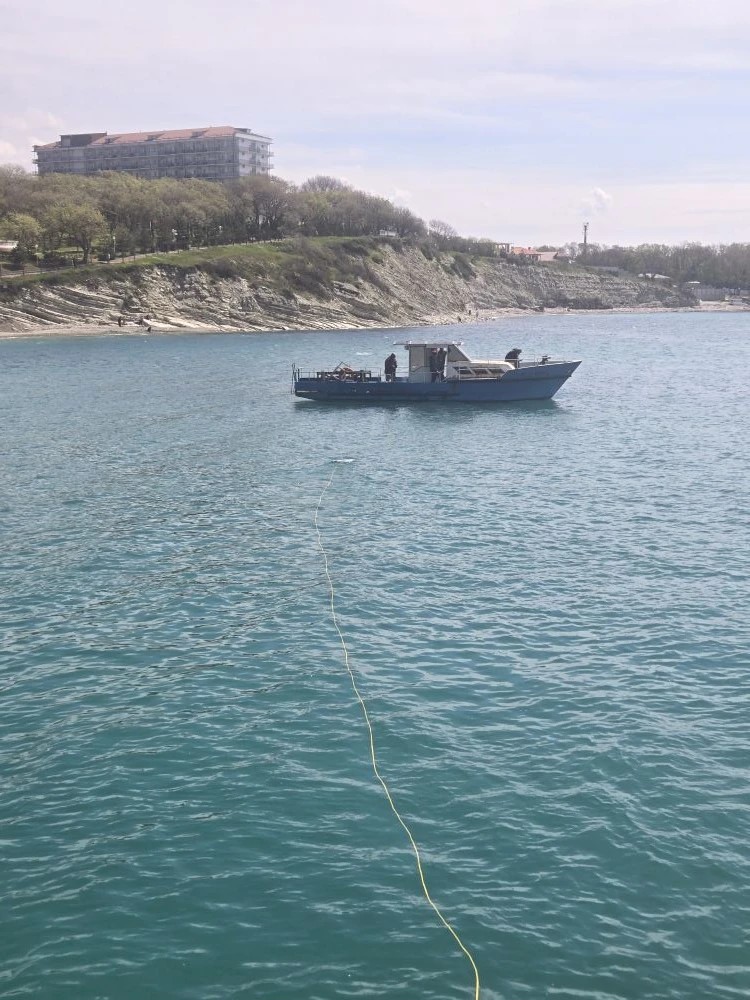
A ten-meter diving boat with a crew is moving towards a civilian vessel in the Black Sea. The boat rocks quite a lot on the waves, but the weather cannot be called stormy. It becomes clear how large the cargo ship is to be inspected when the boat comes close to it: the length of the vessel is at least 200 meters, and the height of the side is 20 meters.

A representative of the diving group contacts the captain and submits the documents for the inspection. It is forbidden to board: the cargo ship is considered the territory of a foreign state.
After that, the captain locks the ship's control system, instructs the crew and raises the white and blue Alpha flag. This signal warns other vessels that the ship is not moving, and diving operations are underway nearby.

The same flag is raised on the bot.
Before diving, the descent supervisor evaluates the situation: wind strength, wave height, current, and other risks. The safety of the entire group depends on his decisions.

Diver Vladimir Filippov told Izvestia that even when inspecting vessels where deep dives are not usually required, the risk of barotrauma remains high. According to him, it is necessary to surface slowly and strictly according to the rules, otherwise you can get serious injuries.
— Damage to the eardrum is one of the most common injuries among divers. Recovery from it sometimes takes up to six months," he said.
On the bot, the supervisor distributes surveillance sectors among insurers. While the divers are underwater, they are continuously monitored and ready to warn of any danger.
Dry or wet
Finally, the supervisor gives the command to get to work. Divers check their equipment and put on wetsuits, which come in two types — wet and dry. The first one is neoprene, which is worn on a naked body. It is lighter, but when immersed, water gets into it, and therefore they are only good in hot weather.

Dry — they don't let water through. Together with a special lining, they allow you to work even at very low temperatures. These are the suits that divers use during inspections.
Underwater tugboats are lowered into the sea — special devices that help divers overcome long distances without unnecessary effort.
Then it's the turn of the two swimmers. Each of them has two air tanks, masks on their faces.
— All work is carried out by at least two pairs for safety reasons — one insures the other, — they explain.
Action cameras are mounted on the helmets, which record the entire operation process.
— All cameras are illuminated, — says Alexey Malyshev, General Director of JSC "Network Company", which is engaged in ship inspection. — Camera and light settings are important. In the Black Sea, at a depth of several meters, visibility does not exceed two to three meters. It can be worse. In the Caspian Sea, it can reach 20-30 centimeters. It is very difficult to work in such conditions.

Divers inspect the vessel according to a pre—approved route — first they pass the length of the hull at a depth of 1.5 meters, then at three and five.
In the end, they will have to examine the bottom and the steering group — these places are considered the most dangerous. Special attention is also paid to the zygomatic keels (pitching dampers), tread protection and kingston grilles.
The probability of installing an underwater mine or a disguised explosive device is very high here.
When working, divers pay attention to any anomaly that may even indirectly indicate the activities of saboteurs.
While the work is underway underwater, we are told that on the outer roadstead of Novorossiysk, near a ship en route from Istanbul, divers found one of the observation hatches of the rudder pen suspicious. The bolts that fixed it to the body were brand new, although the entire bottom was covered in growths. It was impossible to exclude the possibility that an explosive device had been placed in the cavity.
The divers stopped the inspection and reported their discovery to the port. As a result, it turned out that the ship had recently been in Ukraine and for this reason it was deployed.
A similar case occurred in one of the Russian ports in the Caspian Sea.
Despite the apparent simplicity of the work, divers face many dangers at depth, explains Vladimir Filippov.

"There are many nuances," he says. — It is impossible to surface instantly while under the ship. You need to walk 15-30 meters under the hull to get out from under it and only then climb up. And the current near the hull can increase, and if you do not calculate the forces, the diver can be carried out to sea.
And when diving, divers always take a knife with them. Many ships use screws to hook on old fishing nets. And the chances of getting tangled in them are not zero — there is poor visibility at depth. In this case, only a knife or a safety partner can save the diver.

Currently, remote-controlled underwater vehicles are used for inspections.
— We consider the equipment as divers' assistants, — Alexey Malyshev noted. — It is suitable for inspection of simple areas, such as the sides. The most difficult ones should be examined by people in order to be able to give an intellectual assessment of what they saw.
The use of underwater technology is more than justified. Divers have to work on a tight schedule. They can only conduct ship surveys during the day. Weather, port management, and military alarms inevitably make their own adjustments to their work.
Finally, the divers return — the examination was carried out without incident. They only need to submit the inspection report and video recordings to the port administration and representatives of the FSB.

Such work is not carried out in vain. The special services of Ukraine and Western countries unfriendly to Russia can arrange serious sabotage in one of our ports, military expert Dmitry Boltenkov told Izvestia.
"Mining a ship outside Russian territorial waters and its remote explosion in a port is one of the most likely scenarios," he said. — Such a diversion can cause serious damage to the harbor's activities. For example, a ship may sink to the bottom, blocking a shipping channel through which ships are moving. It won't be easy to lift it. Ship—lifting is one of the most difficult and time-consuming operations.
There are more than enough trained specialists in underwater sabotage in Europe. They may be attracted as "vacationers," the expert explained.
Thousands of verified
Mass inspections of ships arriving from abroad began after the presidential decree in July last year. During such work, not only divers of the Ministry of Defense of the Russian Federation, Rosgvardiya and other law enforcement agencies, but also private companies are widely involved.

The decision on inspections was made against the background of incidents that showed signs of external interference, including the explosion of the Koala tanker in Ust-Luga in February 2025. At that time, according to a number of media reports, the cause of the incident was also considered to be an external impact: the nature of the damage indicated an explosion outside the ship's hull.
From July 21, 2025 to the middle of April this year, 7,983 civilian vessels arriving from abroad were examined at Russian seaports, Izvestia wrote. This has become part of large-scale measures to ensure the safety of ships in Russian harbors.
Переведено сервисом «Яндекс Переводчик»
