- Статьи
- Economy
- All in the collection: the budget received a record amount from the "tax on the rich"

All in the collection: the budget received a record amount from the "tax on the rich"

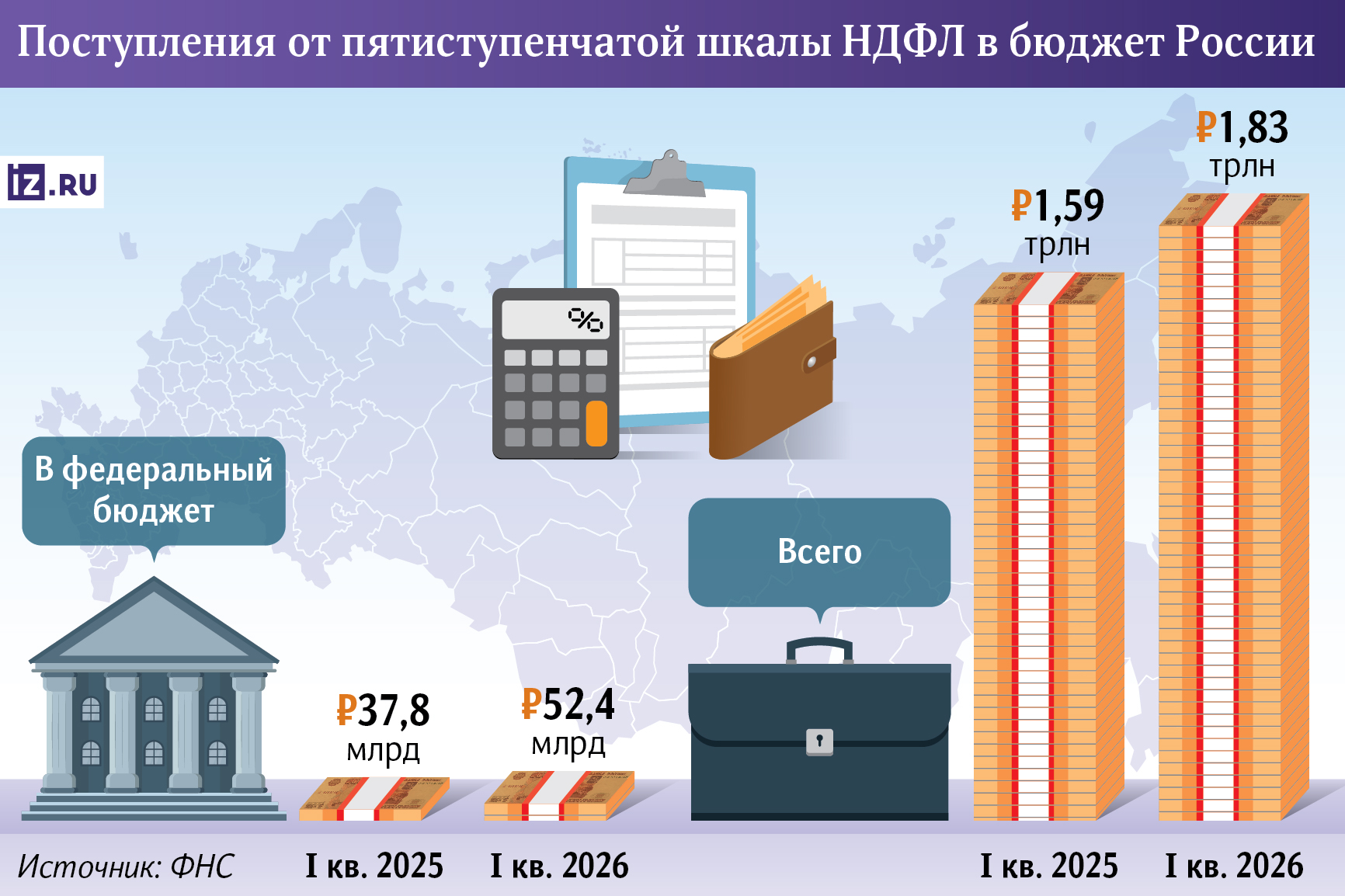
In the first three months of 2026, the federal budget received over 52 billion rubles from the so-called tax on the rich, according to the Federal Tax Service (Izvestia studied them). This is a third more than a year earlier, when the five-step scale was just introduced. The reasons are rising salaries, whitewashing incomes and deposit receipts against a backdrop of high inflation. More than half of the amount was collected from citizens in the capital — 28.2 billion rubles. Whether they will continue to increase against the background of stricter control of the Federal Tax Service is in the Izvestia article.
How much personal income tax was collected from the rich in Russia in 2026
The five-step personal income tax scale has been in effect in Russia for the second year. Fees at the 13% tax rate go to regional and municipal budgets, and anything above this level goes to the federal budget.
In the first three months of this year, 52.4 billion rubles were collected from the "tax on the rich" to the federal budget, according to Federal Tax Service statistics. This is 38% more than in the same period last year. The editorial board asked the tax service and the Ministry of Finance to comment on the reason for this increase.

Since 2025, the tax system for individuals has become more complicated, it has become a five-step system — for those who receive income over 2.4 million per year, the rate was:
- 15% — with earnings from 2.4 million to 5 million per year (from 200 thousand to 416.7 thousand rubles per month);
- 18% — from 5 million to 20 million per year (from 416.7 thousand to 1.67 million per month);
- 20% — from 20 million to 50 million per year (from 1.67 million to 4.17 million per month);
- 22% — from 50 million per year (over 4.17 million per month).
These rates apply only to the excess amount, not to the entire income. For example, an earner of 250 thousand monthly pays only 1 thousand in excess of what would have to be transferred at the previous 13%. Increased interest rates appear when the total amount of income per year has already reached the threshold — for example, 2.4 million rubles.
That is, in the first months of the year, a person pays only the usual 13%, and then a larger amount. It is this "surcharge" that goes to the federal budget. Thus, treasury revenues of 52 billion per quarter are receipts from the wealthiest Russians, explained Ekaterina Golubtsova, Associate Professor of the Department of State and Municipal Finance at Plekhanov Russian University of Economics.

Previously, in 2021-2024, there were only two steps: 13% and 15%. The increased level applied to those who earned over 5 million rubles a year — in this case, 13% of this amount went to the regions, and a 2 percentage point surcharge went to the general treasury.

So far, revenues from the "tax on the rich" are small compared to revenues to regional and municipal budgets (at a base rate of 13%). In the first quarter, they received 1.8 trillion rubles, according to the Federal Tax Service. For comparison, last year, in January – March, 1.6 trillion such taxes were collected from the income of individuals.
Why are the receipts from the progressive scale growing?
As the press service of the Ministry of Finance told Izvestia, the positive dynamics of personal income tax receipts in early 2026 confirms the expectations set out in the financial plan. This is due to an increase in citizens' incomes, including on bank deposits, which were affected by high interest rates last year, they added.
One of the main reasons for the increase in income tax receipts at a rate of more than 13% is an increase in salaries, explained Alexey Krylov, an expert at the Council of the Chamber of Commerce and Industry of the Russian Federation on the financial market and investments, a tax consultant. So, in 2025, the nominal salary increased by 13.5%.

Another reason is the tightening of tax administration. According to the expert, the fight is underway against the substitution of labor relations and with salaries in an envelope. As Izvestia wrote earlier, last year alone, the authorities removed 976,000 people from shadow employment, which is 20% more than in 2024.
The growth of budget revenues is also influenced by the income of Russians on deposits and investments, which are also subject to a fee, said Vladimir Chernov, analyst at Freedom Finance Global. Since the beginning of 2026, the key rate has gradually decreased from 16 to 14.5%, and deposit rates have been 9-15%, depending on the term. This is still a profitable investment, the expert noted.
It is also important to take into account the growth of citizens' incomes from the sale of real estate and rental, said Vadim Zasko, Dean of the Faculty of Taxes, Audit and Business Analysis at the Financial University under the Government of the Russian Federation. According to him, this increases nominal incomes and may lead to the application of a higher personal income tax rate.

More than half of the revenues to the federal budget came from fees from citizens in the capital — almost 28.8 billion. According to Rosstat, the average salary in Moscow is about 198,000.
The scale of the tax base is important — it is in the capital that the majority of the head offices of large enterprises, banks, IT companies, organizations in the fields of consulting and finance are concentrated, Vladimir Chernov added. Therefore, there are many taxpayers in Moscow who are subject to increased personal income tax rates.
How personal income tax receipts affect the economy
In Russia, they want to strengthen control over large non-cash receipts of citizens. The Federal Tax Service reported that incomes in excess of 2.4 million rubles per year may automatically become the subject of tax authorities' attention without confirming the source. The government has already submitted a bill to the State Duma. If adopted, the measure will be effective from 2027. As Izvestia wrote earlier, not only shadow entrepreneurs can come under control, but also citizens with mixed incomes, for example, those who combine work with part—time jobs or rent housing.

Stricter controls will continue to increase budget revenues. If a person used to receive money regularly as an individual without registration, but now he is registered as self-employed, sole proprietor, or begins to declare income, this gradually expands the tax base. However, the effect of such measures usually does not appear immediately, but through the tax period and subsequent inspections, Vladimir Chernov noted.

As the expert explained, the result will be visible through three channels. Some citizens will begin to voluntarily declare income (for example, from rent), the rest will switch to "legal" regimes — they will register self-employment or sole proprietorship. Additional personal income tax, penalties and fines are also possible based on the results of inspections, he explained.
— For the federal budget, the effect will remain moderate for now: the bulk of personal income tax traditionally goes to the regions, while the center receives increased revenues from incomes exceeding the established thresholds. Therefore, in the first year after the tightening, we will most likely be talking about small amounts. A more noticeable financial effect will appear later if the control becomes systemic and affects a wide range of gray incomes: from rental housing and services to trade and earnings in the online segment," the specialist explained.

In the coming years, an important factor will be the growing awareness of citizens about the possibilities of the Federal Tax Service and the understanding that taxes will have to be paid anyway, said Alexey Krylov from the Chamber of Commerce and Industry. Such a feeling of "inevitability" may encourage Russians to declare their income more actively. This is especially true for residents of Moscow: the profit from renting an apartment, combined with a high salary, often allows you to exceed the threshold of 2.4 million rubles per year, the expert explained.
The growth of treasury revenues at the expense of high-income citizens, as well as the identification of undeclared income, correspond to the principle of fair taxation, says Ekaterina Golubtsova. This approach also makes it possible to ensure a balanced budget without increasing the burden, taking into account the interests of taxpayers.

The effectiveness of the progressive personal income tax scale is evidenced by the fact that in the first quarter of this year alone, the federal budget received more than 52 billion in revenue at increased rates, Vadim Zasko noted. According to him, a significant part of the funds has a social orientation — they go, in particular, to support large families and help children with rare diseases. According to the financial plan for 2026, personal income tax receipts to the state treasury are estimated at over 1 trillion rubles, which is a third more than was collected last year (763 billion).
Such sums are unlikely to eliminate the budget deficit, analysts interviewed by Izvestia noted. According to the Ministry of Finance, the shortfall by the end of April had already amounted to 5.8 trillion (2.5% of GDP), with 3.8 trillion included in the financial plan. But the growth of personal income tax revenues allows us to cover significant budget expenditure items. It is expected that incomes under this item will continue to grow — they will continue to be supported by salary increases and government plans to whitewash the economy.
Переведено сервисом «Яндекс Переводчик»
