
Take a pencil: why Efimov and the "Kukryniks" became personal enemies of Hitler

During the Great Patriotic War, many authors switched to creating patriotic posters, leaflets, and performances by front-line brigades. Among them were the "Izvestia" cartoonists Boris Yefimov and Dmitry Moore. The contribution that fine art made to supporting the morale of soldiers and how Izvestia covered the propaganda work of other artists is in our material.
"Battle pencil"
Already in the first days of the war, the cultural life of the country was rebuilt under Stalin's slogan "Everything for the front! Everything for victory!". Cultural institutions have been tasked with forming art brigades to perform at the front, creating campaign posts and producing posters, including continuing the tradition of "Windows of Growth." Many painters and graphic artists did not stand aside: they took up arms and went to the front. Having experienced all the hardships of trench life, they captured what they saw in their works.
On June 28, 1941, a small note "Combat pencil" from the Leningrad Sobkor appeared on the pages of Izvestia. It reported that a military commission had been formed under the Union of Soviet Artists under the chairmanship of the famous batalist Mikhail Avilov. The largest masters of fine art of Leningrad were involved in its composition.

"Together with representatives of the political administration of the Leningrad Military District, the commission organized the periodic release of wall campaign leaflets "Combat Pencil". Initially, three sheets are issued: "For the Motherland, for Stalin!", "We beat, we beat and we will beat!", "Death to fascism!", the newspaper wrote.
Even in the conditions of the blockade, the artists of the creative association "Combat Pencil" did not stop working. Propaganda posters and collections of satirical drawings appeared from their pens, helping to maintain the morale of the townspeople and fighters.

A note to Hitler
During the Great Patriotic War, poster art became a powerful tool for mobilization and inspiration. The drawings, simple in form but powerful in impact, were created by professional artists, many of whom went through serious painting school.
The key feature of the poster was the unity of image and word. The laconic phrase hit the target, and the visual range enhanced its impact. Such a drawing could lead a person either to a feat of arms or to the labor front.
The canonical image that has entered the cultural memory of the people, "The Motherland is calling!" is the work of Irakli Toidze. The poster depicts the artist's wife. He captured her at the moment when she informed him about the outbreak of war. The image became the embodiment of the Motherland - monumental and inviting.

Dmitry Moore, who collaborated with the newspaper Izvestia in the 1920s, created posters during the Great Patriotic War exposing the brutality of the Nazi occupiers. Moore made history with the call "Did you volunteer?" (1920). The poster directly appealed to the civic conscience and called for the defense of the country. Many admitted that it was he who encouraged them to take up arms. In 1941, Moore created a new version of the poster — with a soldier in a helmet and the slogan "How did you help the front?". Variants were produced in the languages of the peoples of the USSR.
Wartime drawings had a special compositional power. His principle of organization resembled an icon in many ways: a clear foreground with mainly a heroic warrior, a summoning woman, and a menacing warning, and a changed perspective in the background.

Drawing by Boris Yefimov, 1944
Among those who became famous for their military works are Alexey Kokorekin, Vladimir Serov, Viktor Ivanov, Viktor Koretsky. Sometimes a whole group of authors worked on one poster. The most striking example is the creative association "Kukryniksy", which included Mikhail Kupriyanov, Porfiry Krylov and Nikolai Sokolov. Hitler added their names to the list of personal enemies.
On April 1, 1942, Mikhail Khrapchenko's article "Artists during the War" was published in Izvestia. It says: "First of all, it is necessary to tell about the work of "Kukryniks". Masters with expressive and vivid talent, "Kukryniksy" made a number of brilliant posters. Their works such as "The Whole Europe of Hitler and Ribbentrop," "The Debt is Red," "German Pincers," "Soviet and British Pilots over Berlin," "Suvorov's Grandchildren are Chapaev's Children," were done brilliantly, with great political acuteness and satirical talent."
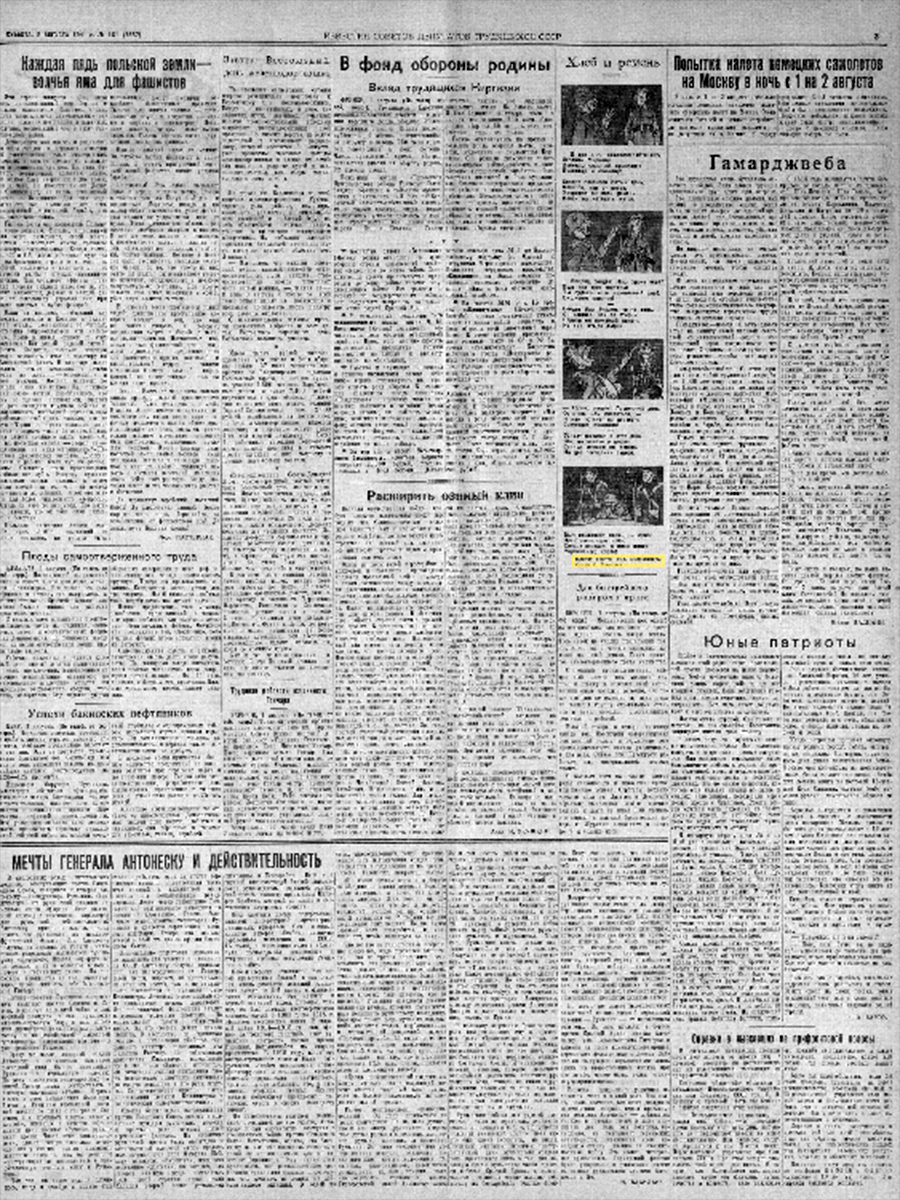
The drawings of the "Kukryniks" were also published in Izvestia. On August 2, 1941, they illustrated Samuel Marshak's poem "Bread and a Belt." In four cartoons, Hitler bends his fingers in front of the nose of a Wehrmacht soldier, counting down the days for which they will take the USSR. "Be patient, soldier! We have the last day left to fast, and Soviet wheat will flow to us from the villages!" But the soldier is only losing weight, and Hitler's end is known — the tribunal.

The "Fascist Menagerie"
Boris Yefimov, a unique cartoonist, lived for 108 years. 85 of them collaborated with Izvestia, creating about 70 thousand works. For his dedication to his profession, Boris Yefimov's name was included in the Guinness Book of Records as the oldest cartoonist in the world.
He was flamboyant in his satire. For his accuracy and accuracy, Yefimov was called the sniper of the Soviet caricature. His work was ridiculed by many politicians, but a series of anti-Hitler cartoons became especially noticeable. Just like Kukryniksov, the Fuhrer considered him a personal enemy. However, it was Yefimov who witnessed how Hitler's henchmen were tried at the Nuremberg Tribunal.

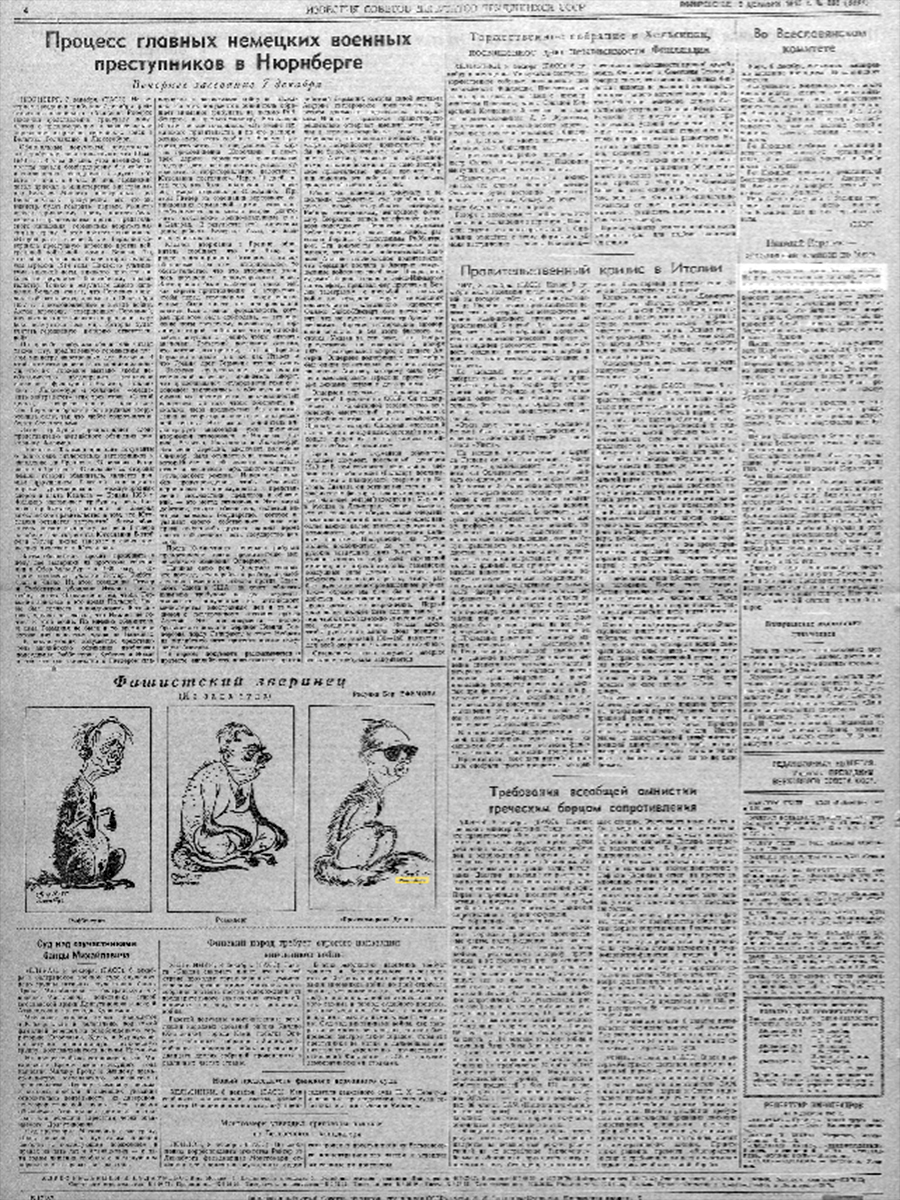
On the instructions of Izvestia, the artist was sent to the trial, where, with a pencil in his hands, he made sketches from life of what was happening in the hall of the Palace of Justice. In the December 5, 1945 issue of the newspaper, a report entitled "The trial of the main German war criminals in Nuremberg" was published. Below it are Boris Yefimov's caricatures with the general title "The Fascist Menagerie". He portrayed Hitler's henchmen in the form of a variety of animals: reptiles, birds. The Fuhrer's official successor, Hermann Goering, is a coiled boa constrictor, Field Marshal Wilhelm Keitel, who signed the surrender, is a crouching tailless dog. And Hans Frank, the organizer of the large—scale terror against the Polish and Jewish population of Poland, is a bespectacled snake in a rack.
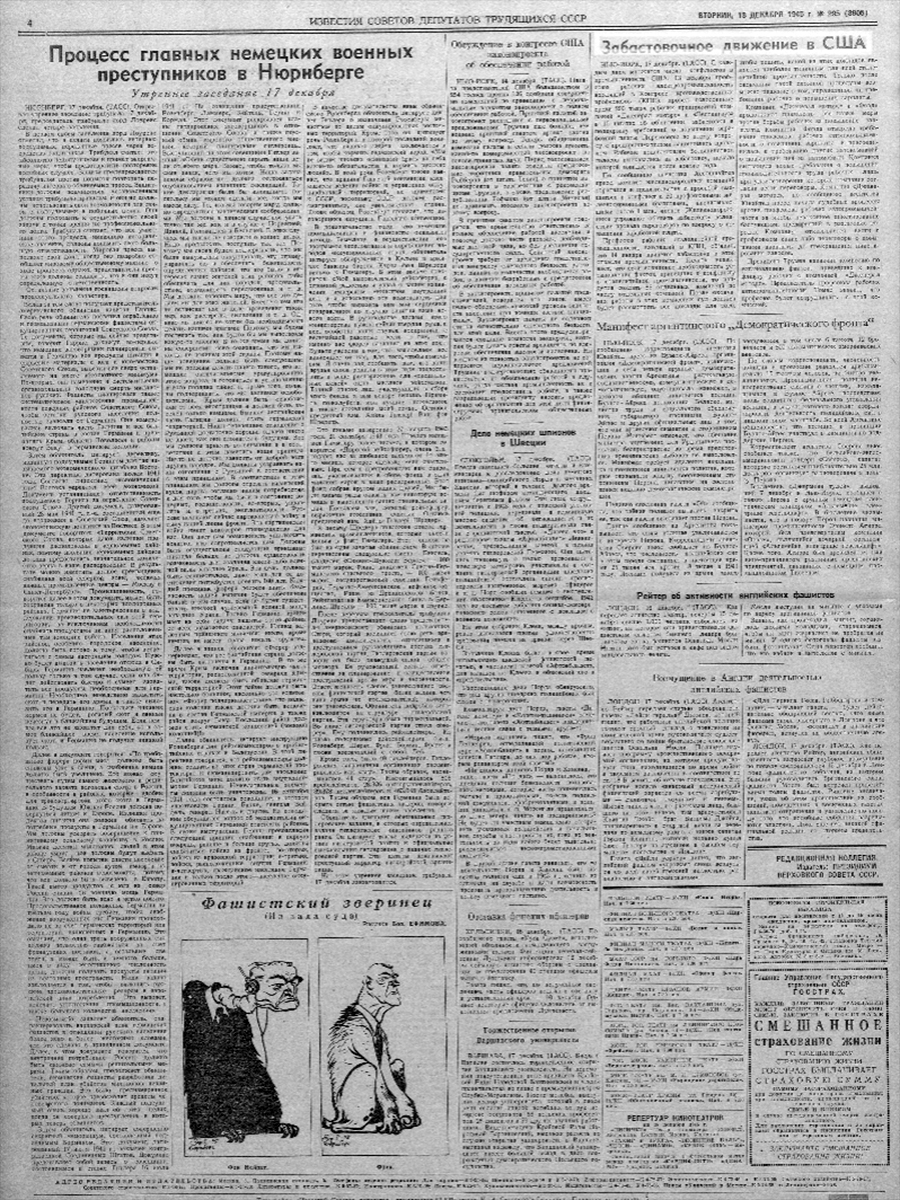
On December 8, 1945, a gloomy Ribbentrop with headphones appeared on the pages of Izvestia in the skin of a hyena. One of the main war criminals, the Reich Minister of the Eastern occupied territories, Alfred Rosenberg, is a clumsy boar, and "Grand Admiral" Doenitz is a cunning fox. In the newspaper for December 18, 1945, other inhabitants of the "menagerie" were posted: SS Obergruppenfuhrer von Neurath in the form of a vulture-scavenger with a uniform cap on his head and SA and SS Obergruppenfuhrer Wilhelm Frick sitting boxer.
On the occasion of the 125th anniversary of the master and the 80th anniversary of the beginning of the Nuremberg Trials, Izvestia together with the Russian Academy of Arts organized a large-scale exhibition "Cartoons. Comics. The humor of the Fuhrer's personal enemy", where Boris Yefimov's work was presented.

The works of veterans are not just works of art, but living evidence of an era where creative inspiration is intertwined with historical truth. Posters, caricatures, satirical drawings and propaganda leaflets not only conveyed important messages to people, they strengthened faith in victory, awakened patriotism and helped to withstand the most difficult trials. And Boris Yefimov, "Kukryniksy", Dmitry Moore, Irakli Toidze and other masters turned a brush and pencil into a real weapon.
Переведено сервисом «Яндекс Переводчик»
