- Статьи
- World
- Potential and action: Russia will respond to the nuclear alliance of Germany and France

Potential and action: Russia will respond to the nuclear alliance of Germany and France

Germany and France's nuclear plans are capable of posing a direct strategic threat to Russia, Russian Ambassador to Berlin Sergey Nechaev told Izvestia. According to him, the interaction of these countries requires consideration in Moscow's military-political planning. Earlier, Berlin and Paris established a high-level steering group on nuclear cooperation. Experts believe that Moscow, in response, may deploy additional weapons in the Leningrad Military District, as well as expand its capabilities to overcome European missile defenses.
Russia is concerned about the nuclear alliance between France and Germany
Russia will take into account cooperation between Berlin and Paris in the nuclear field in its military and political planning, Russian Ambassador to Germany Sergey Nechaev told Izvestia.

"Any plans, especially practical ones, and steps taken by the Europeans regarding the nuclear sphere require careful consideration within the framework of Russian military and political planning, since they can pose a direct threat to our country's strategic order,— the diplomat stressed.
According to him, there is no talk about the deployment of French nuclear weapons on the territory of Germany yet. However, recently, expert assessments and stuffing in the German media have become more frequent about the possibility of Germany's involvement in one form or another in the idea of "Europeanization" of the French "nuclear umbrella", for example, through co-financing of specialized projects.
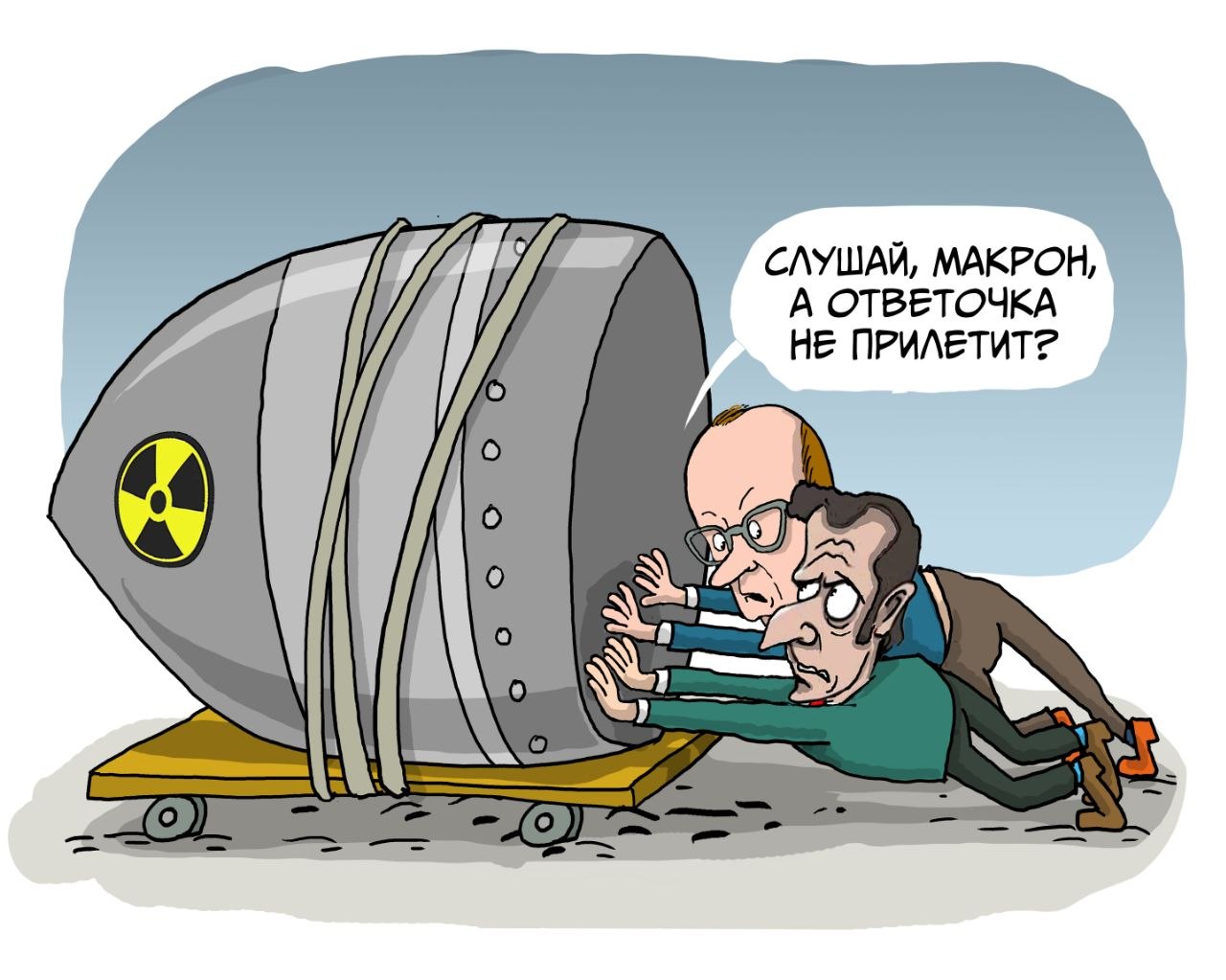
Back in March, German Chancellor Friedrich Merz and French President Emmanuel Macron issued a joint statement that Berlin and Paris had established a high-level steering group on nuclear cooperation.

German Chancellor Friedrich Merz and French President Emmanuel Macron
— This structure is designed to become the main mechanism for dialogue on relevant issues and coordination of strategic cooperation. Among other things, the "conventional" participation of the Bundeswehr in the exercises of the French nuclear forces is planned," Sergei Nechaev said.

Cooperation between Paris and Berlin in the field of nuclear and strategic deterrence in the future leads to an increase in their joint potential both in terms of the possibility of launching strikes deep into Russia's territory, and in reducing the effectiveness of retaliatory or preemptive actions by the Russian Federation, Dmitry Stefanovich, a researcher at the IMEMO RAS Center for International Security, told Izvestia.
"We are talking not only about the possible deployment of French nuclear weapons carriers in Germany, but also about cooperation in the field of high—precision long-range weapons in non—nuclear equipment, in missile and air defense, and in the military space sphere," the expert added.

Stefanovich believes that the plans of Berlin and Paris will require a response both at the planning level and by deploying additional offensive and defensive weapons, primarily on the territory of the Leningrad Military District.
Tigran Meloyan, an analyst at the HSE Center for Mediterranean Studies, suggested in an interview with Izvestia that, as a response, Russia may reconsider its plans for strategic deterrence, in particular, expand its own capabilities to overcome European missile defenses and redistribute and increase the number of nuclear warheads designed to hit targets in the European direction.
—The problem facing Russia requires a comprehensive approach, therefore, taking into account the capabilities of the United States, France, Great Britain and Germany to create a broader ecosystem of NATO directed against Russia is the only correct solution for today," the expert believes.

Other possible response options include increasing the number of deployed Oreshnik complexes in Belarus, strengthening air defense and missile defense systems, as well as adapting the nuclear doctrine. By the way, Moscow has been making adjustments to the fundamentals of state policy in the field of nuclear deterrence in 2024. At that time, the category of states and military alliances against which Russia would conduct nuclear deterrence was expanded and the list of military threats was expanded.

France's "nuclear umbrella" over Europe
France remains the only EU country with nuclear weapons and has been significantly expanding its role in recent months. In March, Emmanuel Macron announced that Paris would increase its nuclear arsenal and involve European allies in new cooperation formats. In particular, the deployment of French nuclear weapons carriers — Rafale aircraft — on the territory of other EU countries is not excluded.
According to media reports, Belgium, Denmark, Greece, the Netherlands, the Czech Republic and Sweden may join the exercises and other cooperation formats. Poland stands apart in this row, as Warsaw and Paris are already discussing plans for joint exercises to launch nuclear strikes against Russia and Belarus. Russian Presidential spokesman Dmitry Peskov is confident that such plans "do not contribute to stability and predictability on the European continent."

In February, the Russian Foreign Intelligence Service issued a statement saying that Britain and France were preparing plans to transfer nuclear weapons to Ukraine. The French Embassy in Russia told Izvestia earlier that there were no specific plans to deploy this type of weapon in other countries, and Paris was not considering transferring its nuclear arsenal or strategic missiles to any state.
At the same time, investments in the defense sector are growing in France — the country's military budget for 2025 has been increased to €50.5 billion. In addition, the government has launched a mechanism to attract up to €5 billion in capital to the defense industry. New hypersonic missiles and nuclear missile carriers are being actively developed.
Other EU countries may be involved in financing promising defense projects. For example, France and Poland have announced a military communications satellite project. Paris remains one of the key participants in the FCAS new generation fighter program, which it is developing together with Germany and Spain. The country is also involved in initiatives on long-range strike systems.
Separately, coordination with London is being strengthened. In July 2025, France and the United Kingdom signed the Northwood Declaration. At the same time, a joint Franco-British coordination group on nuclear deterrence was established. However, the United Kingdom is not a member of the European Union, and its nuclear forces are based on ballistic missile submarines, so London has limited opportunities to deploy such elements in other countries.

Cooperation between Berlin and Paris will also affect future negotiations on an agreement to replace the START Treaty (Strategic Offensive Arms Treaty), which expired on February 5. Previously, Russia viewed NATO's nuclear potential as predominantly American. With the potential resumption of negotiations on this issue, Moscow may put forward consideration of the strategic potentials of European countries as the main condition.
However, Paris and London do not intend to impose restrictions on the modernization of their nuclear arsenals. By the way, another growing nuclear power, China, also has no plans to join the possible agreement. The arguments of France, Great Britain and China are similar: their nuclear capabilities are seriously inferior in number to Russian and American ones. Therefore, the prospects for the creation of a new document on strategic weapons are still extremely low.
Переведено сервисом «Яндекс Переводчик»
