- Статьи
- Culture
- Mind Games: "On the trail of the beast" will tell about Hitler's plans thwarted by intelligence agents

Mind Games: "On the trail of the beast" will tell about Hitler's plans thwarted by intelligence agents

In the spring of 1943, the fate of victory in the Great Patriotic War was decided not only on the front line. While the troops were preparing for the Kursk Bulge, those who were not in the reports were operating in the shadows. Their weapons were not guns, but information. It was the work of Soviet intelligence that thwarted Hitler's offensive plans and turned the tide of history. This historic event became the basis for the dynamic spy thriller "On the Trail of the Beast", all episodes of which will be released on REN TV on Victory Day. Our article is about the family drama between the central characters, the trials on the set and the real heroes of intelligence, whose feat is witnessed on the pages of Izvestia.
Heroes of the Invisible Front
The victory in the Battle of Kursk disrupted a large-scale offensive by the Wehrmacht and forced Germany to go on the defensive. From that moment on, the Nazi army ceased to seem invincible. Many outstanding feats were performed during the battle, but the chain of heroic events began with the work of Soviet intelligence.

A shot from the movie "On the trail of the Beast"
It was this historical context that formed the basis of the spy drama "On the Trail of the Beast."
— Our story is, of course, fiction. But we relied on Marshal Georgy Zhukov's recollections that as early as the spring of 1943, the Soviet command knew the date of the German offensive on the Kursk Bulge," Peter Amelin, the film's director, told Izvestia.
One of the first intelligence officers who informed Moscow of the detailed plans for Operation Citadel was Hungarian cartographer Sandor Rado. In October 1975, Boris Rodionov, a special correspondent for Izvestia, visited him in Budapest and made a large piece of material under the heading "Heroes of the Invisible Front. The feat of Comrade Rado." A smiling 76-year-old man looked at the readers from a small black-and-white photograph. During the Second World War, he lived in Geneva with his two children, his wife and his mother-in-law, and ran the Geopress agency, which supplied the European press with maps of military operations.
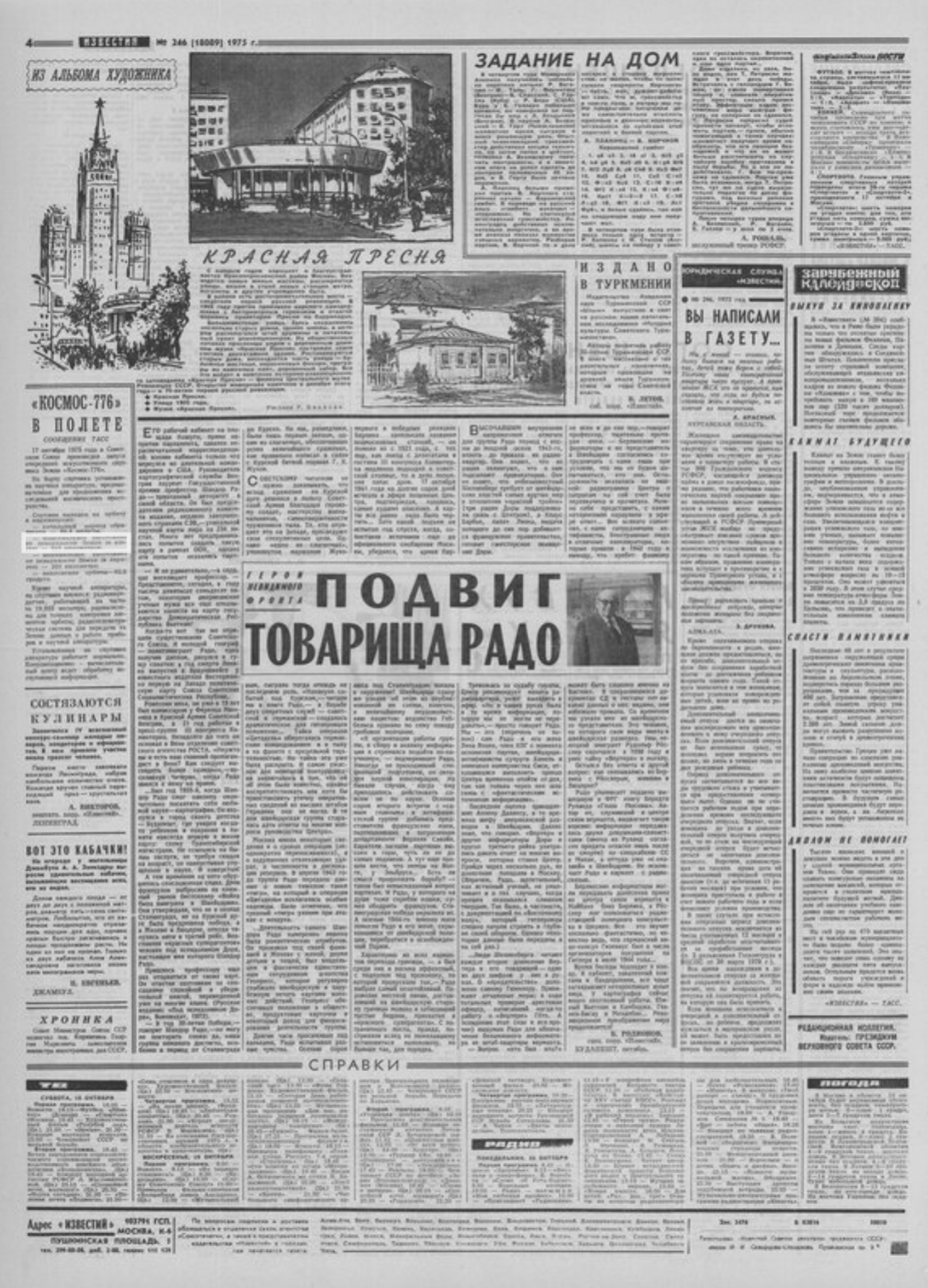
In reality, Rado, under the pseudonym Dora, headed the anti-Fascist resistance intelligence group. It was he who received secret information from a German agent that allowed the Red Army to provide accurate information about the deployment of Nazi troops on the Eastern Front and disrupt the strategic plan of the offensive of Hitler's army.

A shot from the movie "On the trail of the Beast"
"We, the scouts, were only the first link, one of the components that ensured the success of the greatest battle, as Marshal GK Zhukov correctly wrote in connection with the Battle of Kursk," Rado told the Izvestia journalist.
Sandor received data from a Werther agent, who transmitted top-secret information about Hitler's plans directly from the Wehrmacht High Command. As the Izvestia special correspondent reported, it was Rado who invented the pseudonym "Werther" when it was necessary to somehow designate an unnamed informant.
Later, it was this image that inspired the writer Julian Semenov to create Otto von Stirlitz, whom the audience especially loved in the performance of Vyacheslav Tikhonov in "Seventeen Moments of Spring."

Although in 1943 the role of the Dora reconnaissance group in the Battle of Kursk was highly appreciated, after the war the fate of Sandor Rado turned out tragically. Fearing arrest on false charges, he tried to commit suicide, and was later sentenced to 15 years for espionage. It was only in 1956 that the Military Collegium of the Supreme Court of the USSR fully acquitted him. Rado returned to Hungary and resumed his cartography, far from the secret war in which he had once played a key role.
You're not my brother.
The feat of Soviet intelligence became the starting point in the REN TV spy drama "On the Trail of the Beast." The plot of the film unfolds in the late autumn of 1942, when, in an attempt to change the course of the war, the German command is preparing the ground for a counteroffensive near Kursk. To do this, groups of highly skilled German saboteurs are thrown into the Soviet rear.

A shot from the movie "On the trail of the Beast"
At the center of the story are the brothers Andrey Losev and Sergey Skorin. Fate separated them on different sides of the front: one remained loyal to the Red Army, the other, renouncing the past, ended up in the service of the Nazis. But this is just a first look at the fraternal conflict. With each episode, it becomes clear that the recruitment of Skorin by the Wehrmacht is just a cover, and the paternal betrayal that split the brothers is a well—planned plan.
— My hero is a single—minded, dedicated and focused person who is ready for a lot. And I like that he is suspected on both sides. At some point, he will even have to abandon his own father," actor Pavel Kharlanchuk, who plays Sergei Skorin, told Izvestia.
His on-screen brother was played by Mikhail Gavrilov-Tretyakov, for whom this is the first military picture in his career. And when the actor was offered to try out for the role of a Nazi soldier, he categorically refused.
— I said right away that I would not play a fascist in my first war movie, — said Gavrilov-Tretyakov.

Director Peter Amelin builds the narrative through a family drama: war destroys not only cities, but also destinies. Two close people become enemies, and their confrontation turns into a tragedy.
— Of course, the brothers' fight is especially interesting here. It's not only the war that's important here, but also feelings — hatred, pain, and the possibility of forgiveness," Gavrilov-Tretyakov said.

The creators relied on a tense plot and spectacular scenes. Filming took place in harsh conditions: The actors spent hours lying in the snow in subzero temperatures, working in the marshes of the Leningrad region, where they literally got bogged down in a quagmire.
— The cold is the main difficulty of this filming period. The 1936 cars did not want to start, the boots slipped, and the overcoats were not warm. We were all very cold, but we didn't whine and worked," Oleg Taktarov, the performer of the role of General Rendel, confessed to Izvestia reporters.

Pavel Kharlanchuk called the most difficult ordeal on the set the episode when he had to pretend to faint in the cockpit of an airplane. The actor had to lie "unconscious" for several takes in the bitter cold.
The actors had to run, shoot and fight a lot, but even if all safety rules were followed, they could not do without injuries.
— A machine gun was fired near my head. I thought my eardrums had burst. I even started bleeding from my ear. It only got easier after three days," said Mikhail Gavrilov-Tretyakov.
In addition to the humans, Trisha, a specially trained border collie, was on the trail, who played a scout dog named Ruta in the series. In the story, the dog comes to the rescue of the squad more than once and literally smells enemy mines.

Tricia has been acting in movies since she was a puppy. He is now five years old. As Denis, the dog's trainer, told Izvestia, in addition to the standard training for working in the frame, the dog must know special commands — to work with its back to the trainer and be friendly to actors whom it sees for the first time.
The creators not only promise the audience a fascinating narrative, but also guarantee the preservation of historical authenticity of time. Thus, "On the Trail of the Beast" becomes not just a story about intelligence and war, but a tense drama about a choice that cannot be undone. The series will premiere on REN TV on Victory Day. The channel will show all 12 episodes at once.
Переведено сервисом «Яндекс Переводчик»
