- Статьи
- Society
- Hogweed party: the sale of poisonous and harmful plants will be restricted on the Internet

Hogweed party: the sale of poisonous and harmful plants will be restricted on the Internet

In Russia, it is planned to restrict the online sale of seeds of poisonous and invasive plants. The Rosselkhoznadzor creates a list of crops that must be destroyed. Among them are hogweed, "rabid cucumber", shrubby amorpha and others. From March 1, land owners are required to exterminate them. However, many of these plants are still freely sold and grown in dachas for decorative purposes. For violating the requirements, land owners may face administrative liability up to and including the seizure of land.
Why do they want to restrict the sale of dangerous plants
Marketplaces are being offered to introduce restrictions on the sale of seeds and seedlings of invasive species capable of harming human health and the environment from October this year. The press service of the Rosselkhoznadzor told Izvestia about this, where they believe that the sale of such goods should be accompanied by special "reminder leaflets."

Invasive plants are viable plants of any species, varieties, or biological types, the spread and abundance of which pose a threat to the environment, the life or health of citizens, as well as the preservation of natural ecological systems and biological diversity. They are characterized by a high rate of reproduction and the ability to quickly adapt to new conditions, soils and climate. These include Sosnovsky's hogweed, shrubby amorpha, echinocystis spiky ("rabid cucumber"), maned barley, and rheinturia. According to the federal law on invasive (alien) plants, which entered into force on March 1, 2026, several lists of such crops have been identified, depending on their distribution. Including for forests (approved by the Federal Forestry Agency), for specially protected natural territories of federal significance (approved by the Ministry of Natural Resources and Environment), and for lands of other categories (approved by a regulatory legal act of a constituent entity of the Russian Federation).
"Considering that the provisions of Article 13 of the law "On Certain Issues of Regulating the Platform Economy in the Russian Federation", which comes into force on October 1, 2026, define the powers of the marketplace operator, including limiting or terminating the placement of a product card, the Rosselkhoznadzor considers it appropriate to consider mechanisms for imposing restrictions on platforms by this date," the press service said.- the department's service, noting that this measure should be effective in the regions that have approved special lists of such plants.
At the same time, they recognized that so far the subjects are not solving this problem effectively enough. According to the Rosselkhoznadzor, special registers of dangerous vegetation prohibited for cultivation on land plots, including suburban ones, have been approved only in 34 regions. However, the problem remains relevant and has not yet been resolved.

— Close interdepartmental and interregional cooperation, information and educational work among the population is necessary. It is important to work together, depending on which plants are identified in the relevant lists, the category of land and the regime under which it is allowed or prohibited to carry out certain activities, such as mechanical or chemical treatments, the Rosselkhoznadzor noted.

The service stressed that the presence of such plants on agricultural lands, as well as on land plots, threatens to punish their owners.
— In accordance with the amendments to Article 13 of the Land Code of the Russian Federation, land rights holders are required to take measures to protect them from the spread of invasive plants and further destroy them. If such crops are identified, which are included in the lists approved by the regions, the Rosselkhoznadzor will issue a binding order. If such measures are not carried out and the Rosselkhoznadzor does not comply with the instructions, measures may be taken up to sending materials to authorized bodies to initiate the seizure of land plots, the press service of the agency reported.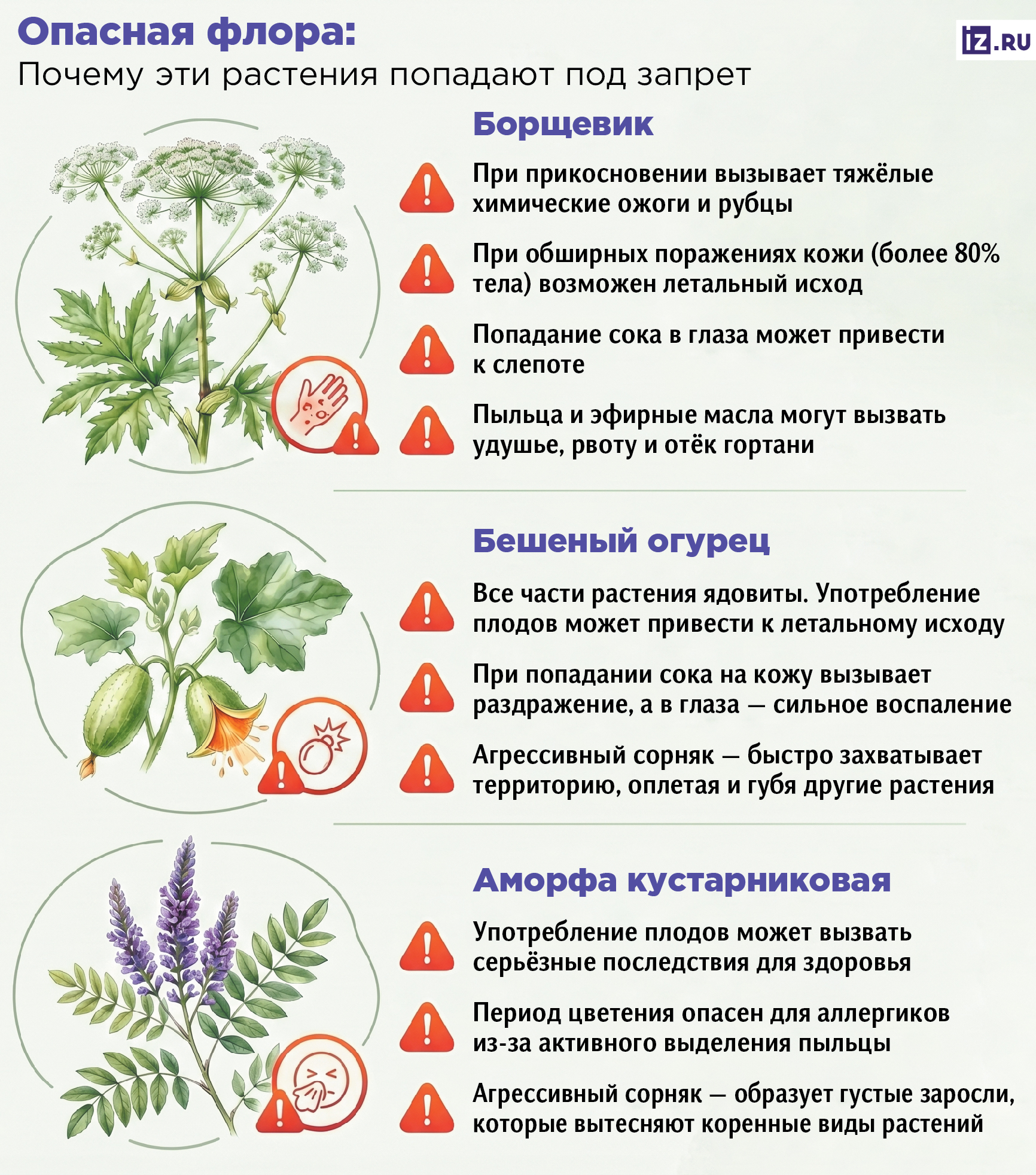
Izvestia sent a request to the Ministry of Agriculture with a request to comment on the Rosselkhoznadzor's proposal.
Will marketplaces support the restrictions
The company has not received such requests from the Rosselkhoznadzor, but is ready for dialogue if such a discussion develops, the press service of Wildberries & Russ (RWB) told Izvestia.

The editorial board also sent inquiries to other major marketplaces asking if they were aware of the agency's proposals and the measures that were being taken.
— The problem of hogweed is more typical for Central Russia and other regions, but it is not found in the south. Of course, there are plants that harm agriculture and they need to be combated," Konstantin Yurov, chairman of the Kuban People's Farmer Association, explained to Izvestia.
According to Olga Bashmachnikova, vice-president of the Association of Peasant (Farmer) Farms and Agricultural Cooperatives of Russia (AKKOR), agrarians today treat the problem of invasive plants ambiguously. There are those who believe that too much attention is being paid to this issue against the background of other more important problems for agricultural producers. For example, a lot of money is being allocated to combat the same hogweed, which could be used to support farmers.

At the same time, the topic of the spread of such plants is of considerable concern among the population.
— We have a lot of hogweed in the Leningrad region. It's being treated with a herbicide, but it's still growing. There are many seeds in the ground. Once a lawn was made in the city, the land was brought in, and with it they brought hogweed seeds. I started digging it up, and I did it for three summers in a row, because it was growing out of the roots left in the ground. Of course, a suburban area cannot be compared with a lawn. But the struggle leads to the desired results," a resident of this region shares her experience of fighting the plant on the Internet.

If there is a source of hogweed seeds near the site, then it will never be possible to get rid of it completely, says a resident of the Yaroslavl region. According to her, a local victory is impossible, it is only necessary to destroy the plant en masse.
— This problem is very acute in our country: the area of land overgrown with hogweed is huge. And it increases from year to year, because the fight against it is conducted mainly in reports. There are hectares of orphan lands all around where this weed is spreading, and our municipality can't even carry out timely processing on its plots, let alone the rest," she says.
According to Russian scientists, for 2023, invasive plant species in Russia are distributed as follows: the Southern Federal District — 263 species, the Northwestern — 229, the Central - 228, the Volga — 226, the Far Eastern — 142, the Ural — 134, the Siberian - 116, the North Caucasian — 66 species.
Переведено сервисом «Яндекс Переводчик»
