- Статьи
- Economy
- Unattended service: Russians have reduced spending on ateliers, dry cleaning and clothing repairs by a quarter

Unattended service: Russians have reduced spending on ateliers, dry cleaning and clothing repairs by a quarter

Russians are reducing spending on non-food products and services, while increasing spending on food. Spending on ateliers, dry cleaning and clothing repairs decreased by almost a quarter, by 6.4% on car maintenance, by 16% on clothes purchases and by 5.3% on telecommunications services. This is the conclusion reached by the analysts of Sberindex, who studied the dynamics of consumer spending. Experts explain this trend by the population's transition from a consumer model to a savings model — by reducing costs for non-food categories.
What Russians began to save on
The expenses of Russians for the month (from March to April) decreased most noticeably in the segment of household services — they decreased by 22.4% for ateliers, dry cleaning and clothing repairs. Such data is provided by analysts of Sberindex, who studied the dynamics of consumer spending from April 20 to April 26 in comparison with the previous week and March. Overall, household spending decreased by 1.7% during the week.
The decrease was also recorded in other categories.: Spending on car maintenance decreased by 12.3% compared to the week and by 6.4% compared to March, while spending on telecommunications services decreased by 10.3% and 5.3%, respectively.

"Consumption decreased in most categories of non-food products and services, but at the same time food costs increased: by 1.5% compared to the previous week and 1.4% compared to March. Catering indicators remained at the level of the previous week and are 2.2% higher than in March," the study says.

According to analysts, marketplaces had the greatest impact on reducing the total expenses of the population: the growth rate in this segment decreased by 4.4% compared to the previous week and by 2.6% compared to March. Spending on clothing, shoes and accessories also decreased markedly — by 7.7% over the week and by 15.9% compared to March. Household appliances expenses decreased by 3.9% compared to the week and by 6% compared to March.

The data of Sberindex is confirmed by other studies. As Izvestia reported with reference to the Center for Macroeconomic Analysis and Short-term Forecasting (CMAKP), Russians noticeably reduced their spending at the beginning of the year. Sales of non-food products (for example, appliances and household chemicals) decreased the most, as well as products that rose in price due to the effect of "postponing purchases" from January to December. This could have been triggered by the expected VAT change. Many Russians sought to make purchases in advance, before the price increase.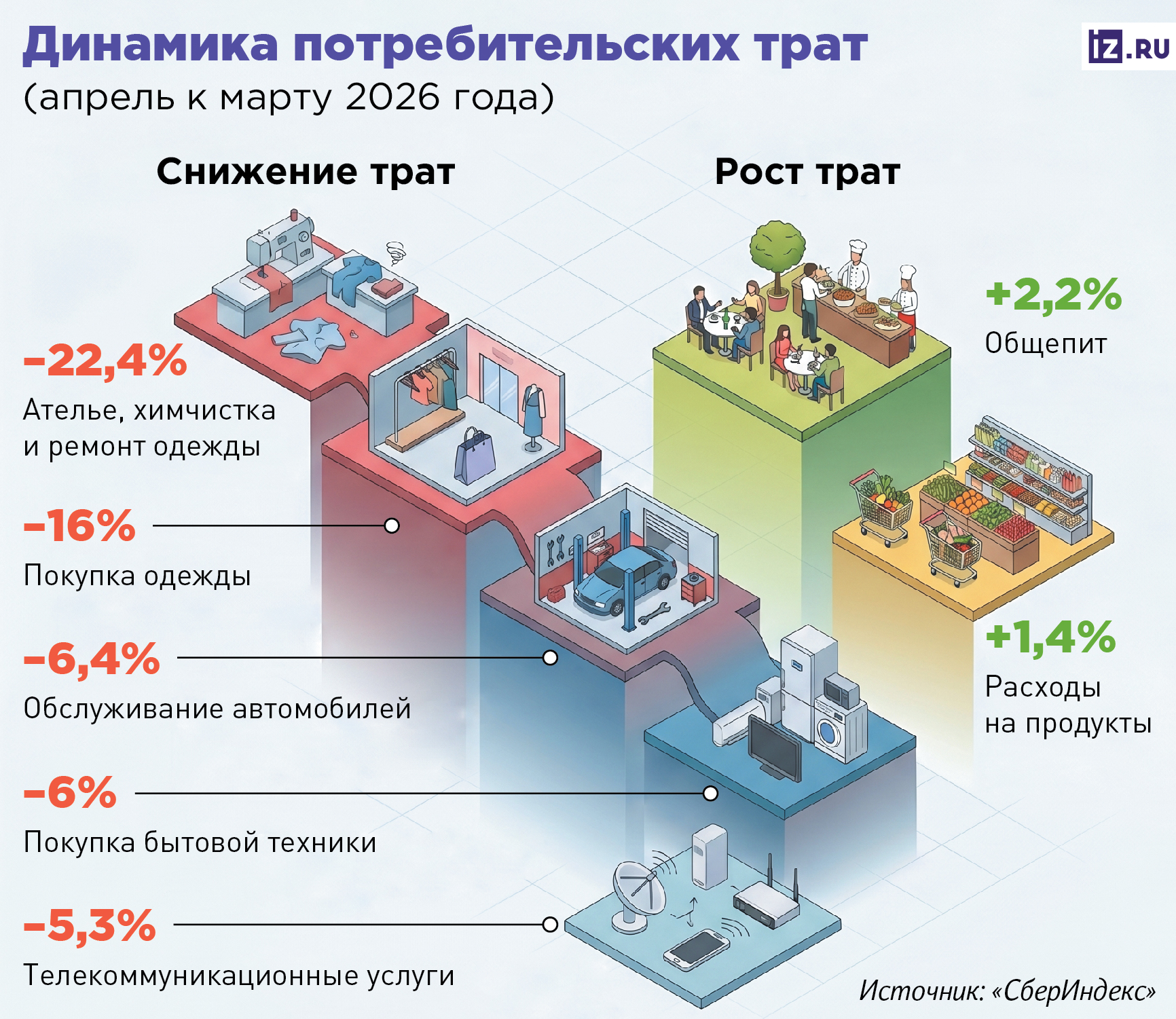
What caused the savings?
The research data suggests that Russians are reallocating the budget in favor of high-priority expenses that they are not ready to save on, experts explained.
— Indeed, food and groceries have become the main trend in consumer spending today. If we talk about non—food services and goods, then the population did not completely abandon them, but significantly minimized costs," Georgy Ostapkovich, scientific director of the HSE Center for Market Research, explained to Izvestia.
According to him, in conditions of economic instability and turbulence, Russians are switching from a consumption model to a savings model, compensating for this at the expense of non-food categories. This explains the absence of a sharp drop in total expenses. At the same time, it is premature to talk about the long-term nature of such a trend, he added.

This assessment is indirectly confirmed by the position of Russian Finance Minister Anton Siluanov, who earlier urged citizens to use savings more actively, rather than keeping funds "under the pillow." According to him, funds lying idle do not benefit either the owner or the country's economy. The minister added that now about half of Russians have a financial safety cushion, although back in 2017 there were just over a third of them.

According to Yaroslav Nilov, head of the State Duma Committee on Labor and Social Policy, there are several reasons for the change in consumer behavior among Russians. This includes a reduction in household incomes, an increase in anxiety, and an unstable economic situation. Many citizens do not have confidence in income stability, as well as in price restraint, the parliamentarian notes, so citizens actively resort to savings.

Pavel Shapkin, Chairman of the National Consumer Rights Protection Union, believes that the main reason for the drop in demand for non-food products and services is the decline in household incomes, which have recently begun to spend much more on utilities, fuel, taxes and other items of expenditure. According to him, it is necessary to stimulate an increase in demand by increasing the incomes of the population, primarily people who need these funds, for example, large families who will not save, but spend this money.
Переведено сервисом «Яндекс Переводчик»
