- Статьи
- Science and technology
- In the right steering wheel: "digital radio" will allow you to control the drone when the signal is suppressed by the enemy

In the right steering wheel: "digital radio" will allow you to control the drone when the signal is suppressed by the enemy

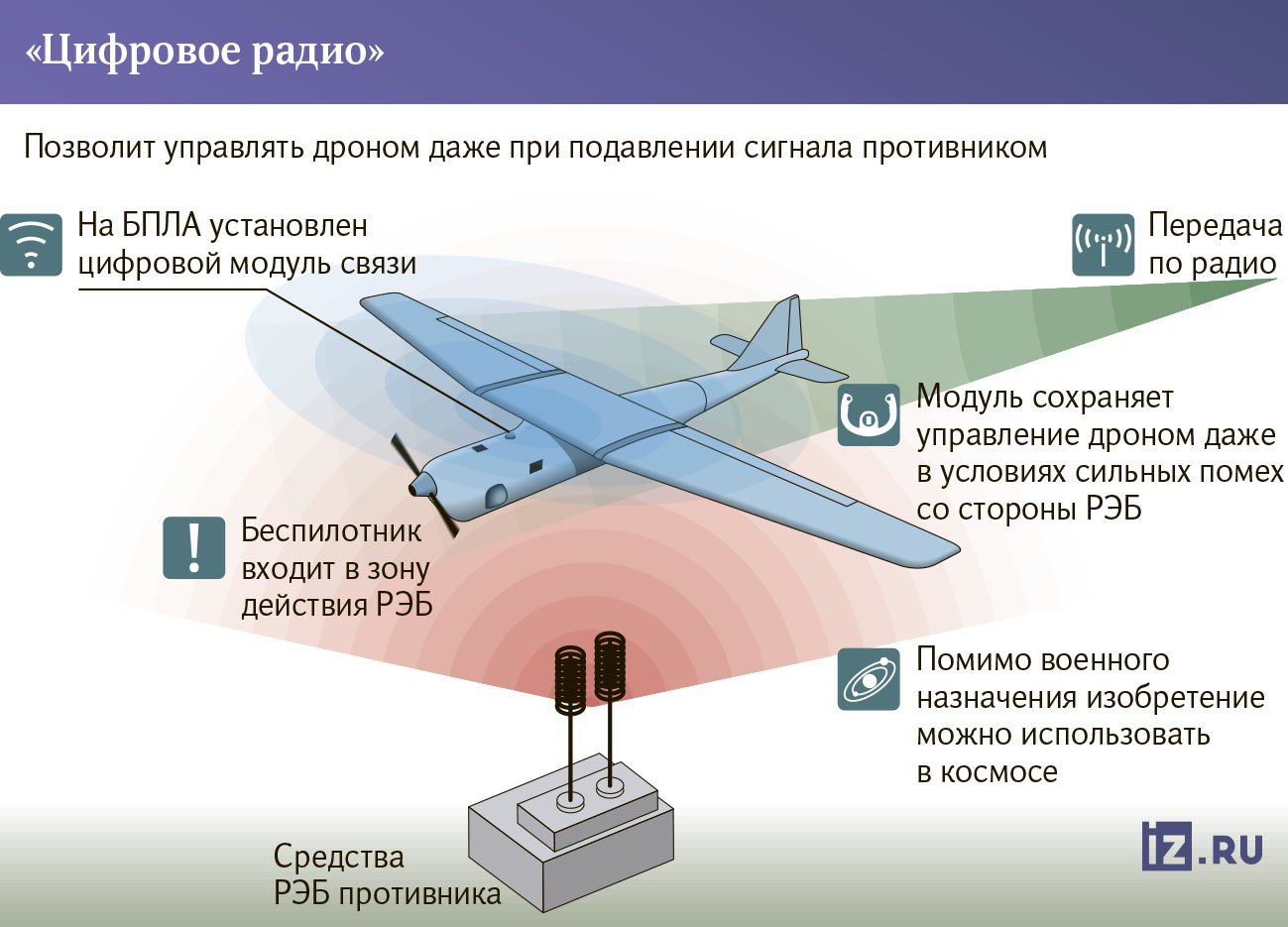
Russian developers have created the first domestic radio communication module for drones, which allows you to maintain drone control even in conditions of intense interference from enemy electronic warfare. In addition to military applications, the technology can also be used in civilian areas, including space projects. According to experts, it is impossible to imagine further development of UAV technologies without such solutions. However, they emphasize that the creation of the module is only the first stage: the next step should be its implementation in drone designs. The cost of production remains a separate limiting factor, which means that developers will have to find a balance between technological efficiency and economic feasibility.
Digital Radio
Russian engineers from the Aerospace Antenna Systems company have developed the Efiron complex for receiving, transmitting and processing radio signals by drones. The device makes it possible to effectively control unmanned UAVs, boats and ground robots even in conditions of electronic jamming, the press service of the National Technology Initiative (NTI) platform told Izvestia.
— Our team has assembled a prototype device, developed software and conducted laboratory tests of radio engineering and electrical characteristics. It is in the pre-production stage and is ready for pilot testing with customers. The system provides resistance to intentional interference at a level that allows communication to be maintained at a signal—to-noise ratio of up to -10 dB," said project representative German Yangalin.

The SDR complex is a software-defined radio in which key functions are implemented by software rather than hardware. This allows the device to be adapted to various communication standards without replacing hardware, providing flexibility and increased resistance to interference. In addition, the development is capable of filtering satellite navigation signals and providing jam-proof navigation in conditions of active electronic warfare, the specialist added.
The device is made in the form of two printed circuit boards combining more than 300 microelectronics components. It allows simultaneous transmission of video, telemetry, and commands. When used in spacecraft, the development makes it possible to change communication protocols after launch, adapt to interference, and integrate into inter-satellite networks.

According to the developers, Efiron has improved technical characteristics: the operating frequency range is from 150 MHz to 10 GHz, and the bandwidth is up to 60 MHz. The device transmits video and telemetry at speeds up to 30 Mbit/s (up to 50 Mbit/s in the future) at any frequency range and supports HD quality. The estimated cost is from 350 thousand rubles. The system supports various data transfer protocols.

— Sanctions stimulate the development of domestic SDR solutions. By 2030, the global market for such complexes will reach $30 billion, with the Russian segment accounting for about $3 billion. Such complexes can be used on modern drones, ground—based robotics, spacecraft, as well as to protect the Arctic and the Northern Sea Route, the NTI noted.
A new generation connection
The introduction of software-defined radio (SDR) technologies is one of the most promising areas in the development of communication and control systems today. This technology, used by both sides of the conflict in Ukraine, has ceased to be just a tool, becoming the foundation for a qualitative breakthrough in the effectiveness of the combat use of forces, Klim Dmitriev, a veteran of the electronic warfare forces of the Russian Armed Forces, told Izvestia.
— SDR systems open up possibilities that are not available for traditional hardware solutions. The main one is adaptability. In conditions of intense electronic warfare, software-defined radio allows you to dynamically change the frequency range, avoiding enemy suppression, and implement complex data transmission algorithms," he explained.

According to the expert, such characteristics are crucial for ensuring the stability of communications, including the creation of reliable control circuits — from military systems to satellite channels and ground-based robotic systems. The aspect of secrecy is also noted separately: the adaptation of data transmission protocols makes it possible to reduce the visibility of signals.
The capabilities of SDR technologies are also considered promising for use in early detection systems for enemy drones, which is already partially demonstrated by some enthusiastic developers.

SDR has divided the history of radio into before and after, according to Dmitry Kuzyakin, chief designer of the Center for Integrated Unmanned Solutions. Classical radio works on the principle of tuning to a specific frequency: there is a transmitter, there is a receiver, and they "agreed" to communicate on the same wavelength. SDR is changing the paradigm itself. Instead of tuning into a narrow channel, the system "scans" the entire widest frequency range and digitizes it, transferring the "raw" broadcast to a high-performance processor.
— The Russian development looks impressive, especially considering the creation of its own component base — few countries are able to make their own SDR radio completely on domestic microchips. However, the project is currently at the stage where the "tool" has been created, but an extensive software library has to be written for it. Without it, the potential of the device will only be partially revealed," the expert noted.

According to the expert, the main task is to build a strong professional community and development environment around this piece of hardware in order to turn a promising piece of hardware into a full—fledged working tool for communications and radio intelligence needs.
Pavel Kamnev, market expert at NTI Aeronet, noted that such technologies are in demand and are used in unmanned aircraft, other unmanned vehicles, and data transmission systems. In the future, without such systems, it will no longer be possible to control unmanned aircraft systems, land and water complexes. So far, the technology increases the cost of the drone at least twice. But the more manufacturers there are of such systems, the better it will be for the industry as a whole, so we can hope to reduce the cost of such solutions.
Переведено сервисом «Яндекс Переводчик»
