Waiting room for the beautiful: the art festival takes place in the depot at the Leningrad railway station
- Статьи
- Culture
- Waiting room for the beautiful: the art festival takes place in the depot at the Leningrad railway station


A mysterious sound art object in the center of a former railway depot, a photo exhibition about youth, concerts of experimental electronics and trains passing nearby. These are the main components of the Ton-Fest Contemporary art Festival, which will be held until April 30th inclusive. It is being held for the first time, but it has already attracted a lot of attention: first of all, because of the space itself, which was recently opened to the public. It is a former circular depot for locomotives, an architectural monument of the mid-19th century. Izvestia appreciated his transformation and the proposed journey.
Depot for art
The Tone center opened at the end of last year, and immediately aroused the interest of the public, who are not indifferent to art and architecture. The building in the form of a huge hollow dome is located near the Leningrad railway station, right next to the railway tracks. It was built in the century before last by Konstantin Ton, Nicholas I's favorite architect. Ton designed, for example, the Cathedral of Christ the Savior and the Grand Kremlin Palace; he was also the chief architect of the Nikolayev railway, which connected the two capitals.
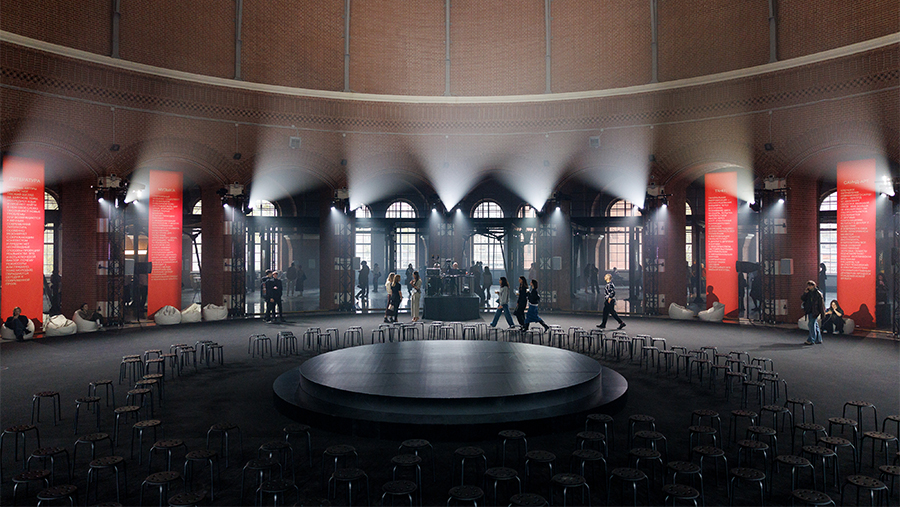
But unlike Leningradsky and Moskovsky railway stations, ordinary visitors were allowed into the circular depot only six months ago, when the building opened after restoration and reorientation as an art center, which in the future should become the cultural dominant of the entire district.
In December, the Tone Center was used for the Overtone graphics fair, but then it was hardly possible to fully appreciate the artistic prospects of this building. And now the team of the new institution has presented its first proprietary project, Ton—Fest, designed specifically to take into account the architecture and location of the depot.
Tone and music
Firstly, the round, high space is ideal for music and sound art, especially where sound surrounds the viewer from all sides. Therefore, the creators of the festival have placed special emphasis on electronic audio genres. And secondly, trains passing just a few meters from the building become an attraction in themselves and are played out in works of art, so the non-stop installation ROTOR, a rotating rod whose circling speed is directly related to the soundtrack, refers, of course, to the theme of constant movement, which the viewer can observe through panoramic windows. windows.
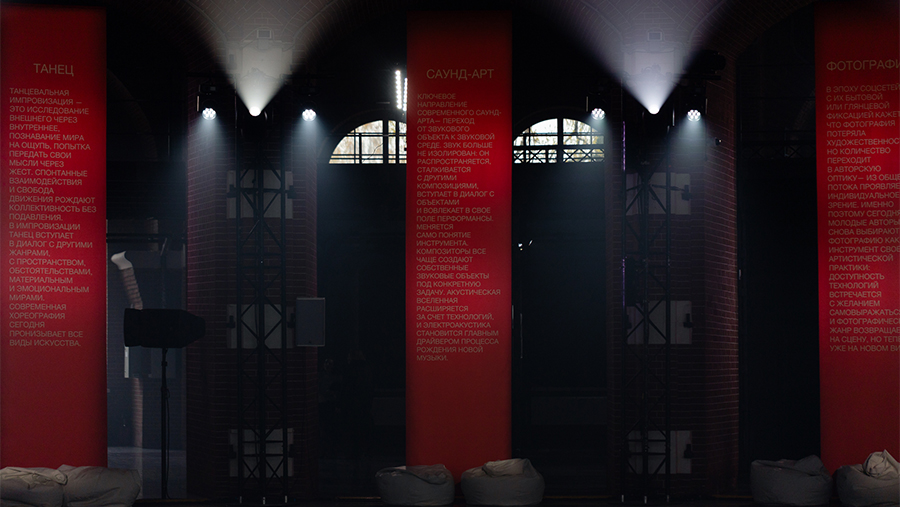
In addition, characteristic station call signs, the sound of wheels and other elements of the railway world periodically appear in the electro-noise score. You might even think that all this is coming from outside, where peregrine falcons, swallows, and other formations are scurrying back and forth literally every minute. But, of course, no: there is complete order with sound insulation. And an attentive listener can't help but notice that there are many sound sources: it bounces between speakers placed in a circle along the walls, forming a three-dimensional audio environment.
The ROTOR is located in the very center of the room, on a circular stage, and every day a kind of cross-media action unfolds around it. At the opening event, the audience saw a performative reading, dance and musical improvisation and a DJ set. And on one of the following evenings, dancers performed on the platform, moving deliberately slowly, as if in slow motion, while the audience was asked to capture their poses on paper: pencils and other drawing supplies were given out right on the spot. It turned out to be a cross between a choreographic act and a class of sitters.
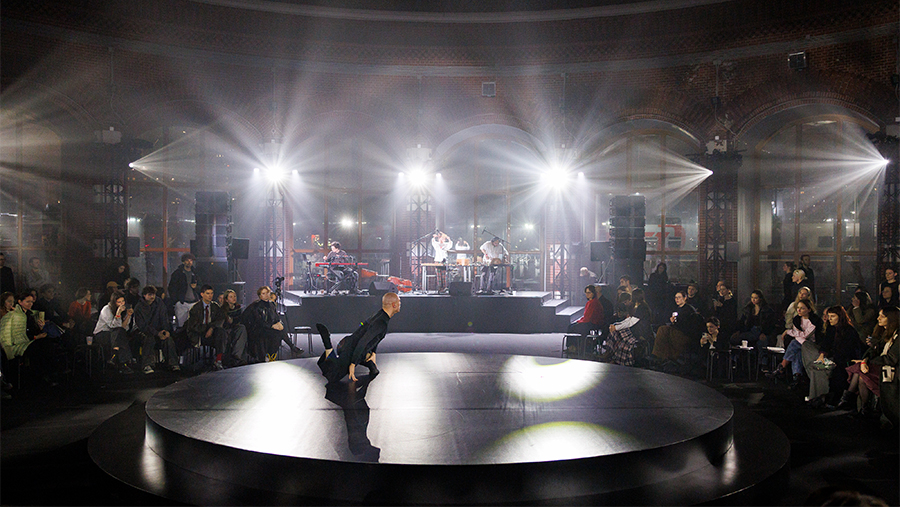
There is a second stage in the Tone center, made in a semicircle along the wall. Concert events take place there: first of all, it is a three-day marathon of artists from the Center for Electroacoustic Music of the Moscow Conservatory (CEAM). Behind them are programs of works for quartet and vocals with electronics. Ahead (April 29) is an improvisational set featuring the latest synthesizers and original sound objects. CEAM specialists mix their sound in real time.
Photo notes from the trip
The Ton-fest events follow each other. There is only one permanent element of the entire program: this is a photo exhibition of 17 young authors offering an original, sometimes ironic, sometimes deeply lyrical view of the world. Of course, the theme of trains also arises in the works — where would it be without them? Sasha Breus, in the frames of the series "Passing through Moscow", captured the outside of the window of a reserved car in such a way that some special beauty and harmony became apparent in completely everyday views. Well, Ilya Nikitin, in the Halfway to spring cycle (Rus. "Halfway to Spring"), entered into a dialogue with Kaspar David Friedrich, only instead of a sea of fog at the feet of the wanderer (more precisely, here — the wanderer), there is a view of a passing train, which our heroine looks at melancholically from a cliff.
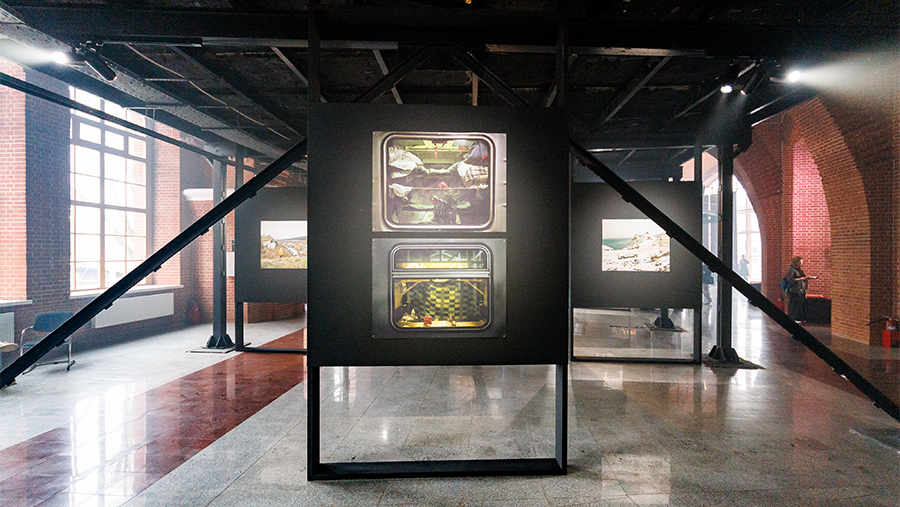
Despite the presence of cross-cutting motifs, the exposition as a whole hardly fits into a single concept. Curator Yulia Tikhomirova compares the pictures with the frames of an imaginary film, but you can put anything in such a wide and conventional frame. But there is a charm in such unfocused selection: everything together is perceived as spontaneous photographs of a young traveler. And it doesn't even matter so much whether he wanders around the country, the city, or according to his imagination.
By celebrating movement in all its forms (be it theater, photography, choreography, or music), Ton-Fest simultaneously convinces visitors that all boundaries are conditional. Art forms merge into each other, the real noises of the railway transform into an artistic fantasy, and the trains running outside the window, on the contrary, seem like mirages, art objects, and guests from another world, as in Jarmusch's film "The Mysterious Train." And this dynamism is a metaphor for the variability of our unstable world. And whether a new creative initiative will be the beginning of a long journey, time will tell.
Переведено сервисом «Яндекс Переводчик»
