Train Event: how the entertainment industry stimulates the tourist flow


Kazan, Nizhny Novgorod, Samara and seven other cities were among the top ten where cultural events have become the most significant driver of domestic tourism. This rating was compiled by analysts, comparing the number of events, leisure expenses, the state of infrastructure, the level of tourist flow and a number of other parameters in the 26 largest cities of Russia. How festivals attract travelers is described in the Izvestia article.
Which cities became the leaders of the rating
The entertainment industry has had the most significant impact on the development of tourist traffic in Kazan, Nizhny Novgorod, Samara, Vladivostok, Sochi, Kaliningrad, Sevastopol, Novosibirsk, Yekaterinburg and Voronezh. This is the top 10 compiled by analysts of ON Media Holding and Onside agency. The study examined the parameters of Russia's 26 largest cities in terms of the number of events, population size and income, leisure spending, standard of living, tourism development, and infrastructure.
Analysts named Kazan, Nizhny Novgorod, Samara and Vladivostok as the centers of event tourism. They have their own urban brands, and the audience actively travels there for large-scale events.
"During peak periods, the entertainment market in these cities becomes super profitable due to the tourist flow, comparable to the population," the researchers noted. "In 2025, almost 4 million people visited these four cities in total, and the projected volume of the offline entertainment market for this year is 10.8 billion rubles."
The resort towns of Sochi, Kaliningrad and Sevastopol host many festivals during the season, and in 2025 the tourist flow there reached 2.19 million people out of a population of 1.49 million. The projected volume of the offline entertainment market for 2026 is 4.6 billion rubles.
Novosibirsk, Yekaterinburg and Voronezh attract tourists for short trips. Analysts note their high transport accessibility, as well as the formed tour routes of the artists, which increases the influx of guests. The tourist flow in this group of cities almost reaches the size of the population and in 2025 amounted to 3.58 million people. The projected total volume of the offline entertainment market for 2026 is estimated at 11.3 billion rubles.
"In many ways, the tourist flow depends on the image of the city and leisure formats. For example, Kazan is a leader in event tourism and cultural events of an ethnically regional nature, while Sevastopol is a city with pronounced military—patriotic and historical specifics," the analysts noted.
Russian cities are increasingly competing for audiences through festivals and new formats that shape urban identity, said Sofya Mitrofanova, CEO of ON Media Holding.
"Guests come from other regions specifically for the event, and some extend their visit, creating a steady demand for local museums, restaurants, and excursions," she explained.
The analysis of the last two or three years shows a clear trend: people are increasingly choosing a trip not just to see the city, but for a specific event, confirmed Evgeny Osmolovsky, an expert in the field of event marketing, creative director of VNV agency.
— A festival, an outdoor concert, a gastronomic market or even a dinner from a famous chef become a reason to buy tickets and book a hotel, - he said. — According to tour aggregators and event booking systems, the demand for such trips in 2024-2025 increased by about 25-30% compared to the previous period. The share of event tours already accounts for about 15-18% of the total domestic tourist flow in some regions.
He recalled that Kazan has many street festivals, open-air concerts, and events related to modern culture, Nizhny Novgorod hosts gastrofests and street theater performances, and Kaliningrad is known for music and film festivals by the sea. And Yekaterinburg is synonymous with industrial tourism, street art and nightlife events.
Maria Kiselyova, Managing Partner of Trends Travel Consulting, expert of the Russian Union of Travel Industry, noted that the event program is an absolute leader among the most promising types of tourism today.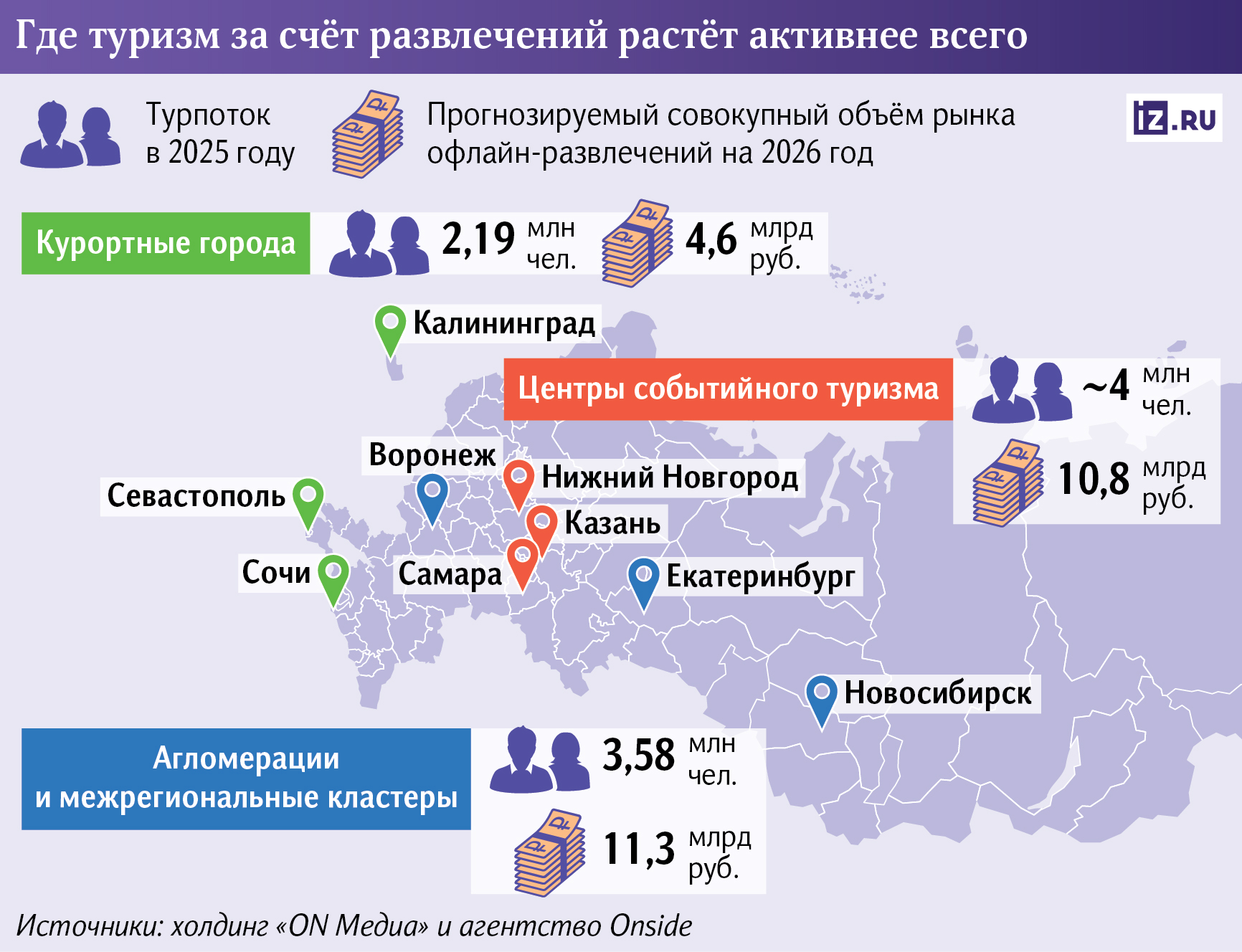
"69% of the regions plan to develop it in 2026," she said.
How events stimulate travelers
Russia is a leader in the segment of short trips as a destination: 90% of one- to four-night tours departing on Friday or Saturday are in Russian cities, the company noted. Level.Travel . They reported that Sochi accounts for up to 45% of such trips.
"Sochi is also chosen by many Russian stars, including this city in their concert program. This year Basta, Dima Bilan, Guf, Lolita, Factor 2, Vyacheslav Butusov, and Kipelov will perform there. So going to a concert is easy to combine with a tour at sea," the company noted.
According to the Tutu travel service, Kazan has recorded a steady increase in passengers on all types of transport (+13%) and Vladivostok (+11%). In Samara and Nizhny Novgorod, the growth is more moderate — +3% and +2%, respectively.
"At the same time, the dynamics of hotel bookings is even more pronounced: especially in Vladivostok and Kazan, where the number of bookings has approximately doubled," the service noted.
Over the past two years, the share of bookings on YouTravel.me The share of users linked to specific cultural or musical events has almost doubled — it has grown from 18% to 34%, Valery Britaus, the commercial director of the platform, told Izvestia.
"Music festivals and concerts remain the main motivators for travel — they account for 43% of event demand," he said. — This is followed by city holidays and local festivals with a share of about 40%, while sports and business events take about 19% each.
Valery Britaus noted that the Northern Capital ranks first in terms of the number of exhibitions and concerts. According to the festivals, the top five cities look like this: St. Petersburg, Novosibirsk, Moscow, Kazan, Nizhny Novgorod and Yekaterinburg.
— Krasnodar, Krasnoyarsk, Samara and Perm are also among the top ten destinations with the most diverse entertainment offerings. Omsk is also worth noting, which predicts a 30% increase in tourist traffic as the cultural capital of this year," he said.
How do events affect hotel occupancy?
Event tourism is one of the main engines of the flow of travel in Russia: on average, more than 50% of trips are connected with it, the press service of the Azimut Hotels chain confirmed.
In summer, cultural events form the agenda more often, and in autumn the number of business tourists increases significantly, since it is during this period that most major mice events take place, the company noted. On the days of major business forums or city festivals, the occupancy rate of 3-5-star hotels tends to 95-100%, and the booking depth can reach six months.
"We regularly observe this pattern in St. Petersburg during the SPIEF and Scarlet Sails, in Vladivostok during the Eastern Economic Forum, in Tyumen during the Industrial and Energy Forum, and in Murmansk during the Arctic Forum," the hotel chain said. — Recently, the trend has been set by mass sports events. During major triathlon starts and races, the load tends to be 100%."
For most regions, event tourism has already become part of the itinerary and vacation scenario, Cosmos Hotel Group confirmed.
— We see a steady increase in workload during major cultural, business and sports events not only in Moscow and St. Petersburg, but also in Sochi, Kazan, Murmansk, Vladivostok, Novosibirsk, Yekaterinburg, Voronezh and other cities of our presence. On such dates, the load of the chain's hotels, depending on the format and scale of the event, reaches 80-100%," said Alexander Biba, president of the chain.
What to see in the regions
The national tour operator Alean (part of the Russian Union of Travel Industry) singled out the Scarlet Sails, the Navy Parade, Fontanka SUP, and sports marathons (the White Nights race, etc.) in St. Petersburg among the events that attract tourists annually. In addition, they drew attention to the Sky of Russia aeronautics Festival in the Ryazan region, the Pereslavl-Zalessky aeronautics Festival, the Maralnik Blossom Festival in Altai, and the Gorky Fest in Nizhny Novgorod.
In addition, the demand for hotel accommodation on dates of gastronomic festivals is higher than on regular days of the month.
"Depending on the destination, the number of bookings in the city during gastro events increases by 20-30%," Alean said. — Among the annual events that attract tourists, one can single out "Tastes of Russia" in Moscow, "Cucumber Day" in Suzdal, "Feast on the Volga" in Yaroslavl, the Black Sea Wine Week in the resorts of the Krasnodar Territory, "Fishtival" in Zelenogradsk, the festivals "Gastronomic Christmas" in Nizhny Novgorod, "Siberia for taste"in Tyumen."
Over the past ten years, regions, especially those deprived of tourist attractiveness in terms of significant historical sites, have increased interest in their regions thanks to festivals, event tourism, and interactive programs, the press service of the Multitour tour operator (part of the PCT) stated.
Maria Kiselyova recalled the INTERVALS 2026 Media Art Festival in Nizhny Novgorod, which attracted 530,000 visitors, an increase of 80,000. compared to 2025, as well as about the Sunset Capital Festival (last year it was attended by 490 thousand people). viewers).
— And in Yekaterinburg, Ural Music Night was recognized as the "National Event" of the year, and the Sverdlovsk region itself is one of the five strongest regions in the field of event tourism, — said the expert. — The Novosibirsk festival "There is in Siberia!" gathered over 300 thousand visitors. Sochi has become the main jazz center of the country during the Sochi Jazz Festival.
How regions are developing event tourism
A well-planned calendar of events is often a crucial factor in organizing a trip, says Alexey Cheptsov, a PCT expert and director of the Kirov Region Tourism Development Center.
— Our experience confirms: An event program can turn an ordinary day off into an exciting journey. Guests of the Kirov region are particularly fond of authentic festivals that allow them to immerse themselves in the cultural code of the region," he said.
Among them, he named the festival "Istobensky Cucumber" — with a cucumber crunching championship, "Craft" — an iron festival where blacksmiths from different parts of the country create metal art objects, "Orlovskaya Ladya" - a festival with jousting and chess tournaments, a ball on a huge chessboard.
Inna Khvatkova, PCT expert, General Director of the Chelyabinsk Region Project Development Center, said that the region recorded a twofold increase in tourist traffic at the Camel Dishes gastronomic festival in 2025.
"On average, we see an annual increase in the tourist flow to event events by 10-20%," she said.
The expert added that the final of the Russian Biathlon Cup in Zlatoust annually attracts about 20 thousand spectators, the final of the Russian Freestyle Cup in Miass attracts about 2 thousand guests. Ski resorts in the region host more than 20 events per year, both in winter and summer.
The PCT experts in Kalmykia recalled that large—scale events are held throughout the republic, from a festival to an International Buddhist forum, which attract thousands of tourists. And event tourism in the republic has become a key tool for increasing the tourist attractiveness of the region, contributing to the growth of the flow of guests and the development of infrastructure.
"The tulip festival in Kalmykia annually demonstrates the positive dynamics of the tourist flow," they noted. — About 40 thousand tourists visited it in 2024, about 70 thousand in 2025, and significant growth is also expected in 2026.
The Ministry of Economic Development, in response to a request from Izvestia about the impact of events on the growth of tourist traffic, recalled that as part of a single subsidy in 2025, the regions received 8.5 billion rubles for the development of local points of attraction. And a little more is planned for this and next year.
Переведено сервисом «Яндекс Переводчик»
