- Статьи
- Culture
- The uniform during the plague: SMERSH 4 revealed the secret of the bacteriological threat

The uniform during the plague: SMERSH 4 revealed the secret of the bacteriological threat

When it seemed that the war was coming to an end, the Nazis were preparing not just a diversion — they were preparing an epidemic. In the latest novels of one of the most popular REN TV series "SMERSH", a little-known side of history comes to life.: an attempt to use bacteriological weapons against the USSR. Izvestia wrote about the Japanese "Detachment 731" not only during the Great Patriotic War, but also after the Khabarovsk trial of death doctors in 1949. And the head of the group, General Shiro Ishii, was exposed by the cartoonist Boris Yefimov on the pages of the newspaper. Now this and other stories are being told with frightening accuracy by SMERSH 4. Details can be found in the Izvestia article.
The Bestial Face of Science
The creators of the series will present two novels — "Moscow-44" and "Operation Cerberus". The first was based on the story of preventing the bombing of strategically important facilities in the capital, prepared by Fascist agents who were thrown into the Soviet rear. The second one tells about the threat of biological weapons created by Japanese scientists, which the Nazis intend to use during the Lublin-Brest operation to liberate Western Belarus and Eastern Poland.
— We take documentary facts as a basis and build a story around them with our main characters, Lavrov and Semenov. The activities of the 731 Squad are one of the darkest and scariest pages of the war, so the characters are drawn into the plot related to it," Mikhail Kabanov, the film's director, told Izvestia.
Indeed, in 1932, by order of Emperor Hirohito, a special unit was created in Japan to develop biological weapons. Until 1942, it was led by Lieutenant General Shiro Ishii, then by Masaji Kitano. The staff of the 731 Detachment conducted brutal experiments on humans, seeking to create and spread deadly plague, anthrax, typhus, cholera and gas gangrene bacteria in China and the Soviet Union.
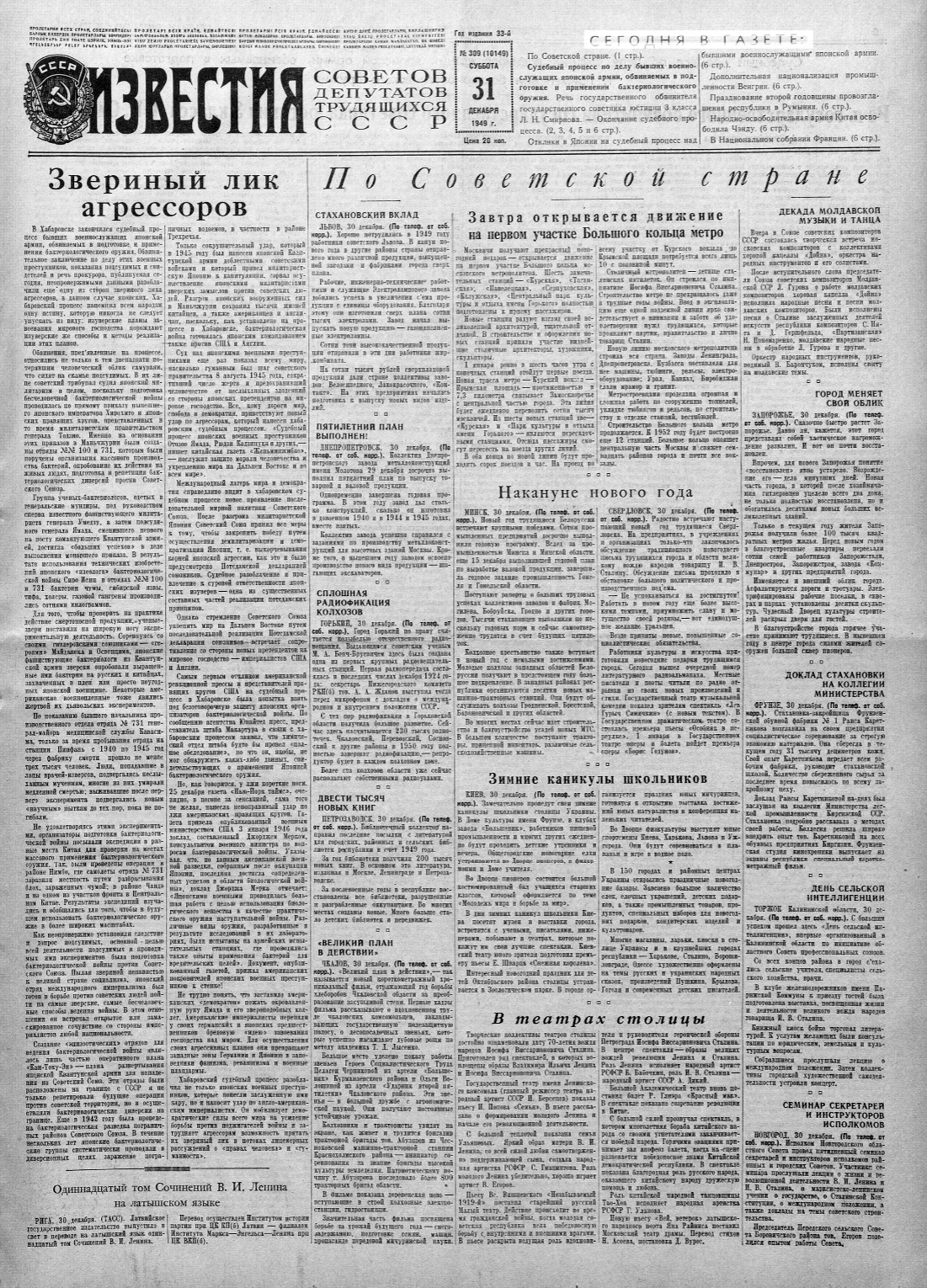
In December 1949, the trial of the Japanese military ended in Khabarovsk. On that day, an expository article was published on the front page of Izvestia under the headline "The bestial Face of the aggressors."
"People who fell into the clutches of monster doctors were subjected to unheard-of torments: many died a slow death, and the survivors of the first experiments became victims of 'scientific' torture over and over again, until they died," the newspaper reported.

Japanese torturers studied the limits of endurance of the human body. People were placed in pressure chambers, their agony was recorded on film, and limbs were artificially frostbitten, observing the development of gangrene. If the infected test subject somehow survived, he was subjected to new tests, which inevitably ended in death. There were no survivors.
— Surprisingly, many members of the 731 Squad lived to a ripe old age, despite the atrocities they committed. They called their victims logs. The most striking thing is the complete lack of empathy. A mother and child could be gassed in a glass chamber, watching them slowly die," Mikhail Kabanov noted.
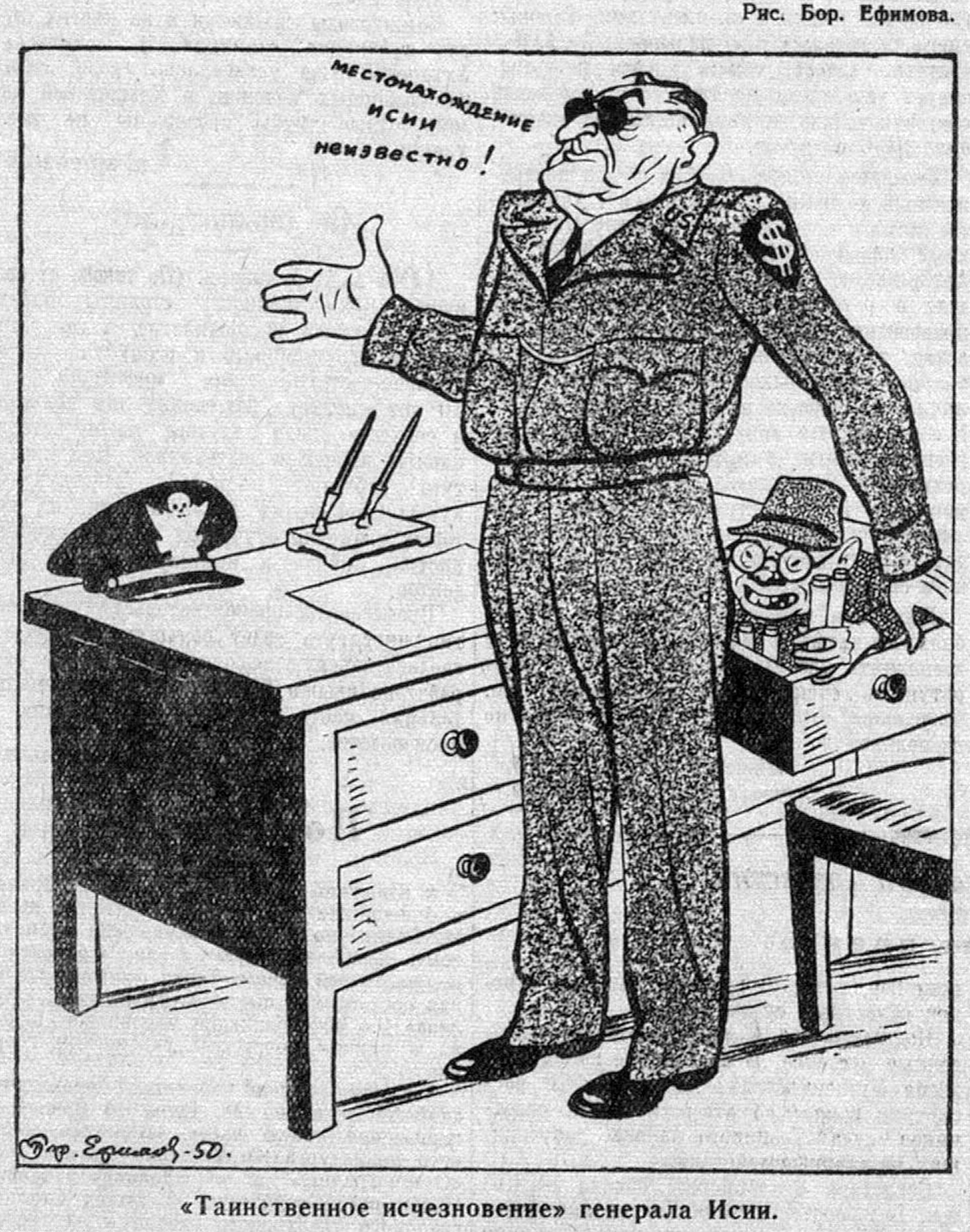
Already on January 1, Izvestia reported on the verdict: the guilt of all 12 defendants was proven, they received prison terms. And on January 6, the newspaper reported that the Japanese and American authorities were harboring war criminal Shiro Ishii, adding a scathing illustration by the famous Izvestia cartoonist Boris Yefimov. In his trademark manner, he portrayed a former Japanese general with test tubes in his hands, who is hidden in a desk drawer by an American military man with a dollar patch on his shoulder. The cartoon was called "The Mysterious Disappearance of General Ishii" — and there was more truth in it than I would like to admit.
Surprisingly, the key figures of the 731 Squad, including Shiro Ishii and Masaji Kitano, escaped punishment: after the war, they found themselves under the protection of the United States, handing over the results of their research to the American side. Moreover, many of the squad members later became successful doctors in civilian life. Some even founded their own clinics and maternity hospitals.
Porcelain bombs and running in stilettos
The sequel "SMERSH" shows scenes of the Japanese using biological weapons, including the dropping of porcelain bombs filled with plague on Chinese villages. These episodes are based on real facts. However, as the director of the film said, the plot in which the laboratory finds itself on the path of the advancing Red Army in Europe is fiction.
For greater authenticity, actor Junsuke Kinoshita, who has been living and working in Russia for a long time and has been starring in films about the Great Patriotic War, was invited to play the role of a Japanese doctor.

— I especially remember shooting with Valery Storozhik, who played the role of a Soviet professor of virology, Chizhov. My hero is torturing his character to extract information. But even when he is being tortured, he does not give out a word about research and retains incredible dignity. It completely corresponds to the character of the character, and I was sincerely delighted with this work," Kinoshita told Izvestia.
If the image of the Japanese doctor is extremely clear, then the heroine of Lyanka Gryu — Marika Werner — remains a mystery. In the novella "Moscow-44", the actress played a German journalist, whose dual nature becomes one of the engines of the plot.
— I'm practically Mata Hari! It was important for me to keep the inner truth and a constant sense of danger in every scene," the actress said in an interview with Izvestia.

During the filming, the girl fired firearms, ran on spiral stairs in heels, climbed exhaust pipes in clothes completely unsuited for this — in tight skirts and light blouses.
Gru's partner in the film was Igor Petrenko, for whom this season of "SMERSH" is not the first. The actor again played the role of the restrained and determined captain of counterintelligence Konstantin Lavrov. According to him, the main advantage of the project is its careful attitude to the fate of the characters and the way in which fiction is organically woven into the fabric of history.
— We were filming an episode about Operation Big Waltz, which took place in 1944. Then columns of 57,000 German soldiers and officers, captured by the troops of the 1st, 2nd and 3rd Belorussian fronts, marched along the Garden Ring and other Moscow streets. According to the authors, the main characters find themselves in the center of events on these days: they must prevent a sabotage group that is trying to disrupt the operation," the actor said.

Why did the series become a personal story for the actors?
For some participants of the SMERSH project, it has become a truly personal story. So, one of the scenes of the novella "Moscow-44" was based on a real episode from the family biography of Vladislav Kotlyarsky, who played Captain Pavel Semenov.

In 1944, his mother was seven years old, her sisters were five and three. Their father, a military pilot, has gone missing. There is an episode in the series where two girls come to a Moscow bakery for bread, and the saleswoman asks, "How's Mom? Is there any news from the father?"
— Both girls were played by my daughters. The eldest, Elina, is my mother Elena, and the middle one, Nicole, is her sister. I have three daughters too. They also wanted to use the youngest, Ariana, but at the time of filming she still couldn't even walk, so she wasn't in the frame. This is such a warm, truthful and touching moment in our film," Kotlyarsky told Izvestia.
The actor admits that the strength of the project is not only in dynamics and entertainment, but also in the human dimension.
— We show inner light, we give hope. It is always important and valuable. The project turned out to have a lot of fans, even among the actors I play with, which pleasantly surprised me, and they are looking forward to the release of new episodes," he said.

The series was created by REN TV, Star Media, Zvezda and Wink. SMERSH 4 became one of the last projects of Alexey Pimanov, who died suddenly on April 23. Both novels will be broadcast on REN TV in full on May 3 — as a reminder of the price of Victory and that the fate, pain and courage of people are always behind the dry lines of history.
Переведено сервисом «Яндекс Переводчик»
