
Warhead: Finland considers production of mines on its territory

Finland is considering the possibility of setting up production of anti-personnel mines, the Russian Embassy in the country told Izvestia. After withdrawing from the Ottawa Convention, Helsinki has already begun training the military in handling this type of weapon. At the same time, the Finnish side is building barriers on the border with Russia — the bulk of the work is planned to be completed by early autumn. At the same time, according to diplomats, there are no signs of Finland's readiness to resume constructive dialogue with Moscow: Russia continues to be viewed there as a long-term and "existential" threat. Experts believe that a return to the previous relationship model should not be expected in the next decade.
Finland is preparing to produce mines
After withdrawing from the Ottawa Convention, Finland began to return anti-personnel mines to its defense system. The country plans to receive the first new warheads and training equipment in 2027. However, starting this year, Helsinki begins training the military to handle this type of weapon, the Russian Embassy in Finland told Izvestia.

— The issue of the possibility of establishing the production of mines in Finland is being considered. At the same time, the official Helsinki emphasizes that under normal conditions in peacetime, the installation of mines will not be carried out. According to the statements of the Ministry of Defense, all warheads, with the exception of those used for training purposes, will be stored in warehouses, the diplomats said.
Izvestia sent a request to the Finnish Ministry of Defense with a request to clarify plans for the production of antipersonnel mines and their use on the border with the Russian Federation.

Formally, the treaty prohibiting the use of anti-personnel mines for Helsinki ended on January 10, 2026. Finland explained the withdrawal from the Ottawa Convention by a change in the security situation. According to the country's Defense Minister Antti Hyakkanen, infantry is still a crucial factor, and technological breakthroughs and new weapons systems do not allow for the complete abandonment of conventional weapons.
The return to mines is also explained by the specifics of the Russian-Finnish border. Its length is about 1.3 thousand km, with a significant part passing through sparsely populated, wooded and lake-swampy areas. It is difficult to control such a boundary only due to the constant presence of people: many sections are remote from large settlements and roads.

Finland is not the only country that has decided to get out of the previous restrictions on antipersonnel mines. Poland, Lithuania, Latvia and Estonia have also recently left the Agreement. They also attributed this to a change in the military situation and the need to strengthen defense against the background of the conflict in Ukraine.
In Moscow, Finland's withdrawal from the Ottawa Convention was called a hostile step. Russian Foreign Ministry spokeswoman Maria Zakharova said Russia reserves the right to respond to such actions with "adequate measures," including if necessary of a military-technical nature.
At the same time, Russia was not a party to the Ottawa Convention. Gennady Gatilov, Permanent Representative of the Russian Federation to the UN Office and other international organizations in Geneva, earlier noted that the document has shortcomings that allow it to circumvent its prohibitive provisions. According to him, Moscow remains a responsible participant in a more effective instrument, the Convention on Inhumane Weapons and its relevant protocols.
The Russian Foreign Ministry also linked Helsinki's decision to the general policy of the countries of the eastern flank of NATO towards militarization at the Russian borders. After Finland joined the alliance in 2023, Helsinki has consistently strengthened its eastern direction: land checkpoints with Russia remain closed, and a fence with a technical surveillance system is being built along the border.

— According to the latest reports from the Finnish border guards, the construction of barriers on the border with Russia is proceeding in accordance with the approved plan. It is expected that the bulk of the work will be completed by early autumn. Now, according to local media reports, the project has already been completed by more than half," the Russian embassy said.
The fence should extend for about 200 km. To date, about 174 km has been built. The Finnish border service explains the construction by saying that the barrier should give the border guards more time to react.

In the fall of 2023, the migration crisis escalated on the Russian-Finnish border when asylum seekers from third countries began arriving at the checkpoint. Helsinki accused Moscow of "instrumentalizing" migration and gradually closed all automobile checkpoints on the eastern border. The Russian Federation denied these accusations. Since then, the border has remained closed, and the Finnish authorities use this episode as one of the arguments in favor of strengthening control in the Russian direction.
The creation of a system of engineering barriers on the Russian-Finnish border is a complex task that requires taking into account both the complex landscape and resource capabilities, said Reserve Colonel Alexei Ivanov, a veteran of the engineering forces. In his opinion, the effectiveness of such a defense directly depends on the density of cover and the participation of NATO allies.

— The length of the border is characterized by extremely difficult terrain: wooded areas, rocks, an abundance of lakes and ravines make the movement of military equipment off the roads almost impossible. Based on this, if a decision is made, the engineering troops will focus not on "continuous" mining, but on blocking existing transport arteries — roads, bridges and tunnels," he said.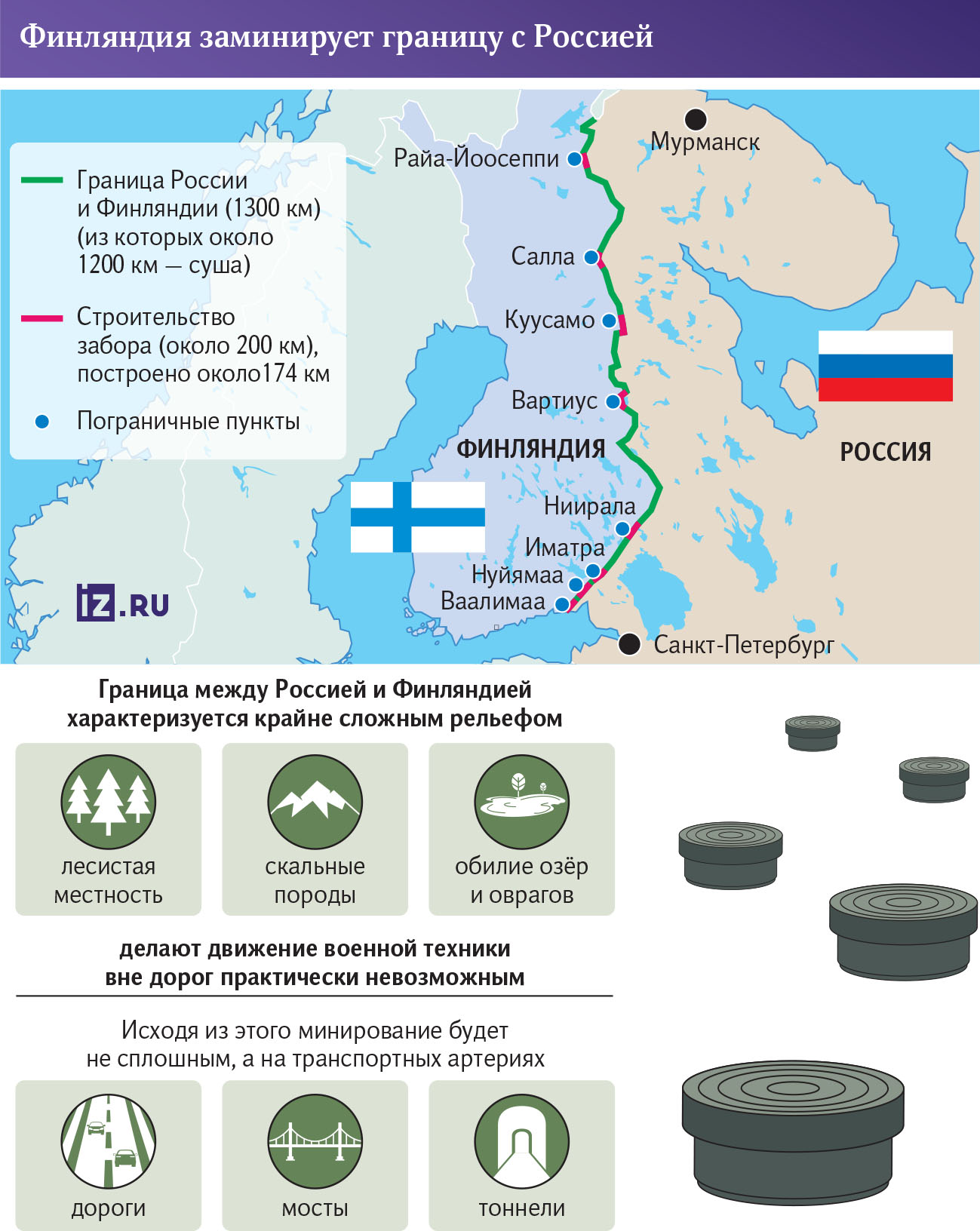
According to an officer of the engineering troops with the call sign Tyumen, minefields have lost their relevance in modern conflicts. The dominance of artillery, UAVs, and small-group tactics make traditional barriers ineffective. Today, their use looks more like a tribute to outdated military doctrines than as a real deterrent.
Finland's policy towards Russia
In the current situation, there are no signs of Helsinki's readiness to restore constructive dialogue with Moscow, the Russian embassy told Izvestia.
"On the contrary, the current Finnish authorities make it clear in every possible way that they do not intend to abandon the current confrontational line and continue to consider our country exclusively as a long—term and 'existential' threat," they stressed.

Helsinki, Finland
The degradation of Russian-Finnish relations is systemic and long-term, said Yaroslav Klimov, an assistant at the Department of Humanities at the Financial University under the Government of the Russian Federation.
"Joining the North Atlantic Alliance, militarization of the border and the construction of barriers create an irreversible configuration that precludes a return to the model of "good neighborliness" on the horizon of the next decade," he said.

Although until 2022, the trade turnover between the two countries amounted to €11-13 billion per year, and Finnish investments in Russia were estimated at €12-14 billion. According to Russian Ambassador to the country Pavel Kuznetsov, the closure of the border and the termination of previous economic ties have particularly affected the eastern and northern regions of Finland. In particular, South Karelia alone, as the diplomat pointed out, loses about €1 million a day due to the absence of Russian tourists. In April, Kuznetsov compared the current socio-economic situation in Finland with the crisis of the 1990s, when the country experienced a deep recession after the collapse of "eastern trade" with the USSR.
Meanwhile, Helsinki does not rule out that the dialogue with Moscow will have to be restored in the future.

— At some point, the dialogue will definitely be restored in some format. I've learned from my own experience that not all negotiations and channels of influence are worth talking about publicly," Finnish President Stubb said in November 2025.
However, he later admitted that Finland's relations with Russia had "changed forever": in the long run, Helsinki would need to find a way to live next to its neighbor, but "there is no turning back." In many ways, the position of the Finns remains dependent on the Ukrainian crisis: The restoration of contacts with Moscow in Helsinki, as in many other European capitals, is associated precisely with the future settlement.
The Kremlin, for its part, declared openness to restoring relations with Finland. However, Moscow believes that it was the Helsinki authorities who reduced bilateral ties "almost to zero" after the country joined NATO.
Переведено сервисом «Яндекс Переводчик»
