Swan on the shoulder: acrobatic version of the famous ballet presented at the Bolshoi Theater
- Статьи
- Culture
- Swan on the shoulder: acrobatic version of the famous ballet presented at the Bolshoi Theater


The long—awaited performance of one of the most famous Chinese groups, the Guangzhou Acrobatic Arts Theater, took place on the main stage of the country. The troupe brought their hit interpretation of "Swan Lake" to the Bolshoi Theatre. It is a combination of classical choreography, dizzying stunts, projection set design and a poignant story about a dream. About the ballet on shoulders, inspired by Pyotr Tchaikovsky's masterpiece, in the material of Izvestia.
Jump over the abyss
The Guangzhou Acrobatic Arts Theater is famous for its performances, full of spectacular numbers. The troupe has already performed in Russia and gained a reputation as one of the best Chinese circus groups, which successfully combines the traditional school of acrobatics with modern artistic interpretations.
"When we received the invitation to come to Russia again, we were very touched," said Wu Zhengdan, the creator of Ballet on Shoulders and artistic director of the play The Swan. — It is especially an honor to perform in honor of the 250th anniversary of the Bolshoi Theater. We are incredibly excited and very grateful for the love and recognition of the Russian audience.
The play "The Swan" is special for the theater. It was established in 2004. Since then, I've traveled half the world. The story tells about the formation of a unique genre of "ballet on shoulders" and the creation of the world's first acrobatic show based on "Swan Lake". The plot focuses on the creative path of artist Yu Meng, which has both internal conflicts and a thorny path to success. This is a figurative story not only about Chinese acrobatic art in general, but also about the perseverance and perseverance of each artist.

The Bolshoi's playbill featured four theater performances from China. For those who are not familiar with the Guangzhou Acrobatic Arts Theater, before the performance began, a film was shown about the creation of the "Swan" — about how the artists practiced each movement over and over again in order to achieve visible ease in performing the most difficult tricks.
"We talk a lot about the gap between dream and reality," said Deputy chief Director Li Lei. "To jump over the gap, we need to try to do it over and over again.
"Ballet on shoulders"
Several generations of theater artists grew up at the Swan. Li Mennan, who plays Yu Meng, saw this unique group in a TV show. She was impressed by the performance of the founders of Ballet on shoulders, Wu Zhengdan and Wei Baohua.
"I didn't know you could dance like that,— recalls Li Mennan. — It's so beautiful, the spotlight is shining only on you. The feeling is dazzling. If I can reach this level in ballet, my creative career will not be in vain.
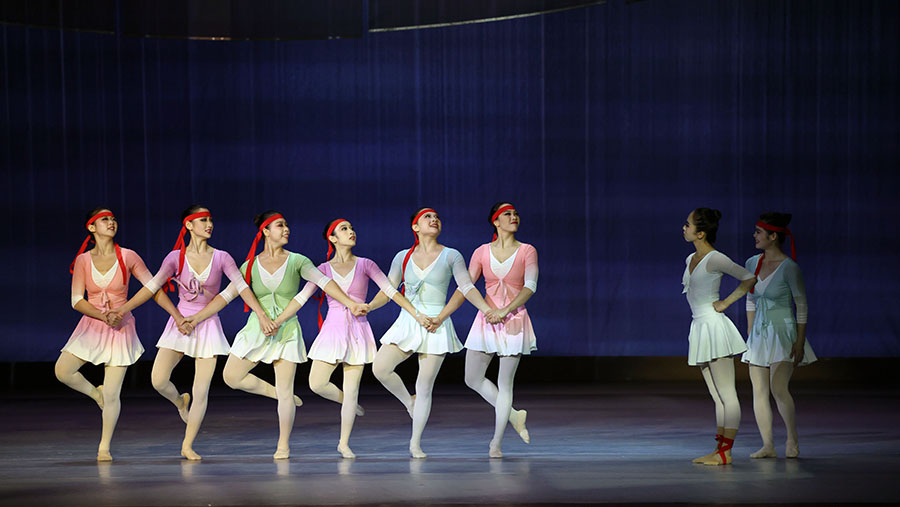
In the story, her character Yu Meng gets injured, after which people usually give up their profession. But the desire to perform the role of the White Swan lifts her from her hospital bed. The artist herself believes that there are no limits to art. She traveled from Shenyang in northern China to Guangzhou in the south of the country to study with the masters. Hard work has brought her to the main stages of the world.
The main director of the acrobatic drama "The Swan" Zhao Ming also speaks about discipline. He believes that if an artist doesn't like practicing one movement hundreds of times, then you shouldn't even start. Acrobatics can only be done with love.
— The drama was named "Swan" because this bird is the embodiment of truth, goodness and beauty, — says Zhao Ming. — The story shows the world the spirit of struggle, perseverance, love and overcoming inherent in the Chinese nation.

Dance of the little swans on their hands
The performance showcases the numerous talents of the troupe's artists: diabolo juggling, tightrope balance, balancing, aerial tricks on ribbons, and the "Wheel of Syrah." The skill and skill were admired by some of the metropolitan public. But some people were wary of the show on the classical stage.
"We've seen more than that at Nikulin Circus," the audience shared their impressions.
And at first, there were only leitmotifs from "Swan Lake" as a reminder of the heroine Yu Meng's dream to stand on pointe shoes. But I had to wait for the second act. After the intermission, "Swan Lake" was performed on stage to Tchaikovsky's familiar music in a modern arrangement. However, the Guangzhou Acrobatic Arts Theater turned everything upside down.
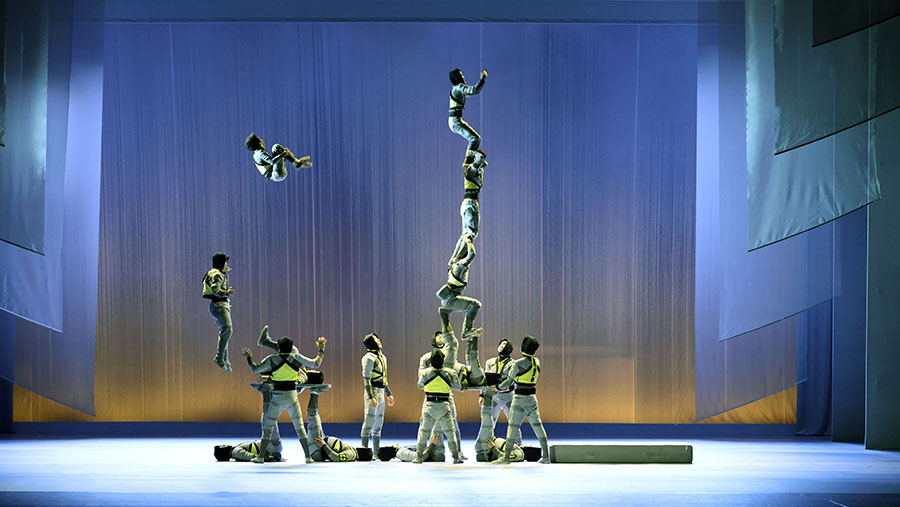
Behind a light curtain, acrobats built two inclined pyramids. Deviating 45 degrees from the stage, they resembled giant swan wings. A difficult trick — the gymnasts stood on their hands on the back of a chair that balanced on two legs. And so, leaning on each other, twelve acrobats built two inclined structures.
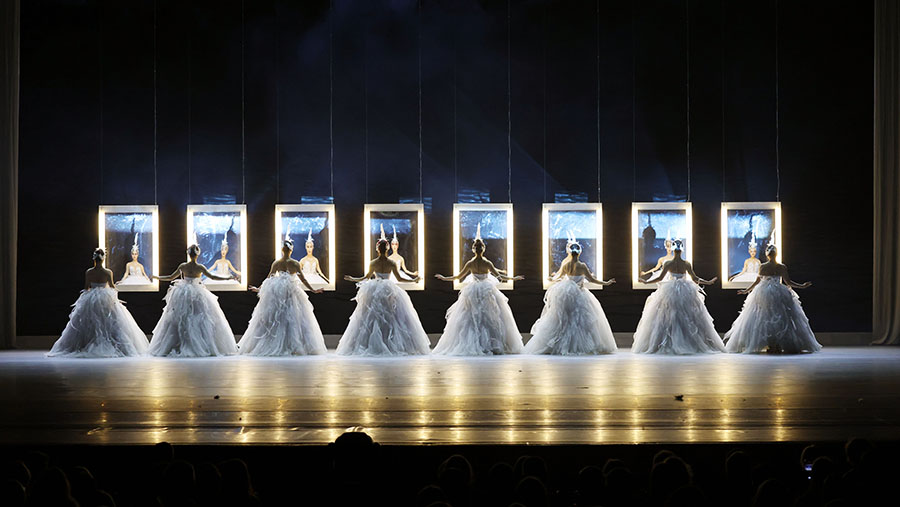
Another spectacular appearance is the scene on the lake, where a flock of swans arrived. The artists were not in tutus, as in Tchaikovsky's ballet, but in full white floor-length skirts, under which the videos were hidden. This made it possible to glide smoothly across the stage.
Harlequins in curved-toed shoes dance for the little swans in the play. But when the actors stand on their hands, the toes of the shoes turn into the beaks of swans.
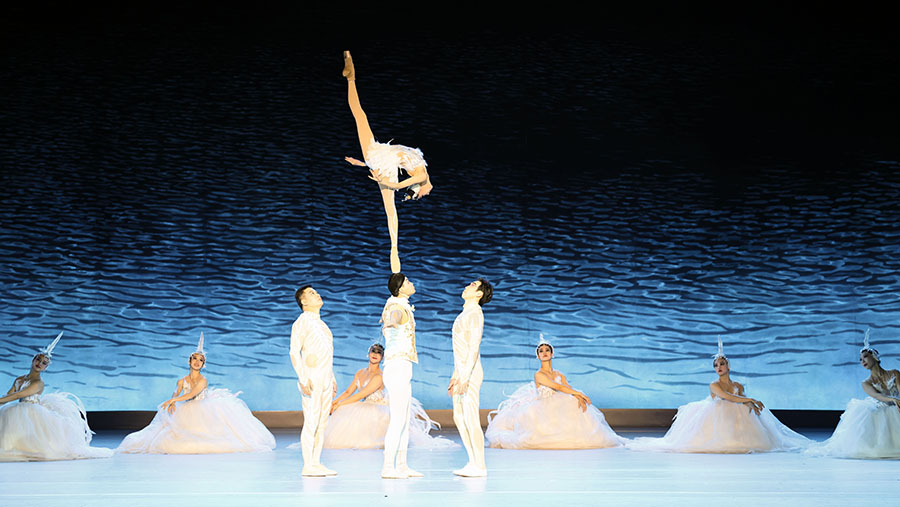
The variation of Odette with the prince performed by acrobats is a celebration of strength and lightness at the same time. Going out on pointe shoes, wearing a tiara and a white suit with feathers, suddenly gives way to stunts. Wang Chenxi, who plays Siegfried in this scene, lifts his partner above him from a prone position, which physically seems impossible. Li Mennan, she has the role of Odette here, as if she's taking off from the sky. And when a girl stands on pointe shoes on her partner's shoulders, the audience holds its breath: pirouettes on one leg without insurance and dancing on his head finally ends with shouts of "Bravo!"
The Swan will now travel to St. Petersburg. On April 29, 30, and May 1, the production will be shown on the New Stage of the Mariinsky Theater.
Переведено сервисом «Яндекс Переводчик»
