- Статьи
- Society
- Tolerable conditions: 300 illegal self-construction sites were damaged by flooding in Dagestan

Tolerable conditions: 300 illegal self-construction sites were damaged by flooding in Dagestan

About 300 illegally built residential buildings were damaged in the flood zone in Dagestan, Izvestia estimated, comparing data from the register of unauthorized construction of the regional Ministry of Construction and flood maps. Most of them are in Makhachkala — about 200. The order to help their residents was given by Vladimir Putin on April 21. According to the press secretary of the head of state, the government has begun to work out an appropriate mechanism. The assistance can be implemented through the issuance of housing certificates or compensation at the level of the first mortgage payment, experts suggested. They also drew attention to the risks of this scheme — if assistance is provided regardless of the status of the building, then people will perceive the requirements for the legality of construction as secondary.
How many self-buildings are there in Dagestan
As a result of the floods in Dagestan, about 300 residential buildings were damaged, which are officially recognized as self-construction, Izvestia found out. The editorial board compared the location of objects in the register of unauthorized construction of the Ministry of Construction of the Republic and the map of recorded flooding, which is maintained by volunteers.

There are about 200 such facilities in Makhachkala (including high-rise buildings). At least 35 self—construction buildings were flooded in Buinaksk, 27 in Kaspiysk, and more than 15 in other regions of the republic. When calculating, the editors did not take into account commercial buildings and unfinished residential buildings.
Heavy rains in late March and early April led to large-scale floods in Dagestan. As the head of the republic, Sergey Melikov, reported on April 7, about 6.2 thousand people and about the same number of households suffered because of them. According to the Ministry of Emergency Situations, six people died. On April 13, Dagestan's Deputy Prime Minister Ramazan Jafarov announced data on more than 7,1 thousand damaged buildings. At the time of publication, the figure of 11.1 thousand was indicated in the republican information system of construction supervision. Izvestia appealed to the Ministry of Construction of Dagestan with a request to clarify the data.
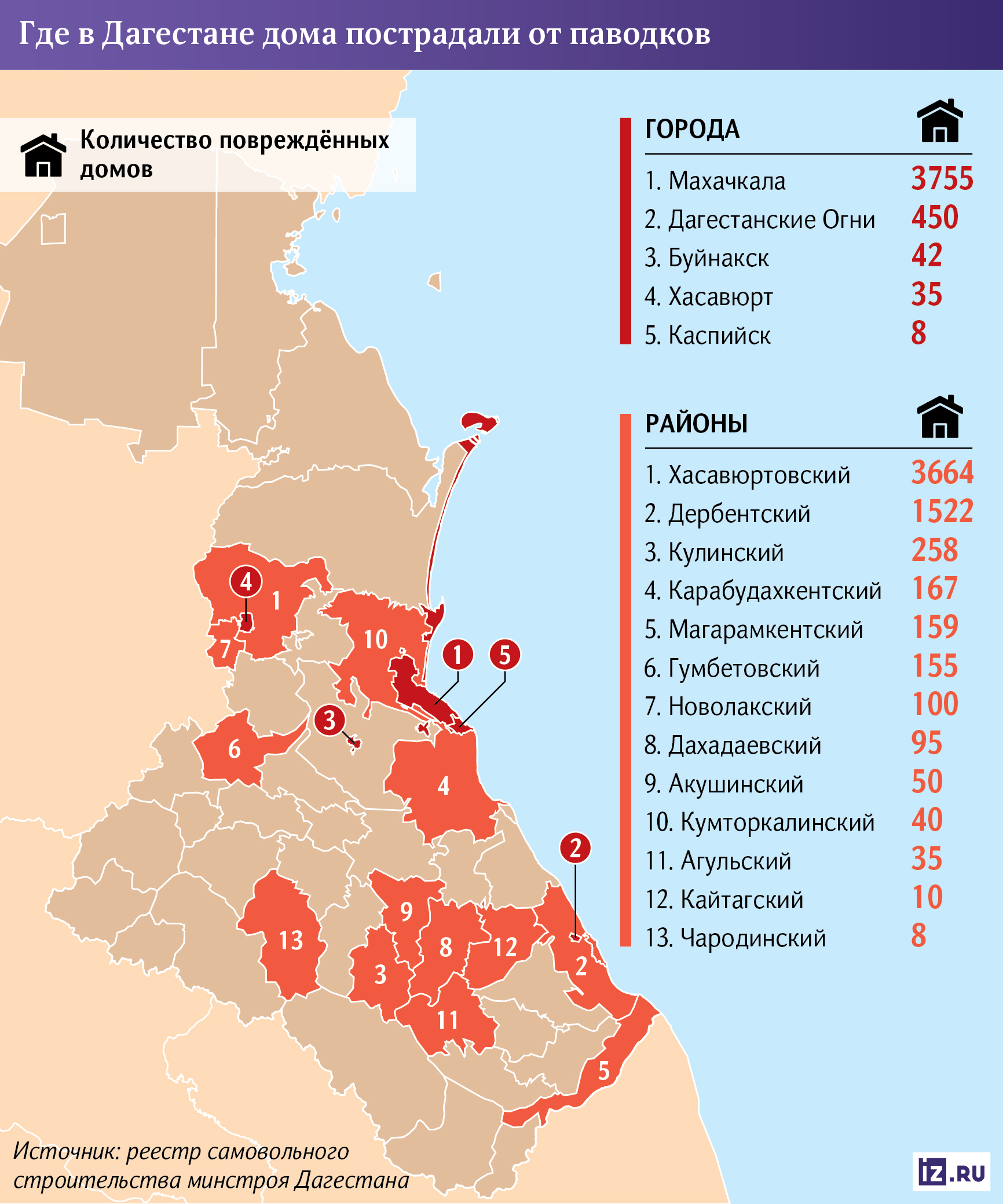
On April 21, Russian President Vladimir Putin, at a meeting with the heads of municipalities, instructed to help residents of Dagestan, whose houses were not officially registered, but were damaged during the floods.
— People have built, and often they have nothing else but what was built, even in violation of regulatory documents. And it's impossible to pretend that both the republic and Russia as a whole have nothing to do with it and not help these people. We need to help them anyway," the president said, asking them to find regulatory and legal solutions for this.

In addition, he instructed to find mechanisms that would help residents insure their homes in the future, as this is a good way to protect the interests of citizens. According to presidential spokesman Dmitry Peskov, the issue of compensation to the owners of the affected samostroy is already being worked out, but he did not give an exact date.

How will samostroy be restored?
From a legal point of view, samostroy does not give the owner the right to compensation, said Alexey Gavrishev, lawyer and managing partner of AVG Legal. However, the president's order to help residents actually shifts the situation from the legal plane to the social one.
"In practice, this means that targeted support mechanisms will be used — through regional programs, reserve funds, possibly with the participation of federal funding," the expert noted.

In his opinion, the implementation of the president's instructions can follow the model of an individual assessment: the fact of residence, the availability of alternative housing, and the degree of property loss will be checked. At the same time, assistance may be provided not in the form of direct restoration of the building, but through other mechanisms, such as compensation or the provision of other housing.
There is no regulatory act that determines the amount of compensation for residents of Samostroy — this is a political decision, Svetlana Razvorotneva, deputy chairman of the State Duma Committee on Construction and Housing and Communal Services, explained to Izvestia.
— There are regional emergency funds, and there is a federal fund. Payments depend on the status assigned to emergencies. If local, then they pay from the regional budget, if regional status, then from the federal budget," she explained. — But the payments there are small according to the law: for the loss of property up to 200 thousand rubles. It is impossible to build new housing with this money.

In her opinion, the residents of Samostroy will be provided with some kind of compensation, the amount of which, if it does not allow them to buy a house in its entirety, it can cover the initial mortgage payment. She recalled that after the floods in the Khabarovsk Territory in 2013, the victims were provided with apartments.
— Recently, housing certificates have been issued in such unusual cases. Their size is calculated based on the average housing price in the region. I think they will follow this path here, too," Svetlana Razvorotneva suggested.
If assistance is provided regardless of the status of the building, then there is a risk of consolidating the practice in which the requirements for the legality of construction are perceived as secondary, Alexey Gavrishev believes.
—This means that in parallel with support measures, increased control over construction and the creation of understandable legalization mechanisms will be required," the lawyer stressed.

According to Ekaterina Kosareva, managing partner of the VMT Consult agency, simplified mechanisms for legalizing real estate with subsequent restoration of facilities can be developed.
Searches at the Republican Ministry of Natural Resources
On April 23, 2026, the Ministry of Natural Resources and Ecology of Dagestan and the Dagmeliovodkhoz department were searched in connection with the initiation of a criminal case on negligence and abuse of official authority, the Investigative Committee reported.
According to investigators, since 2009, land plots located near the water protection zone and rivers have been registered in the republic — nothing can be built there. But, as the investigation notes, officials allowed the construction of high—rise buildings, and then these permits were revoked, and illegally erected high-rise buildings were officially recognized as self-building. But their construction did not stop, and there were no demands for dismantling.

"The riverbed was filled in on these land plots, which prevented the implementation of measures to clean up and ensure the free flow of the water body," the ministry said in a statement. "Insufficient control by the authorized bodies contributed to the threat of flooding of the adjacent territories."
In early April, the head of Dagestan, Sergei Melikov, linked the flooding of Makhachkala with "mindless construction" in the Tarnairka riverbed. According to him, several houses were built right in the riverbed, which prevents the natural flow of water. The mayor of Makhachkala, Dzhambulat Salavov, agreed with him.

Why is there a lot of self-construction in Dagestan
Two weeks before the flood, the Ministry of Construction of the republic reported on work with illegally erected residential buildings, Ekaterina Kosareva recalled. At that time, there were 2,337 facilities on the list of self-construction projects, and only 214 of them were to be demolished.
— The flood and its consequences exposed the existing bundle of contradictions related to the construction sector in the region, — said the expert.

In some municipalities, the share of self-construction has traditionally been high, since construction was often carried out without registration of land rights and permits, said Alexey Gavrishev.
"The fight against this phenomenon has intensified relatively recently, but so far it has not led to a complete streamlining of the building," he stressed. — And it's not just about the number of damaged facilities, but also about the quality of the building and its legal status.
Nargiz Mamazhanova, head of judicial projects at the Intellectual Capital law firm, suggested that not hundreds, but thousands of illegally built houses could have been damaged during the flood, because not all of them have been identified.
— Self—construction in Dagestan is not a private problem of individual owners, but a large-scale phenomenon. Unauthorized buildings are often built in high—risk areas — in floodplains, without observing building regulations and engineering protection," she said.

The expert noted that inspections in this area are carried out regularly — the prosecutor's office and relevant authorities participate in them. However, so far these measures do not lead to a systemic fracture: a significant part of the violations persists, the disorder continues to reproduce.
— This is due to the accumulated volume of problems, the difficulties of registration of rights and a long period when the development actually developed without proper control, — said Nargiz Mamazhanova.

One of the reasons for the current situation is corruption, Ekaterina Kosareva noted. In particular, Magomed Suleymanov, the former acting mayor of Makhachkala, was accused of issuing resolutions authorizing construction without proper expertise.
— 80 apartment buildings have been built in Makhachkala only according to permits with his signature, which are in fact self—building, - Ekaterina Kosareva noted. — Similar detentions of officials are currently taking place in Dagestan. Up to half of the buildings in Dagestan, built at different times, may have problems with permits.

One of the most common schemes, according to the expert, is to obtain a permit for individual housing construction and erect an apartment building on this land.
And Alexander Ivanov, a leading analyst at the federal company Etagi, noted that part of the samostroi is located on lands not intended for housing projects.
"Self—construction projects traditionally place an excessive burden on engineering and social infrastructure," he said. — This is also a burden on the budget: the authorities have to examine each building and make a decision on its fate.
Such buildings limit the market entry of large construction companies: it is difficult for developers to compete in price with problematic facilities.
Переведено сервисом «Яндекс Переводчик»
