
The Battle for the Citadel: how the Red Army stormed the Reichstag

On April 30, 1945, the assault on the Reichstag began. The last battle "with the fascist dark force, with the cursed horde" in its lair. The heroes of this battle won the Victory under fire. "Wars almost always start suddenly and end slowly: the outcome is already clear, but people are still dying and dying," Ilya Ehrenburg wrote. The correctness of this idea was confirmed in the spring of 1945. Izvestia recalled how it was.
At the walls of Berlin
The Allies were jealous of this mission — to take Berlin, putting an end to the war. On April 1, 1945, British Prime Minister Winston Churchill wrote to U.S. President Franklin Roosevelt: "The Russian armies will undoubtedly capture the whole of Austria and enter Vienna. If they capture Berlin, won't they have an exaggerated idea that they have made an overwhelming contribution to our common victory, and might this lead them to a mindset that will cause serious and very significant difficulties in the future? Therefore, I believe that from a political point of view we should move as far east as possible in Germany, and that if Berlin is within our reach, we should certainly take it. It also seems reasonable from a military point of view."

Fighting on the outskirts of Berlin
Field Marshal Bernard Montgomery's group was preparing to attack Berlin. But the American command did not believe in the reality of these plans. The decisive point was the opinion of General Dwight D. Eisenhower, who believed that solving this problem was irrational. The Red Army has come close to Berlin, it has forces that are not comparable to those of the Americans and the British. At that time, only Soviet soldiers could take over Hitler's lair. And this is the ultimate justice of war.

Soviet soldiers write "messages" on shells: "Personally to Hitler", "To Berlin", "On the Reichstag"
On April 16, the Red Army encircled the capital of the Third Reich. The last strategic offensive operation of the Great Patriotic War, the Battle for Berlin, has begun.

Berlin was turned into a continuous series of fortifications. Multi-storey stone bunkers, pillboxes and bunkers, squads of "faustniks" holed up in houses. 400,000 Berliners were building fortification lines on the eve of the battle. The city center, riddled with water barriers, was considered an impregnable fortress. The Germans suffered heavy losses, and SS units recruited from the Scandinavian countries, France and Belgium — Nordland, Charlemagne, and Wallonia - played an important role in the defense of the capital of the Reich. Baltic SS men, Hungarians, and even Spaniards participated in the defense of the Reichstag, of which there were relatively few in the German armed forces.

One of the firing points of the German troops is the Panther tank, buried in the asphalt up to the tower.
Assault groups played a key role in street battles, preventing the enemy from coming to their senses and organizing their defense, moving from building to building. Tank units suffered heavy losses: on the streets of Berlin, combat vehicles became easy prey for "fausts", which it was not easy for the scouts to fight. The Nazis fought their last battles desperately.
The Leap to Victory
Back in November 1944, Stalin spoke about the Victory Banner, which must be hoisted over Berlin to put an end to the war.: "The Soviet people and the Red Army are successfully carrying out the tasks they faced during the Patriotic War. The Red Army has sufficiently fulfilled its patriotic duty and liberated our motherland from the enemy. From now on and forever, our land is free from the evil spirits of Hitler. Now the Red Army has its last and final mission.: to complete, together with the armies of our allies, the task of defeating the German fascist army, finishing off the fascist beast in its own lair and hoisting the Banner of Victory over Berlin." The time has come to plant this banner over Berlin, over the Reichstag, the defense of which the Germans have thoroughly organized. The citadel was defended by SS units, the Volkssturm, three companies of the naval school from Rostock, three field artillery divisions and an anti-aircraft artillery division. The Soviet soldiers had to overcome three trenches, suppress a dozen and a half pillboxes, minefields and anti-tank ditches filled with water.

The battle on the outskirts of the Reichstag
At dawn on April 30, the assault on this fortress began. One breakthrough, one breakthrough. There were thousands of them during the four years of the war. And this is the last frontier, and there was no hope that the Germans would surrender it without a fight. It was necessary to overcome 500 meters of fortifications. The windows and doors of the Reichstag were bricked up, and the Germans fired through the slits. The first attack failed. The Germans, cornered, spared no shells. We had to retreat a few dozen meters, regroup, and bring up the artillery.

Reproduction of Vladimir Bogatkin's painting "Storming the Reichstag"
A daring raid to the central part of the building was undertaken by Lieutenant Rakhimzhan Koshkarbayev and Private Grigory Bulatov. They crawled to the steps of the Reichstag and attached a red flag to the column at the stairs of the main entrance.

The battle for the Reichstag in Berlin
The soldiers and officers who, covering each other, made their way to the Reichstag did not know that at the same time, at 15:30, in his bunker, very close to the assault, Adolf Hitler shot himself. Of course, neither the Soviet soldiers nor the Germans, who attempted to reach the rear of our troops storming the Reichstag, knew this. The platoon commander of the 469th Infantry Regiment, Ivan Klochkov, who managed to stop these attacks, was awarded the title Hero of the Soviet Union for this feat.

The Kukryniks painting "The End"
Finally, at 18:00, on the third attempt, the battalions of captains Stepan Neustroev, Vasily Davydov and senior Lieutenant Konstantin Samsonov suppressed resistance in the trenches and broke into the Reichstag building under fire. Sappers, one of those heroes who always go ahead, made a gap in the north-western wall of the Reichstag, through which detachments of scouts and sappers entered the building. The soldiers of the assault group of Captain Vladimir Makov were the first to break through to the roof of this hulk. Four of them. In addition to the commander, senior sergeants Alexey Bobrov, Gazi Zagitov and Alexander Lisimenko.

An assault group of Soviet troops breaks through to the Reichstag building under enemy fire.
The entire history of the war was reflected in the fate of these young soldiers. Vladimir Makov went to the front as a volunteer on the first day of the Great Patriotic War. He was seriously wounded during the defense of Sevastopol, on Malakhov Kurgan. Then the Red Army was retreating... For the second time, Makov miraculously survived the crossing of the Dnieper. Again— the hospital and the return to the front. He was appointed commander of the reconnaissance company, with which Vladimir Makov reached Berlin. After the war, he joined the criminal investigation department — like many shelled front-line soldiers, such as the hero of the film "The meeting place cannot be changed" Vladimir Sharapov. In the difficult post-war years, he caught criminals in the Istra district of the Moscow region. At about 22:30, they fixed a red banner on the sculpture of the Goddess of Victory, located above the main entrance of the western facade of the Reichstag. At about the same time, the group of Major Mikhail Bondar operated in the same place: another flag was raised over the western corps. The scouts from Lieutenant Semyon Sorokin's platoon also distinguished themselves in that battle. The brave men tied the flag to the neck of a bronze horse that decorated the building's pediment.

Soviet front-line intelligence officers Junior Sergeant Meliton Kantaria and Sergeant Mikhail Egorov (from left to right) with the assault flag of the 150th Idritsky Order of Kutuzov II degree Rifle Division, which they planted on the roof of the Reichstag building. May 2, 1945
On the night of May 1, soldiers of the 150th Infantry Division of Idritsky Mikhail Egorov and Meliton Kantaria hoisted the main Victory Banner. Today, this banner is one of the main shrines of our country.

The Victory banner on the Reichstag building
"Someone from the depths of the Tiergarten Park began to probe the gloomy Reichstag building with searchlights. First, a blue ray of light searched the massive steps of the entrance, ran along the wall, in which there were gaping holes from shells, and then slowly climbed up the column to the roof, and suddenly everyone lying on the Royal Square saw a large red banner above the Reichstag," wrote military commander Alexander Gutorovich, a witness and participant in this battle.

When the artillery stopped
On the morning of May 1, the Germans made a last attempt to break out of the encirclement. The remnants of the German units that had been defeated in other areas approached the Reichstag. A fire started on the ground floor of the building. Most of the building was already controlled by the Red Army, but there were still pockets of resistance in the Reichstag and in neighboring buildings. The battle continued in thick, acrid smoke. When Neustroev's squad attacked the Nazis from the rear, they retreated, hiding in the basement. In the early morning of May 2, after negotiations with the Soviet parliamentarians, they laid down their arms. About 4 thousand Germans and their accomplices died in the battle for the Reichstag and the neighboring Kroll Opera building. About 3 thousand surrendered.

Surrendered German soldiers and officers
At the same time, at 6 a.m., Berlin's chief of defense, General of Artillery Helmut Weidling, accompanied by three German generals, crossed the front line and surrendered. An hour later, at the headquarters of the 8th Guards Army, he signed the order for the surrender of the Berlin garrison: "Every hour of the battle prolongs the terrible suffering of the civilian population of Berlin and our wounded. By mutual agreement with the supreme command of the Soviet forces, I urge you to immediately cease hostilities."

The commander of the city's defense, General Helmut Weidling, during the surrender
This order was read out over loudspeakers to the German units that continued to resist. By 3 p.m., all of them had stopped resisting. Only a few units, mostly SS men, tried to break through to the West. They failed to break out of the encirclement.
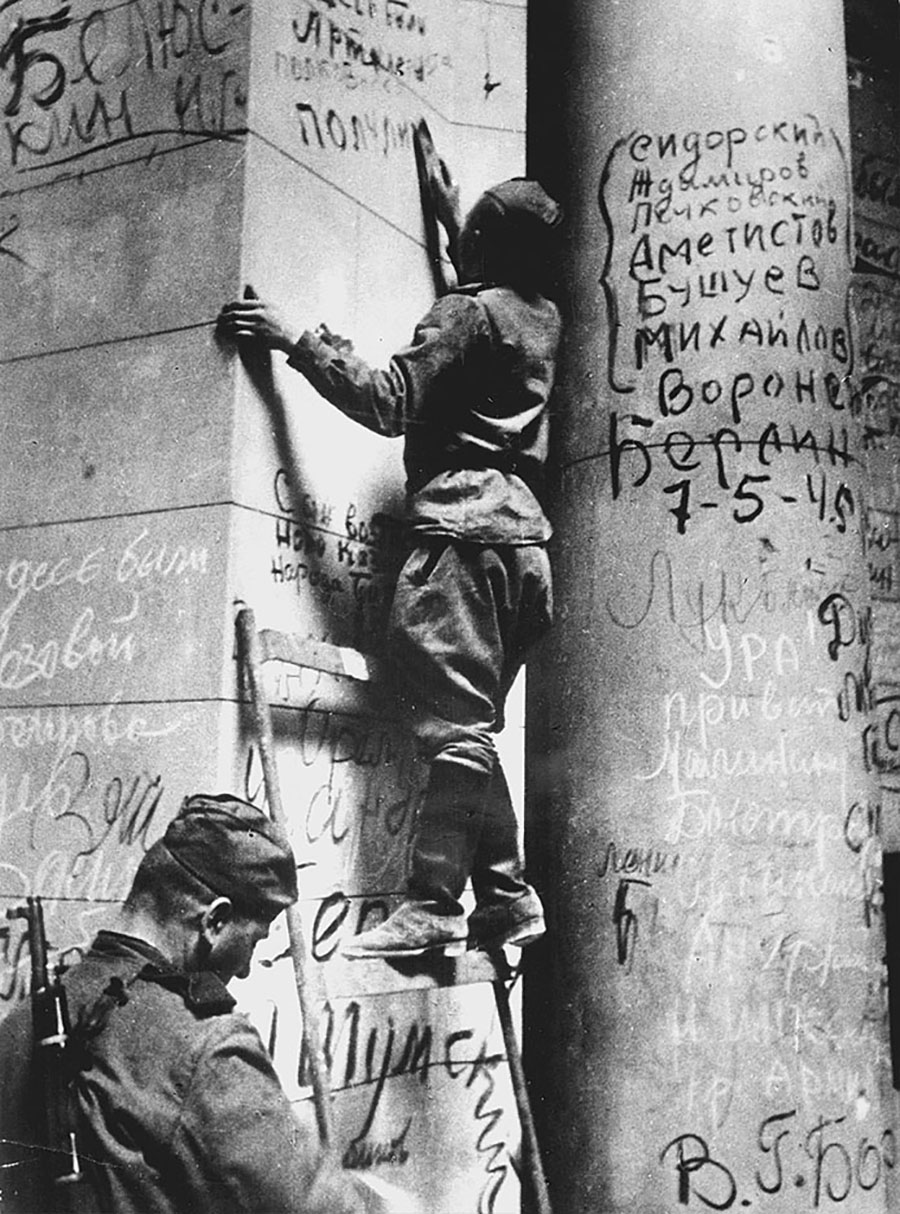
The red flag above the dome of the huge house, blackened by shelling, showed the whole world that Germany was defeated and the bloodshed would soon stop. The battle for the Reichstag ended with the fall of Berlin, which turned into a city of white flags on the second day of May. The roar of battles had stopped, and only sporadic gunfire broke the almost mundane background of city noise. Germany's unconditional surrender was a week away, but the last major battle of the Great Patriotic War ended with the capture of the Reichstag.
The author is the deputy editor—in-chief of the magazine "Historian"
Переведено сервисом «Яндекс Переводчик»
