- Статьи
- Economy
- Not everyone is at home: a quarter of Russia's regions are facing a shortage of new housing

Not everyone is at home: a quarter of Russia's regions are facing a shortage of new housing

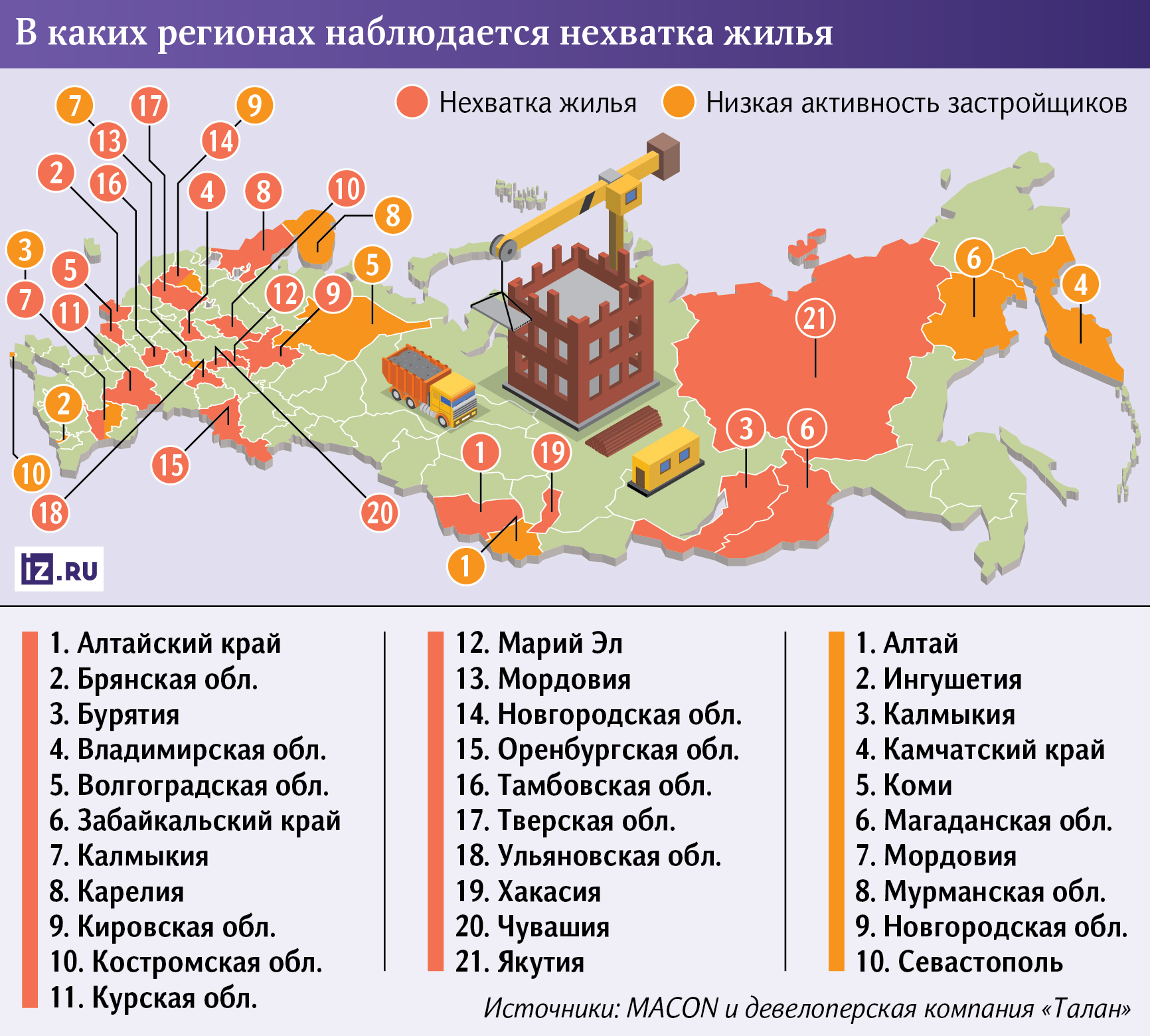
Housing shortage is observed in 21 regions, which is almost a quarter of all subjects of the Russian Federation. Among them are several regions from Central Russia, Chuvashia, Kalmykia, and Mordovia, Izvestia found out. Almost half of the demand is in the nine largest cities, and most often developers build in them. Because of this, apartments in new buildings in some regions cannot be sold for months, while in 80% of cities the pace of construction is low. Why such a problem arose and how to solve it is in the Izvestia article.
Which regions lack new buildings
The most pronounced shortage of new buildings is recorded in Central Russia, according to a study by Macon and the development company Talan (studied by Izvestia). In general, the problem exists in 21 regions, including Volgograd, Orenburg, Ulyanovsk, Kirov regions, as well as Mari El, Transbaikalia, Karelia, Khakassia, Mordovia, Kalmykia, Altai Territory, Yakutia, Buryatia and Chuvashia.

In addition, there are territories where the activity of developers remains minimal, said Rustam Khamdamov, sales director at the development company. Among them are Kalmykia, Ingushetia, Magadan Region, Komi, Murmansk and Novgorod regions, Altai Republic, Sevastopol, Kamchatka and Mordovia.
The shortage of high-quality new housing in the regions, especially in small and medium-sized cities, is very acute, said Nadezhda Lutsenko, Deputy Head of Ostov Group.

In a number of regions, the pace of home sales is noticeably faster than the commissioning of new facilities, added Natalia Milchakova, a leading analyst at Freedom Finance Global. According to her, in the new regions, the gap between sold apartments and commissioned new buildings reaches 1.5–1.7 times. In the future, the problem may spread to other territories, including Ingushetia, Vladimir and Kemerovo regions, said Evgeny Shavnev, CEO of Flip investment company.

An additional indicator of the housing shortage was the expansion of family mortgages to the secondary market in most cities of the country, said Anton Gak, a representative of the Aeroplane group. This measure affected more than 890 out of 1,100 cities — in fact, this is an official recognition that there is not enough supply in new buildings in these locations, and demand has to be maintained through recycling.
Why is there little housing being built in the regions?
The main reasons for the shortage lie in the economic sphere: development activity in the regions is lower, the number of sites prepared for construction is limited, costs are higher and effective demand is weaker, Anton Gak noted. The market is mainly based on large agglomerations — there is stable demand and a sufficient number of transactions, which allows launching projects with lower risks, the "Airplane" added.

Currently, about 41% of demand is in just nine cities — Moscow, St. Petersburg, Yekaterinburg, Krasnodar, Rostov-on-Don, Tyumen, Novosibirsk, Ufa and Kazan, according to a study by Talan. That's where developers most often build. However, at the same time, the sales rate of new buildings in large cities is decreasing. If in 2021, about 70% of the space in the projects was sold at the time of commissioning, then by 2026 this figure had decreased to 51%. This indicates uneven demand and the accumulation of unrealized housing in the millionaires, while in other cities it is not enough.
For developers, such projects are associated with high risks, said Denis Zhalnin, CEO of the People company. Banks are also not always ready to finance construction if there is no certainty of payback. An additional problem is the low cost of secondary housing in a number of regions, the expert added. New buildings may not always compete with them in price.

The launch of new construction projects in the regions often comes down to basic constraints — population outflow, weak economy and low incomes of residents, the "Plane" added. Migration also has a strong impact. People are moving to large cities, where there are more jobs and opportunities, said Yuri Balabanov, Commercial Director of Alfastroyinvest Group. Along with the demand, developers are also going there.
At the same time, a vicious circle is forming: the lack of modern housing itself becomes a factor that pushes people to move.
How the housing shortage affects the regional economy
In cities with low construction rates, there is a shortage of primary supply, noted Anton Gak from Aeroplane. For people, this means a limited choice of modern projects, a slower pace of renovation of the fund and increased competition for quality housing. The shortage of new buildings leads to higher prices and lower availability of square meters, Natalia Milchakova emphasized.

As a result, even those who are willing to take out a mortgage face difficulties and are considering moving. In the long term, this creates risks for the economy, Natalia Milchakova added. In the regions where the population leaves, there is a shortage of personnel, including working professions. This is especially critical for industry and infrastructure projects. In the host cities, on the contrary, the burden on transport, social facilities and the housing market is growing.
"Unfortunately, not all regions are active enough to attract developers to their territories," said Irina Pashkovskaya, head of the analysis center at the federal company Floors.

According to her, the situation in the problem territories may not change without a dialogue between government and business. The level of risks will continue to exceed the potential level of profitability of the projects. However, people there actually need to upgrade their living conditions.

— Preferential lending programs for projects in small towns, subsidizing infrastructure connections and, most importantly, launching mortgage programs with a reduced rate for buyers of local new buildings by the regions themselves could stimulate developers, — says Nadezhda Lutsenko from Ostov Group of Companies.
If local authorities share some of the risks with the developer, this can improve the situation and stimulate construction, Anton Gak concluded. In a broader sense, the development of the regional economy is important — the growth of household incomes, job creation and the formation of a modern urban environment.
Переведено сервисом «Яндекс Переводчик»
