Sales preparation: oil prices may rise to $140 per barrel


The US refusal to extend the license for the sale of Russian oil, announced by the head of the US Treasury, will support prices in the region of $ 100-140 per barrel. While the market is in a "wait-and-see" position, raw materials are trading at $95 per barrel. However, according to experts, the market takes into account the assessment of the International Energy Agency, according to which 24 million barrels will leave the market in April against 12 million in March. The impact of the high cost of raw materials on the market and on Russian exporters is described in the Izvestia article.
About the US decision on Russian oil
Treasury Secretary Scott Bessent told reporters at the White House that the US administration has no plans to extend the validity of licenses for the sale of oil from Russia and Iran. We are talking about the raw materials loaded onto the ships before March 11, all of which were used.
According to Yuri Stankevich, Deputy chairman of the State Duma Committee on Energy, the US Treasury's statement reinforces the sanctions signal to the market, but its direct price effect will depend on the scale of the actual supply reduction. Formally, we are talking about tightening the control regime and complicating calculations, logistics and insurance, which increases transaction costs and narrows the circle of buyers.
"In the short term, this creates an additional risk premium, especially against the background of the simultaneous strengthening of the US military presence in the region and the uncertainty surrounding indirect negotiations with Tehran," the deputy said.
In addition, Ekaterina Kosareva, managing partner of VMT Consult, notes that the United States is partially blocking the exit from the Strait of Hormuz, through which about 20% of the world's oil flows passed, which will force Iran to reduce its production.
"So far, investors have taken a wait—and—see attitude and oil prices are holding at $95-96 per barrel," she said.
According to the French environmental organization Kayrros, which uses satellite imagery to monitor oil reserves, oil storage facilities in the Islamic Republic are 51% full. As the Financial Times noted, the country exports about 1.8 million barrels per day. According to the newspaper, if the current pace is maintained, in 16 days the level of storage capacity may exceed the record high of 92 million barrels recorded during the pandemic.
According to the IEA, 24 million barrels will leave the market in April, compared to 12 million in March. This version, according to Yuri Stankevich, strengthens the arguments in favor of a more tense market balance in the second quarter.
— However, it should be borne in mind that the oil market in the last two years has demonstrated high adaptability to sanctions restrictions through the reorientation of flows and alternative settlement mechanisms. Therefore, the effect of the new restrictions will be not so much in the physical disappearance of volumes, but in increased volatility and an increase in the geopolitical premium," he believes.
What were the oil exports in March?
According to the International Energy Agency, Russia's export revenues in March amounted to $19.04 billion, while total exports increased by only 4.7% and reached 7.13 million barrels per day, Izvestia wrote. Thus, oil supplies in March increased by 270 thousand barrels per day, and petroleum products — by 50 thousand. Revenues from fuel exports reached $11.45 billion ($5.41 billion more than in February), and from exports of petroleum products — $7.59 billion (an increase of $3.88 billion), according to the IEA's monthly report.
According to U.S. government data released on April 15, the country's oil exports rose to 5.2 million barrels per day, the highest figure in the last seven months. Norway, the largest supplier of this fuel to Europe, has also increased supplies: according to the country's Central Bureau of Statistics, exports increased by 67.9% compared to the same period in 2025.
The presence or absence of U.S. licenses does not affect the volume of production and supply of raw materials from Russia and Iran to the global market, said Tamara Safonova, CEO of the Independent Analytical Agency for the Oil and Gas Sector.
Thus, according to OPEC, oil production in Russia, excluding gas condensate, amounted to: in March 2026 — 9.167 million barrels per day, in February 2025 - 9.16 million, in January 2026 - 9.24 million barrels. Iran's production in the same month reached 3.06 million barrels per day, in February 2026 - 3.24 million, in January 2026 — 3.14 million barrels.
— There were no trading operations with American companies either before the licenses were issued or during the license period. In addition, the licenses have not solved the problem of lowering oil prices on the world market and de—escalating tensions in the Middle East," Tamara Safonova noted.
According to her, the issuance of licenses by the US Treasury for operations outside of American jurisdiction can be considered as an act of administrative coercion and influence that has no legitimate legal basis beyond the borders of the States.
What will happen to oil prices
According to Yuri Stankevich, a significant reduction in oil production in Iran may be due not so much to sanctions pressure as to a possible escalation of the conflict over the Strait of Hormuz. Its complete blocking seems to be an unlikely scenario, since it will affect the interests not only of the United States, but also of China, the Persian Gulf countries and the Iranian economy itself. At the same time, even limited incidents in the region can lead to higher prices: according to the expert, the risk premium can be $5-10 per barrel.
— In the baseline scenario, in the coming weeks, oil is likely to remain in a range with increased volatility, with a tendency to increase, while maintaining the harsh rhetoric of the United States and the lack of progress in negotiations. A steady exit of quotations above current levels is possible with a confirmed reduction in physical exports from Iran or with interruptions in shipping," the deputy believes.
At the moment, according to Dmitry Scriabin, portfolio manager of Alfa-Capital Management Company, partial passage of vessels remains. On average, Iran exports about 1.5 million barrels of crude oil per day, and including petroleum products — about 2.5 million barrels. China's position as one of the largest buyers of Iranian oil also plays a significant role. The question is to what extent the United States is ready to escalate relations in this direction.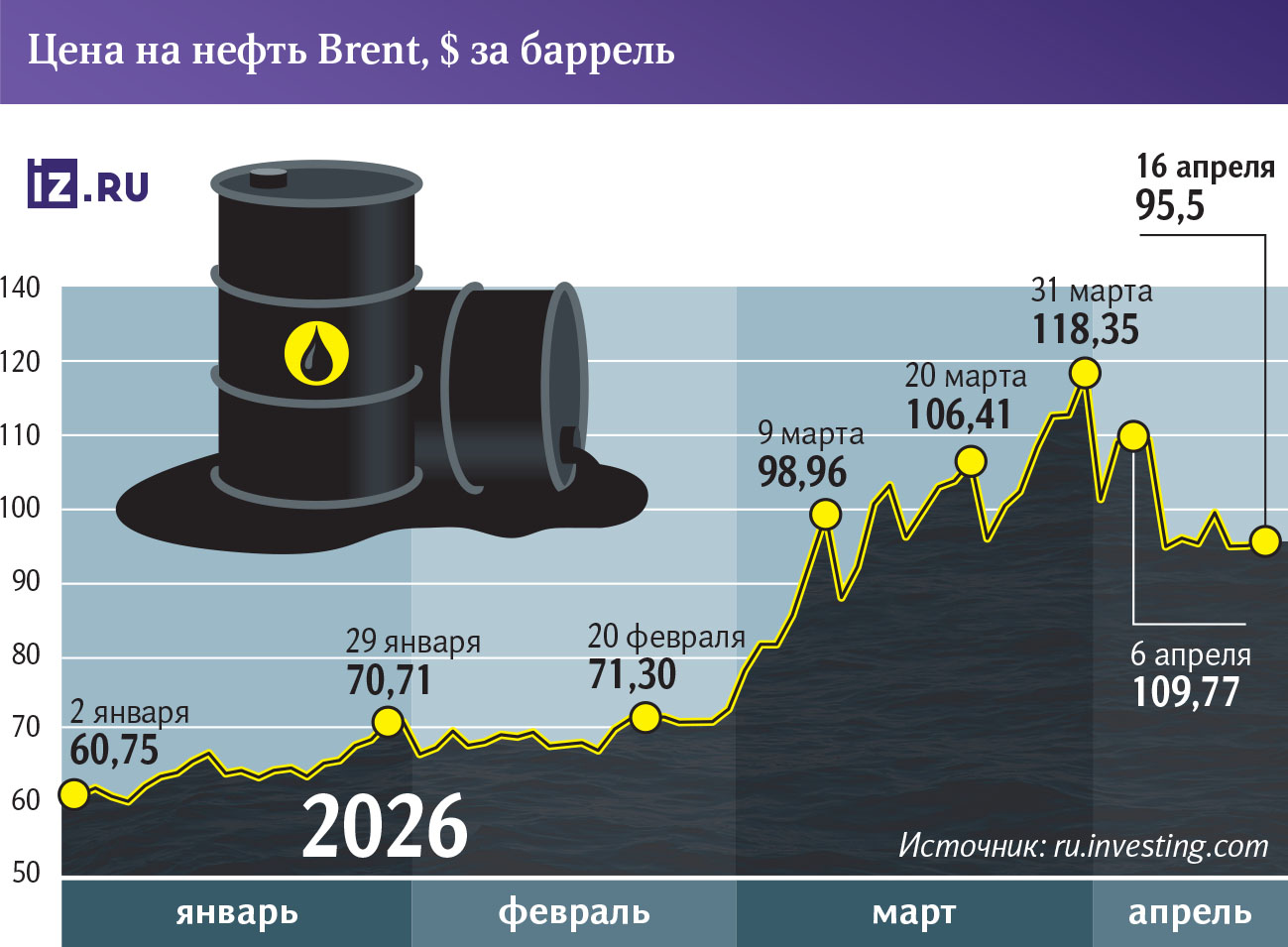
Iran, according to Dmitry Kasatkin, managing partner of Kasatkin Consulting, produces about 3.3 million barrels per day, of which about 1.6–1.8 million are exported, mainly to China.
— Almost all of these exports pass through Kharg Island and further through Hormuz. With a complete blockade of the strait, especially if the United States begins to implement the naval blockade announced on April 12, the Islamic Republic will not be physically able to export oil. Production will decrease following exports: without exports, there is no point in mining. The drop may amount to 1 million barrels. This will not completely paralyze Iran's production: domestic consumption and refinery operations require about 1.5 million barrels per day," the source told Izvestia.
For Russian exporters, moderately higher prices partially offset the sanctions restrictions and the discount to Brent, Yuri Stankevich believes. Russia's export growth of 4.7% in March demonstrates that demand from Asian countries, primarily China and India, remains stable. The interest of the countries of the South‑East Asia also supports redirected flows, especially in the context of flexible pricing policies of Russian suppliers. A significant reduction in Russian supplies should not be expected in the short term — rather, further restructuring of logistics and pricing conditions is possible.
Thus, the factor of US sanctions and Middle East tensions adds a risk premium to the market and increases volatility, which creates a steady supply shortage. The key driver of prices in the near future will be the development of the situation around Iran and the dynamics of actual export flows, not just political statements.
Dmitry Kasatkin believes that in the short term, Brent will remain in the range of $90-110 with the potential to increase to $120-140 under an escalation scenario.
— For Russian exporters, this still means the continuation of the period of maximum revenue over the past four years. The price of a barrel of Urals at the rate of 75 rubles per dollar and the price of $90 per barrel is about 6,750 rubles, which is significantly higher than the levels at the beginning of the year," the expert noted.
At the same time, he stressed that with a significant increase in companies' revenue, physical export volumes are increasing more modestly.
— The Baltic ports are not operating at full capacity, non-renewal of the US license returns the discount and complicates work with customers. The net effect for the industry is positive, of course, but it is limited," the expert said.
According to Valery Andrianov, an associate professor at the Financial University under the Government, prices will depend on the development of the situation in the Persian Gulf. If Iran and the United States manage to agree on something or at least start a stable negotiation process, prices will drop below $100 per barrel. In the event of a resumption of full-scale hostilities and the start of a ground operation by American troops, they may reach $ 150-200 per barrel.
Переведено сервисом «Яндекс Переводчик»
