Sees a Greek in the river Hell: Bezrukov took the actresses of the Moscow Art Theater in the new MGT play
- Статьи
- Culture
- Sees a Greek in the river Hell: Bezrukov took the actresses of the Moscow Art Theater in the new MGT play


Charon's jet ski, the choir of dead widows, a poetic battle with Pushkin and Maria Callas in the kingdom of darkness — this is how the Greek director Vasilios Samourkas saw Aristophanes' comedy "Frogs", rare for the theatrical stage. He himself played three roles, Sergei Bezrukov was asked to voice Homer, and he, in turn, as the newly minted head of the Gorky Moscow Art Theater, connected the actresses of the Art Theater to the production. Izvestia visited an experimental production and found out what the frogs are croaking about in Hades.
Greece in Russian or Russia in Greek
Despite his Greek origin, Samurkas is well acquainted not only with Russian literature, but also with the Russian theater school. In addition to his acting education at the Drama School of the National Theatre of Greece, he graduated from the directing department of GITIS (workshop of E.B. Kamenkovich). Vasilios has directed several tragedies in Russian theaters. Among them are "Medea" by Euripides at the Moscow Drama Theater named after M.N. Ermolova, "Odysseus Descends into Hades" based on Homer at the Chekhov Moscow Art Theater, "Electra" by Euripides at the Smolensk Drama Theater and "Agamemnon" by Aeschylus at the Ryazan Regional Drama Theater. This time Samurkas brought to the Russian audience a comedy, also an ancient Greek one, "Frogs" by Aristophanes.
— Vasilios came to me with this story. The fact is that we have our own narrow idea of Greece: Sirtaki, Parthenon, Greek salad, myths. Unfortunately, everything is often limited to this, which, of course, is unfair when we talk about the culture of another country," Sergei Bezrukov, the theater's artistic director, said before the show.
This is another theatrical experiment in a series of similar ones in the current season of MGT. According to the artistic director, it's more interesting for both the audience and the artists.
In ancient Greece, comedy was not the most popular genre, and even after almost two and a half thousand years, "Frogs" did not appear on stage more often. Of the famous adaptations, one can only single out the musical of the same name by Oscar winner, composer Stephen Sondheim in 2004. Then he replaced the ancient Greek playwrights in the plot with English ones: Aeschylus with William Shakespeare, and Euripides with Bernard Shaw.
"Not a single frog in this play will become a prince," the director said. — We will not be dancing sirtaks, selling ancient Greek chiton or Greek salad in the lobby. And we certainly won't sell you the Parthenon magnet after the final bow.
Samurkas did not go head-on and modernized the composition of the famous Greek. "Frogs" became the starting point of a conversation about the meaning of poetry for a modern person at the crossroads of two cultures. What is Pushkin to a Greek and what is Euripides to a Russian? Are there any decent poets left among the living, or is it time to descend into Hades to drag the great dead out of the world?
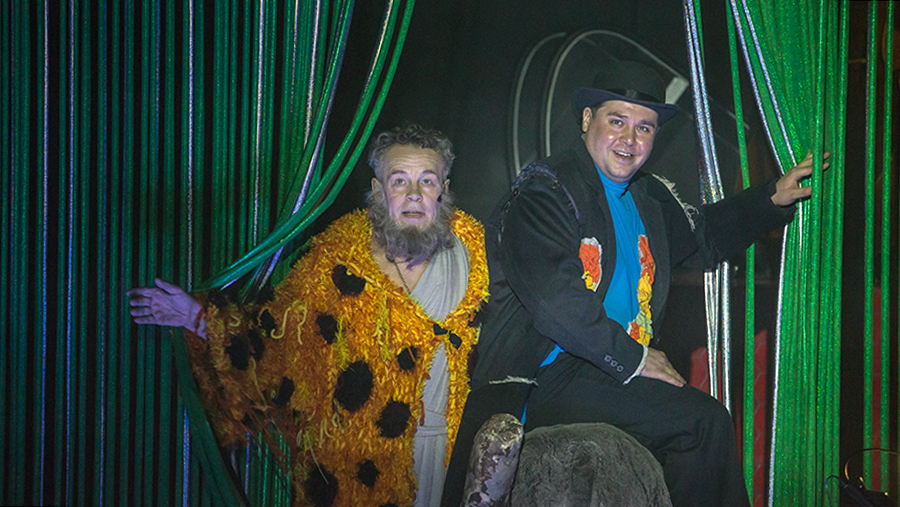
This is exactly what the god of the theater Dionysus (Oleg Kurlov) goes for, along with his slave Xanthius (Igor Nazarenko). They descend into the afterlife to find and bring back the best tragic poet. In the original, Euripides and Aeschylus are fighting in a poetic battle, and in Samurkas' version, Alexander Pushkin, the "sun of Russian poetry", acts as the arbitrator. Twenty years ago, Sergei Bezrukov played him in the cinema, but Alexey Veretin tried on sideburns and a top hat in the performance of the Provincial Theater. Bezrukov himself gave Homer a voice: the play begins and ends with his humorous lines.
Pushkin, Callas and the Frog Choir
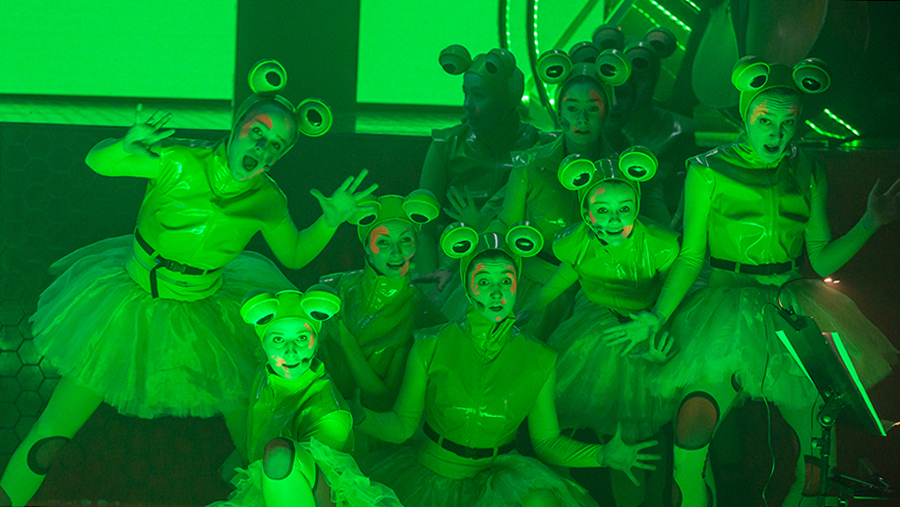
But what does frogs have to do with it? There's a whole choir of them in the play. Back in 405 BC, the very presence of these amphibians in the plot made the Greeks laugh. Dionysus goes to Hades on the waters of the Styx, as it should be, in Charon's boat. Not only does the ferryman have punky white and blue hair, he cuts through the river of the dead on a jet ski. Only in the play does the Styx become a swamp — hence the frogs croaking in Greek. Thanks to Sergei Illarionov's costumes, they surprisingly resemble creatures from Leonid Nechaev's film "The Adventures of Pinocchio."
Aristophanes and Samurkas have two choirs — frogs and dead widows. They involve 13 people, including four actresses from the Gorky Moscow Art Theater, which was headed by Sergei Bezrukov on March 6.
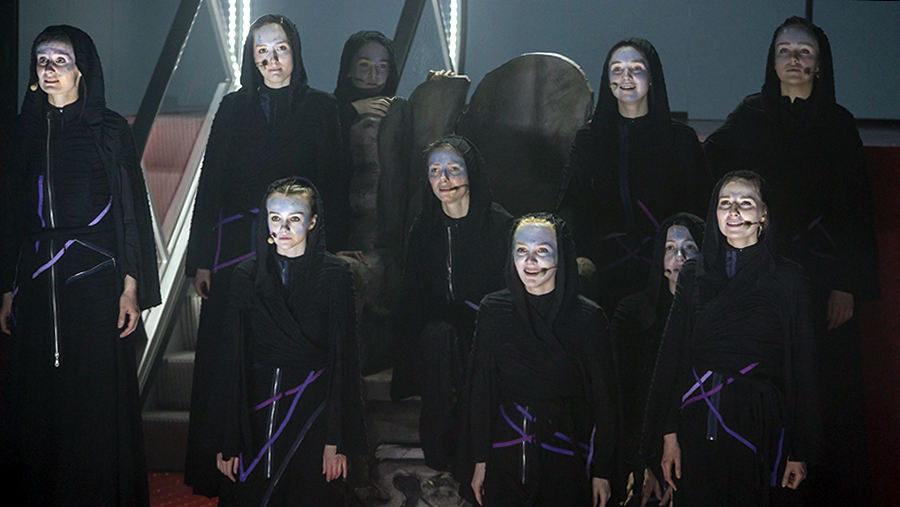
— The girls from the Gorky Moscow Art Theater also work well with the actresses of the Provincial Theater. Thus, we have already had a synthesis," said the artistic director.
Although the Greek salad has already been mentioned as a stereotype, the form of the performance is associated with it. Juicy numbers of frogs, widows carrying a coffin with a dead "non-poet", mirror conversations on the phone with a Greek and Russian mother, and a poetic battle of ancient tragedians are added in large chunks into a common "bowl".
At some point, the most famous Greek woman of our time, Maria Callas, appears on the scene. She, as well as two other roles, is performed by the director himself. He sings Casta Diva in a joking manner, and then talks about a tragic relationship with the Greek millionaire Aristotle Onassis, who preferred Jacqueline Kennedy to her.
The rest of the time, the music of another Greek composer, Theodor Abasis, is played in the hall, performed live by the musicians of the Provincial Theater, located on both sides of the small stage.
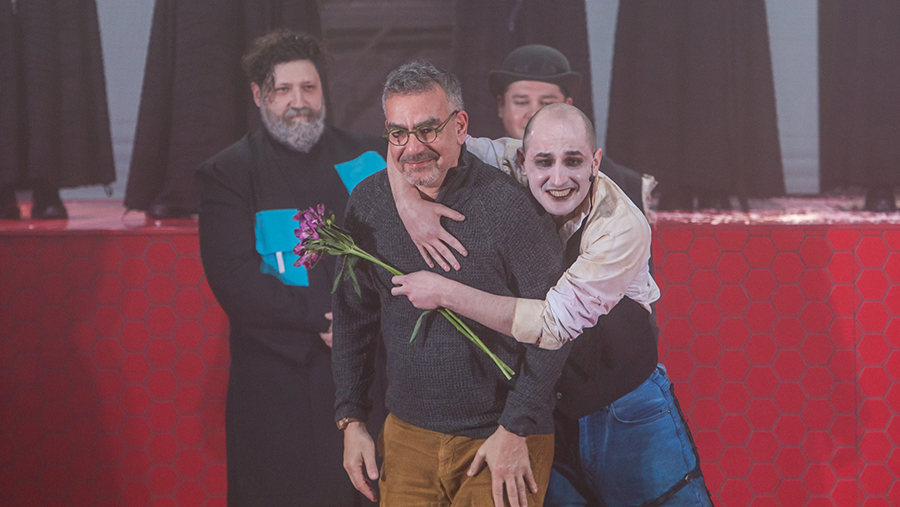
Although the play at first glance may seem like a strange combination of absurdity and grotesque on a Greek theme, in fact, it is not. The color, gesture, and sound hide understandable human issues.: Who am I in this world? What will be left after me? Can I be called a poet when it was Homer, Aeschylus and Pushkin?
Although Samurkas himself calls the performance "his Hades," not only Vasilios is wallowing in this "frog swamp," but also many of the living. That's why he defined the genre of the play as "maybe a comedy."
Переведено сервисом «Яндекс Переводчик»
