- Статьи
- Society
- The gates between worlds open on Krasnaya Gorka: the mystery of the Spring Memorial Day

The gates between worlds open on Krasnaya Gorka: the mystery of the Spring Memorial Day

On April 19, Orthodox Christians celebrate Antipascha, popularly known as Krasnaya Gorka. A holiday where pagan and Christian traditions are intertwined. In Russia, noisy festivities and screenings were held on this day, and the first weddings after a long break were held in churches. Details can be found in the Izvestia article.
The history of the Krasnaya Gorka holiday and how it is celebrated
There are several versions of the origin of this holiday, including those related to Slavic paganism. According to one of them, in pre—Christian times, bonfires were lit on the hills and hills on this day in honor of Dazhbog, the god of sunlight and fertility, they "conjured" spring with special songs and greeted the sunrise.
"However, due to the fact that we have extremely poor ideas about historical Slavic paganism, most likely these are some kind of ethnographic reconstructions of the second half of the 19th century, when such materials were popular," says Associate professor of the Department of Ancient Languages and Ancient Christian Writing at St. Tikhon's Orthodox University for the Humanities (PSTGU) in an interview with Izvestia Peter Pashkov.

In his opinion, the holiday is primarily connected with the folk custom of games — rolling eggs from the slides, as well as with the beginning of the wedding celebration period.
There were really massive weddings on Krasnaya Gorka, as it was the first day after a long break when weddings began again in the church. During Great Lent, the sacrament of marriage was not performed, and during Holy Week it was forbidden to do so, so as not to confuse the joy of the resurrection of Christ with the earthly one. Krasnaya Gorka was even called the "maiden's holiday" precisely for active matchmaking and for a large number of weddings.

There was even a special wedding ceremony, which included matchmaking and a preliminary agreement. Traditionally, young people were wooed before Lent, and the weddings themselves were arranged on Krasnaya Gorka in order to make it to Strada. An important part of the ceremony was the refusal of the bride's parents to the matchmakers, after which they carried the "sad news" to the groom, and then returned to the bride's parents in order to obtain consent.
Rolling painted eggs down the slides was one of the most popular activities on the holiday. The participants competed to see whose egg would roll next — it was believed that this particular person would be lucky and healthy throughout the year.

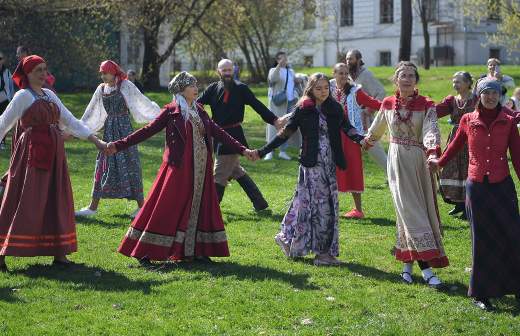
In Russia, noisy and crowded festivities were held on Krasnaya Gorka, and friends and relatives were visited. On this day (although the traditional celebration was not limited to one day), it was not customary to stay at home. For those who were not engaged, the festivities turned into a kind of viewing. The girls wore their best outfits, and the boys demonstrated their strength and dexterity in games and dances. Those who were already engaged were actively preparing for the wedding, which was considered especially happy on Krasnaya Gorka.
There was also a special custom for couples who got married last year: fellow villagers came to their homes with songs and congratulations, wished them happiness and children, and the newlyweds treated the guests with colored eggs and cakes.
Commemoration of the dead on Antipascha
For the Orthodox, it was the first day of their return to ordinary church life after Holy Week, which, according to canonical rules, should have been spent primarily in worship. During this time, services were held daily in churches, and believers were encouraged not only to participate in them, but also to receive communion as often as possible.
In popular beliefs, Krasnaya Gorka was often perceived as a special "transitional" day, when, according to beliefs, the boundary between the world of the living and the world of ancestors became more permeable. This was associated with the traditions of visiting cemeteries, memorial meals and symbolic "communication" with the dead, which reflects the ancient cult of ancestors preserved in ritual culture.

Since visiting cemeteries on Easter was not recommended, many traditionally did it on Krasnaya Gorka, which is why the holiday began to be associated with commemoration of the dead in the popular consciousness. They brought colored eggs to their graves and congratulated them on the Resurrection of Christ. However, in church practice, Krasnaya Gorka is not considered the main day for commemoration.
— After Easter, the commemoration of the dead begins on the ninth day — Radonitsa. There are no funeral commemorations as part of the Easter service, and according to the Charter, there should not be any as part of the Sunday service either," says Pyotr Pashkov.
Visiting the cemetery on Krasnaya Gorka is not prohibited. People can tidy up the graves, pray and remember their loved ones. However, the priests ask them to give up divination and magical rituals and visit the temple.
What are the differences between Krasnaya Gorka and Antipaskha?
In the Orthodox tradition, the first Sunday after Easter is called Antipascha. Many consider Krasnaya Gorka to be its popular name.
Peter Pashkov believes that church and national holidays, which coincide in time, should technically be considered as two different events. According to him, Krasnaya Gorka represents folk festivals, egg rolling, wedding games and customs, as well as the tradition of congratulating mothers-in-law and mothers-in-law. At the same time, Antipascha, as he notes, is a church holiday — "a certain church memory", which is celebrated a week after Easter. Thus, in his opinion, it is rather about two different holidays — church and national.

In the church, this day is called not only Antipascha, but also Thomas Week, since it is dedicated to the commemoration of the appearance of Christ to the Apostle Thomas on the eighth day after the resurrection.
Thomas is a disciple of Christ who was not present at His first appearance on Easter. He said that he would believe in the resurrection when he saw the nail wounds on Jesus' body and touched them. On the eighth day, when the Savior appeared to the disciples again, he invited Thomas to fulfill his intention. Upon seeing the resurrected Master, the shocked apostle immediately confessed his faith in Him, saying: "My Lord and my God." It is this gospel episode that is read at the Sunday liturgy on Antipascha.
This day in the church is directly related to the theme of faith and doubt. For Christians, the bodily resurrection of Christ is fundamental, so the apostle Thomas wanted to make sure that this was not a ghost or a spirit, but a truly resurrected Teacher. Antipascha shows the way from doubt to faith and teaches the importance of trusting the word of God without requiring miracles.
Переведено сервисом «Яндекс Переводчик»
