
Trial by peace: what the Leningraders suffered from in the first years after the war

In mid—April 1945, Philip Tyurin committed his first crime in Leningrad. A year and a half later, he would become known as one of the first serial killers of the post-war period. Tyurin searched for his victims in the markets and lured them with an offer to exchange valuables for potatoes. He was exposed by chance in 1947. This tragic and bloody story became a kind of marker of time — against the background of an active revival after the terrible blockade, the residents of Leningrad, and indeed the whole country, were constantly faced with the severe consequences of the war — the growth of banditry, hunger and lack of housing. For more information about how post—war Leningrad lived and how it survived, see the Izvestia article.
How Leningrad was restored
According to approximate estimates, during the siege of Leningrad, more than 3.2 thousand residential buildings and about 9 thousand wooden houses were destroyed in the city and its surroundings, not counting factories, factories and other institutions.
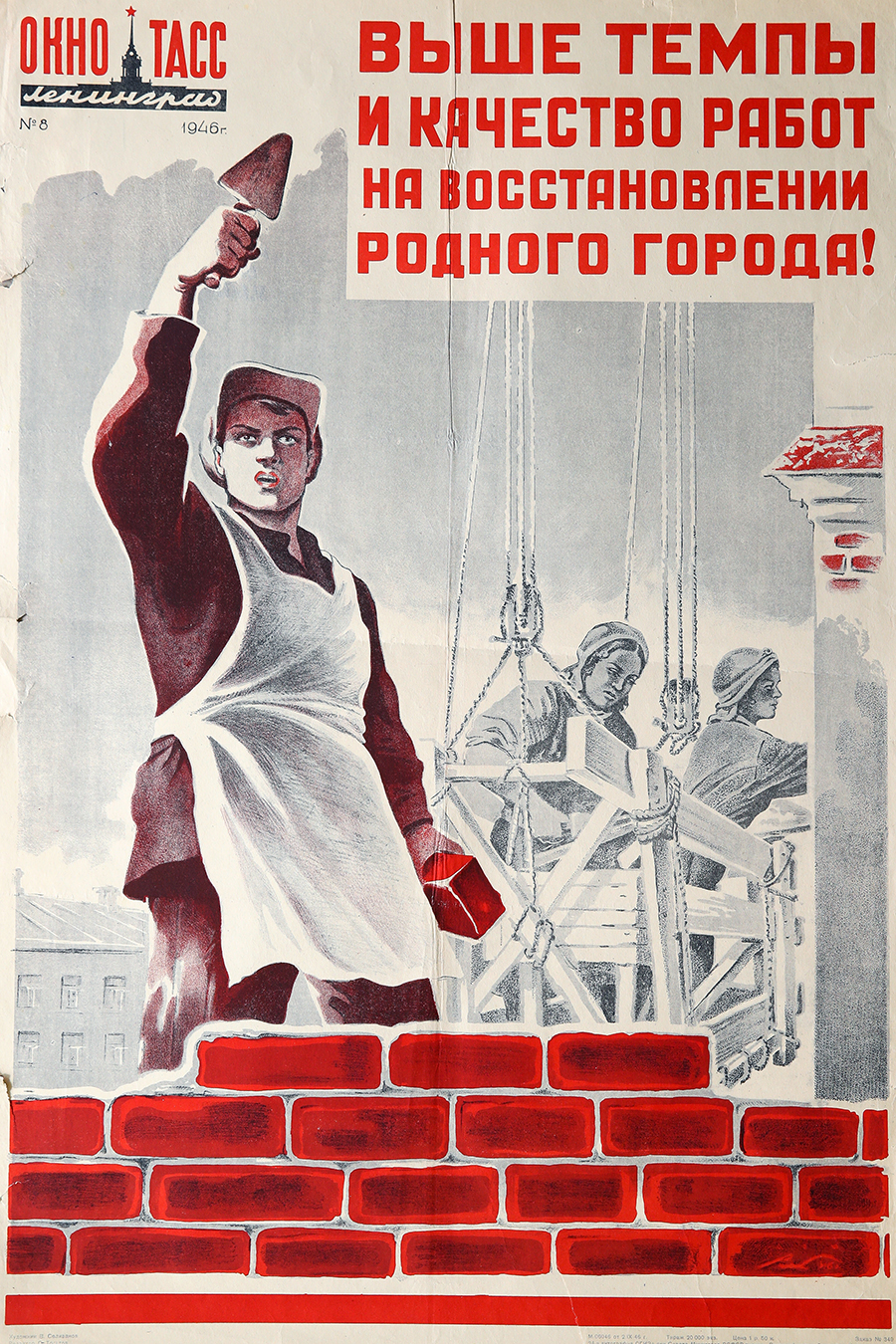
At the same time, active restoration began during the war years — so, in 1944, the General Plan for the restoration of the city was adopted, designed for a period until 1946. His main tasks were to restore the housing stock, clear the streets of rubble and repair communications.

Leningrad residents and local air defense fighters are clearing rubble and putting out fires after German air raids. The year 1942
— Two days after the lifting of the blockade, restrictions on pedestrian, tram and automobile traffic in the city were lifted. In March 1944, the USSR State Defense Committee adopted a special resolution on the restoration of industry and urban economy in Leningrad," Ilya Altman, professor of the Department of Modern Russian History at the Russian State University of Economics and Co—chairman of the Scientific and Educational Center "Holocaust", tells Izvestia.
In particular, the restoration affected 500 schools, almost 200 children's institutions, over 500 hospitals and polyclinics. The number of tram routes has been increased in the city, trolleybus traffic has resumed, street lighting has been carried out, and squares have appeared in place of recent rubble.
Cultural life did not stop during the years of the blockade, however, by the spring of 1945, many theaters had returned from evacuation, cinemas were operating, and sports events were held. Already in 1944, an exhibition dedicated to the heroic defense of Leningrad was opened in the city. By 1946, the republican museum was established on its basis (it existed for several years, but was closed in 1949 as part of the infamous "Leningrad Affair" - the museum's creators were accused of excessive attention to "the sufferings of one particular city").
However, despite the general atmosphere of the renaissance, the city's life was riddled with traces of the war — it is not for nothing that post-war Leningrad often becomes the setting for detective or historical series, such as the series "Rooks", which is expected to premiere in April.
Where did the Leningraders live
The first post—war years throughout the country were a time of re-evacuation and demobilization. Evacuees to the rear and soldiers from the front were returning home. However, Leningrad remained a closed city until mid-1946 due to a shortage of housing stock, says Ilya Altman.
— During the blockade, 20% of the housing stock was destroyed. Due to the lack of fuel and fires, there are practically no wooden houses left in the city. More than 1.5 thousand multi-storey buildings needed major restoration. The vast majority of the townspeople lived in communal apartments, and the workers brought to the city to restore industry lived in barracks, the historian explains.

Women are restoring the destroyed roof of Gostiny Dvor. The year 1946
Many residential buildings did not have toilets or running water, so living conditions in the city at that time could hardly be called comfortable. At the same time, Leningrad was rebuilt not only by professional builders — all able-bodied residents were involved in the restoration of the city, and the labor of German prisoners of war was also used.
Another unexpected problem was the rats that bred in the city due to the almost complete absence of cats and dogs. As a result, immediately after the lifting of the blockade, the city's leaders had to wage a real war against rats, a large number of which threatened mass epidemics.
What the Leningraders ate and drank
The issue of food availability in the post-war years, when all resources were devoted to reconstruction, was all over the country. But in Leningrad, which had survived the tragic siege, it was especially acute. Nevertheless, in the spring of 1944 — that is, immediately after the lifting of the blockade — alcohol appeared on free sale, albeit at increased prices.
— Vodka, wine, and beer were sold in public catering, in movie buffets, theaters, cultural centers, and train stations. However, the supply of vodka and wine in one hand was no more than 100 grams, beer – no more than 0.5 liters or one bottle, — says historian Ilya Altman.

Since the spring of 1944, bread production in the city has increased significantly, but in general, food products — primarily white bread, horsemeat, fish, cheese, sugar and flour — were still in short supply, the source told Izvestia. Their residents had to get them out from under the floors. Despite the increase in food production, the card system was abolished only in December 1947. And this opened up wide opportunities for speculation.
So, Ilya Altman refers to documents of that time, which described the facts of selling bread to his friends contrary to the norms, as well as "criminal transactions between counter workers and a criminal element who buys coupons on the market, delivers coupons to the bakery." It is not surprising that in these circumstances, markets played a huge role in the lives of the townspeople.

In post-war Leningrad, the black market became a notable phenomenon of urban life. It was a structure deeply embedded in legal economic institutions. Some researchers note that the black market was objectively necessary to ensure the socio-economic stability of the city after the lifting of the blockade, Ilya Altman emphasizes.
— The main places of purchase and exchange remained the markets: Sennoy, Maltsevsky, Vladimirsky. Spontaneous crowds and flea markets could be seen at shops, thrift shops, pawnshops, train stations; a black currency exchange was located in Gostiny Dvor and the Tavrichesky Garden, the Izvestia interlocutor lists. — Let's also name the enterprises, including public catering, and warehouses from where the theft of goods took place.

It is not surprising that the market is becoming an important point in the geography of post—war Leningrad — people came there not only for food and scarce household goods, such as clothes or shoes, but also for information, as does the main character of the series "Grachi", captain of the criminal investigation department Ratnikov.
At the same time, such a system posed a serious threat to the socialist system, so the authorities used harsh measures to eliminate such activities in Leningrad.
— However, according to the researchers, despite the constant growth of administrative and criminal cases, the scale of the black market not only did not decrease, but also increased. It was not possible to completely eradicate it, — Ilya Altman notes.
Crime and police
Speculation was an important, but not the only component of the criminal chronicle of those years. The increase in the number of crimes is also noted in the memos of Interior Minister Sergei Kruglov addressed to Stalin and the top Soviet leadership.
For example, in a document dated 1946, he spoke about the tightening of measures throughout the country against the background of "some increase in crime" in 1946-1947: "In the ongoing work to combat criminal crime, the operational staff of the Ministry of Internal Affairs and military units with broad public involvement are used to help the police." At the same time, there was a fierce hunt for war criminals, Nazi collaborators who hid in peacetime under new names — this work, which began in the first post-war years, continued until the 1990s and 2000s.

A surge in crime is a common phenomenon against the background of major historical cataclysms, says Sergey Rossinsky, Doctor of Law, Professor, Chief Researcher of the Criminal Law, Criminal Procedure and Criminology Department at the Institute of State and Law of the Russian Academy of Sciences, in a conversation with Izvestia.
— Of course, this was observed throughout the USSR, but Leningrad was under siege, it has a special position. After such cataclysms, an increase in crime is natural, but there were also a lot of additional factors. Firstly, there is a huge number of unaccounted-for weapons. It is clear that after the war it was found on the battlefield, and taken from the dead, and so on," he explains.
A separate difficulty was that the number of law enforcement officers decreased during the war. Of course, they tried to compensate for the shortage of personnel — in particular, immediately after the war, young officers were often sent to the police on Komsomol vouchers. As a result, experienced operatives had to train newcomers literally on the go. At the same time, the number of serious crimes increased dramatically in the first post-war years.

— For example, there were immediately more robberies and assaults. For obvious reasons, in particular because of the availability of weapons. They've been there before, these crimes are just not so daring, not so boundless," Sergei Rossinsky notes. — So, I would say that the portrait of the criminal has not changed much, he has just become more cynical, tougher, more audacious.
Such, in particular, were the crimes of the infamous Philip Tyurin, a veteran who fought from 1941 until he was seriously wounded at the end of the war, he ended up in Leningrad for treatment. After being discharged from the hospital, he decided to stay in the city: he got a job as a coachman at the factory canteen, and with it — a cart, a horse, and housing in a barrack. However, as it turned out later, this was not enough for him.
Since April 1945, Tyurin went on a bloody "hunt" — in two small Leningrad markets, Predtechensky and Smolensky, he found people trying to exchange things for food. He offered to go with him to pick up potatoes in the cellar on his own, and when the man went down to the cellar, which was really in his barracks, he killed the man with a heavy object and took away simple valuables: worn shoes, shawls, old gramophones. He drowned the bodies of the unfortunate in the backwaters of the Neva River, so for almost a year and a half it was impossible to reach him.

Only in 1947, while searching for scrap metal, factory workers wandered into an abandoned firing point, where they found two bodies. During a search of the factory, the police found traces of blood in Tyurin's room, and learned from neighbors that he had recently left for his homeland in Ryazan with 11 suitcases of "good". Tyurin was arrested and in May 1947 appeared before a court, which sentenced him to capital punishment.
However, not all criminals included in the statistics were like that — cynical, self-serving, heartless, Sergei Rossinsky recalls. It was often the hard life of the post-war years that pushed generally decent people to desperate measures.
— At that time, there were also a lot of crimes that were committed not from the point of view of criminal cynicism, but from hunger. People committed theft, and some other economic crimes, and even thefts, not because they were so bad, but because they had nothing to feed their children," the expert emphasizes.

Piskarevskoye cemetery in Leningrad. The year is 1963
And although by the end of the 1940s the first and most serious problems had been overcome, Leningrad, like the whole country, still had many decades of painstaking restoration and preservation of memory ahead. So, by the 1960s, work on the revival of suburban palaces was still in full swing, but in May, on May 9, 1960, the Piskarevskoye Memorial Cemetery was already opened, Ilya Altman recalls.
— The historical center of the city has been renovated and renovated. However, in the hearts of every Leningrader, relatives and friends of people who survived the blockade and defended the city from the enemy, as well as their descendants, the memory of the victims of civilians, the "Road of Life", and the feat of our soldiers will live forever," he emphasizes.
You can learn more about the life of post-war Leningrad and its brutal criminal world in the series "Rooks", which will premiere on April 26.
Переведено сервисом «Яндекс Переводчик»
