
Arrange the price: the budget may receive 1 trillion oil and gas revenues in April

Oil and gas revenues of the Russian budget in April may amount to 1 trillion rubles, which is the highest level since mid—2024, experts have calculated for Izvestia. The war in the Persian Gulf and the reduction of production in the Middle East countries led to an increase in demand for Russian oil and its cost. According to the International Energy Agency (IEA), revenues from the export of oil and petroleum products in March amounted to almost $19 billion, despite the fact that export growth in the first month of spring increased by only 4.7% and amounted to 7.13 million barrels per day. What prices to expect for Russian oil in the future is in the Izvestia article.
How Russian oil sales have changed
The Middle East conflict has led to a decrease in oil production in the region, an increase in demand for Russian raw materials and an increase in their cost. According to the International Energy Agency (IEA), Russia's export revenues in March amounted to $19.04 billion, while total exports increased by only 4.7% and reached 7.13 million barrels per day.
Oil supplies in March increased by 270 thousand barrels per day, and petroleum products — by 50 thousand. Revenues from fuel exports reached $11.45 billion ($5.41 billion more than in February), and from exports of petroleum products — $7.59 billion (an increase of $3.88 billion), according to the IEA's monthly report.

According to Dmitry Kasatkin, managing partner of Kasatkin Consulting, thus, Russian oil and gas budget revenues may increase by 60% by the end of April and amount to about 1 trillion rubles.
— It is important to separate the export revenue of companies and budget revenues. The $19 billion in export revenues reported by the IEA is, in fact, the estimated revenue of oil companies. It is not directly transferred to budget revenues, but with a time lag," the source said.

He recalled that the March budget receipts amounted to 617 billion rubles, and they are calculated at February prices.
— The price spike in budget revenues will be reflected only in April: the mineral extraction tax is paid on the 28th of next month. Plus, the next quarterly payment on personal income tax will be received in April. Based on this, by April we expect oil and gas revenues to be at the highest level since mid—2024 — in the amount of about 1 trillion rubles," Dmitry Kasatkin calculated for Izvestia.

In February, oil and gas revenues of the Russian budget amounted to 432.3 billion rubles, in January — 393.3 billion.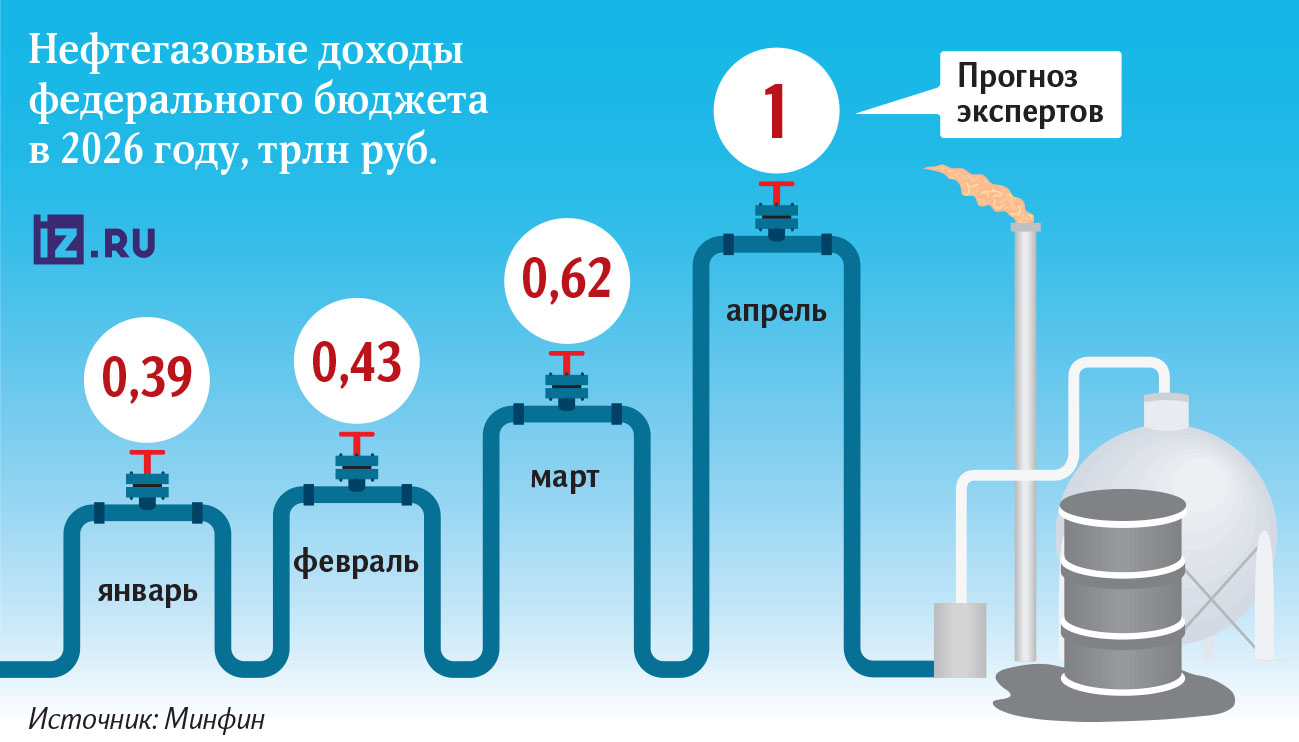
According to the Ministry of Economic Development, the average price of Urals in January was $40.95 per barrel, in February — $44.59, in March — $77 for the same volume.
Why have Russian oil prices increased?
According to an OPEC report published on April 13, in March, the OPEC+ member countries reduced oil production by 7.59 million barrels per day.
According to the head of the IEA, Fatih Birol, about 40 key energy assets in the Middle East were damaged as a result of the Gulf war. "Some of them are slightly damaged, but some are serious or even very serious," he said.
According to the Energy Information Administration of the US Department of Energy (EIA), a gradual return to pre-crisis production figures in the region will occur towards the end of the year, even if the war in the Middle East ends before the end of April and the restoration of shipping in the Strait of Hormuz begins from that time.

According to OPEC, in March 2026, Russia increased oil production by 3,000 barrels per day by February, to 9.167 million barrels per day.
As Deputy Prime Minister Alexander Novak noted at the end of March, Russian oil and petroleum products are in demand on the world market and are sold at no discount, and in some cases at a premium. At the same time, freight costs have increased due to the situation in the Middle East, he added.

In early April, the media, citing the Argus pricing agency, reported that the cost of shipments of Russian Urals grade oil delivered to the ports of the Chinese province of Shandong increased by $14.5, to $109.7 per barrel. The premium to June Brent futures on the ICE exchange reached $6 per barrel.
In India, the premium for Russian oil is also growing. According to Argus, the price of Urals with delivery to the west coast in May increased by $1.5, to $125.7 per barrel, the premium was $5.4. Some shipments with delivery in April are offered at a premium of $10 per barrel, the review said.

Ekaterina Kosareva, Managing Partner of VMT Consult, recalled that different price models are used in the commodity markets. For example, futures contracts are distinguished, in which the buyer commits to purchase raw materials in the future at a pre—agreed price, and spot transactions with almost instant delivery and settlement within a few days. In addition, the bases for the formation of the cost of supplies also differ. The FOB (Free on Board) price includes all costs up to the time of loading the raw materials onto the tanker, CFR (Cost and Freight) — the cost of delivery to the destination port, and CIF (Cost, Insurance and Freight) additionally takes into account the cost of cargo insurance.
—The price of Urals oil, which taxes are calculated on, includes the average cost of raw materials at the time of delivery to the main Russian export ports — Primorsk, Novorossiysk and Kozmino," the analyst noted.
According to her, despite the fact that the G7 imposed a ceiling on Russian oil prices of $47 per barrel, our country did not sell its raw materials at such prices to countries that support the restriction.
— Our main customers lately have been China, India and Turkey. At the same time, the first two countries practically divided the main volumes in half. And they are currently competing for them, which is further fueling the price of Russian oil. In addition, it should be borne in mind that in March, the US Treasury lifted restrictions on the sale of Russian fuel loaded into tankers until March 12 for a month," Ekaterina Kosareva said.

The deadline for such relief expired on April 11. And, according to Dmitry Peskov, the press secretary of the Russian President, the United States has not made any announcements about the renewal of the license for the sale of Russian oil.

What will happen next to oil prices
Currently, oil prices are sensitive to the situation around Iran: if the announced truce led to a decrease, then the statement by US President Donald Trump about the blockade of Hormuz led to a new increase, said Valery Andrianov, associate professor at the Financial University under the Government of the Russian Federation.
— It is unlikely that anything in this regard will change in the coming weeks. Prices will clearly follow the scale of tension in the region, and so far it is absolutely impossible to predict how it will change. It is unknown whether the second round of US-Iranian talks, scheduled for April 16, will be crowned with any success, or whether a new round of escalation will begin. In the first case, the quotes will fall below $ 100 per barrel, but it is unlikely to fall below $90. The risk premium will remain at least until the end of the year and is likely to move on to the next one," says Valery Andrianov.

According to him, if the United States attacks Kharq Island with its shipping terminals or launches a ground operation in other areas of Iran, Tehran will respond with all means at its disposal, including hitting terminals, fields and refineries in the Gulf countries. And then prices will immediately go to the region of $ 150 per barrel, and in case of prolonged hostilities, they may approach $ 200 per barrel.
According to Dmitry Kasatkin, the incentive is now maximum: with the price of Brent oil at $105-110 per barrel, each additional tanker generates 50-60% more revenue than in February.
— But physical abilities are limited. The Baltic ports of Primorsk and Ust-Luga are still operating at reduced capacity after the March accidents, which account for 40-45% of Russian sea exports of oil and petroleum products. Novorossiysk is almost fully loaded, and Kozmino is limited by the capacity of the ESPO pipeline system," the source said.

He believes that the scenario of even a slight decrease in exports may be realistic — by 5% compared to March's 7.13 million barrels, despite the favorable price environment.
— But at the same time, revenue may grow due to higher prices and a narrowing of the Urals discount to Brent. We get a situation where we export a little less, but earn significantly more. In any case, the second quarter will be significantly better for the budget and for companies than the first," the analyst believes.
According to Tamara Safonova, General Director of the Independent Analytical Agency for the Oil and Gas Sector, in order to increase oil and gas budget revenues above the level of January – April 2025, it is necessary that the price of black gold by the end of April be more than $80 per barrel, which in the current market conditions, achieving this level looks realistic.
Переведено сервисом «Яндекс Переводчик»
