Delay group: conflict between Pakistan and Afghanistan has hit Russian projects in the region
- Статьи
- World
- Delay group: conflict between Pakistan and Afghanistan has hit Russian projects in the region


The escalation between Kabul and Islamabad is delaying the implementation of Afghan projects with Russia's participation, Zamir Kabulov, the Russian president's special envoy for Afghanistan, told Izvestia. According to him, practical work on the construction of the Trans-Afghan Railway and the refinery has not begun. The development of an economic justification for transit with the participation of Russian Railways is postponed for at least several years and requires an adjustment of the route, industry sources familiar with the situation told Izvestia. It is important for the Russian Federation to develop logistics through Afghanistan, which would allow it to reach the ports of the Arabian Sea through Pakistan and India.
Which Russian projects are frozen in Afghanistan
The escalation between Pakistan and Afghanistan, which has been going on for several months, has undermined the already fragile security in the region and, in fact, frozen major economic projects involving Russia. First of all, we are talking about the Trans-Afghan Railway. Practical work on its construction has not begun, Zamir Kabulov, the special representative of the President of the Russian Federation for Afghanistan, told Izvestia. In addition to the Russian Federation, Uzbekistan and the conflicting parties directly involved in the project are Afghanistan and Pakistan.
— Of course, any fighting has an impact on the promotion of projects. All this [the Trans-Afghan Railway project] is still at the design stage. And it's probably premature to talk about real work "on the ground." So far, we have not seen such work," he said.
In July 2025, an agreement was signed on the preparation of a feasibility study for the project. Earlier, Russian Deputy Prime Minister Alexei Overchuk stated that it would be ready in early 2026, but due to the outbreak of the conflict, the dates had to be postponed, Alexander Sharov, CEO and head of Rusiranexpo Group, who is familiar with the situation, told Izvestia. According to him, due to large investments on the Termez-Mazar–I-Sharif–Kabul–Peshawar route, many complex long tunnels are required.
— This shift is, if not forever, then at least for several years. Most likely, a more understandable railway will now be built — also Trans-Afghan — along the Turgundi–Herat–Iran route. And after that, it will be possible to get to Karachi and the Iranian port of Chabahar through Iran using the already operating railway. This is much closer," the expert believes.
For Russia, this project plays an important role from the point of view of logistics — it can become one of the elements of the international North–South transport corridor, which should connect the countries of Northern Eurasia with the Global South, Alexey Overchuk noted.
— We have talked more than once, but we have an interest in Afghanistan's transit opportunities. With access through Pakistan to the ports of the Arabian Sea. But if the two countries are actually at war, then such projects will be suspended," Kabulov clarifies.
The second project, which is also, in fact, put on pause due to the conflict, is the construction of an oil refinery in Afghanistan with the participation of the Russian Federation. In May last year, Kabul signed an oil production and refining agreement with the Russian company Inteco Group.
— The agreement is promising. But again, apparently, this is still at the level of desires and intentions, it is also premature to talk about real work "on the ground". I hope that this project will move forward," Kabulov said.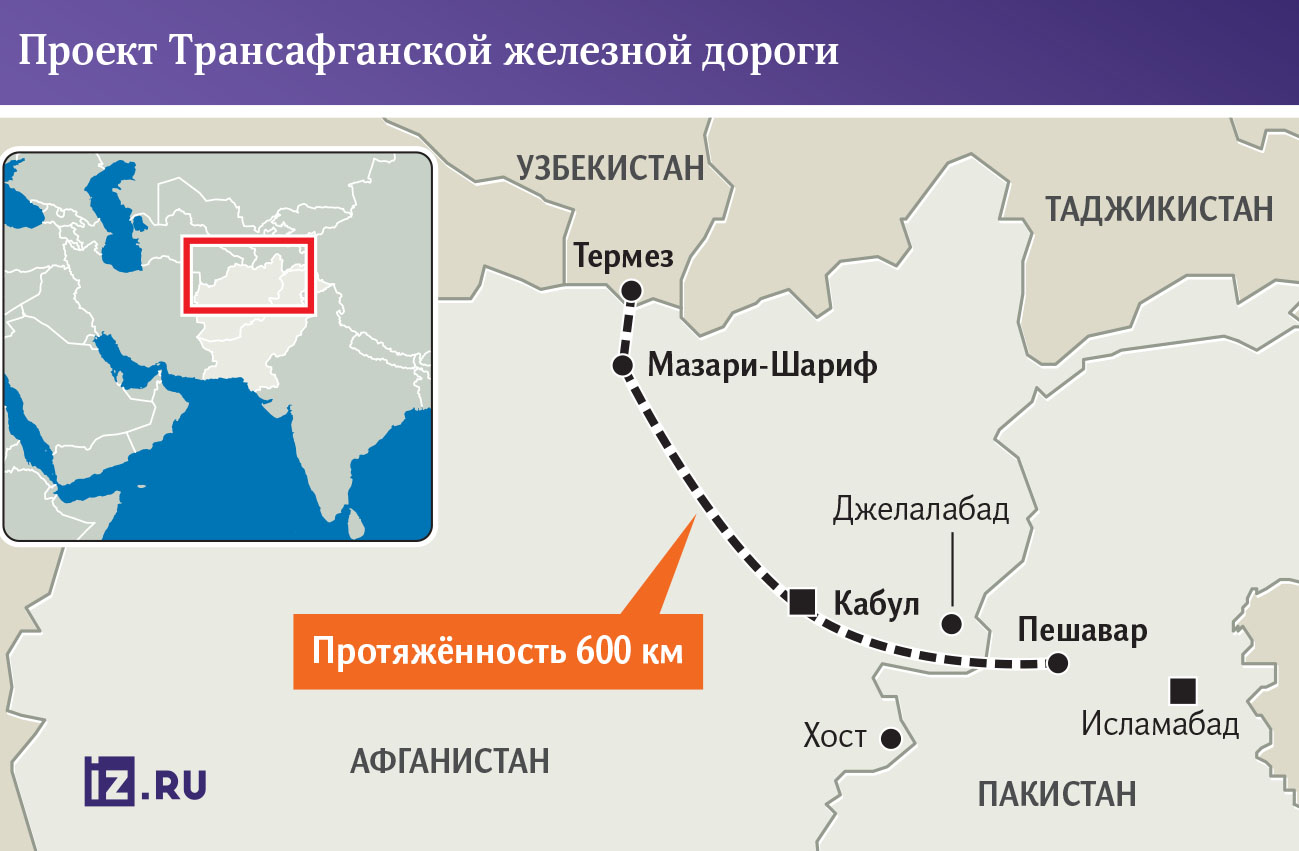
It is obvious that both sides are interested in the construction of the refinery. Today, Afghanistan continues to import Russian oil products in large quantities through Uzbekistan and Kazakhstan, which means that they do not have their own production facilities, the diplomat said. Initially, China tried on the role of an investor in the field of Afghan oil refining, then Russia showed interest. However, Moscow will not face competition from Beijing, because the latter has not achieved much success, Kabulov added. In June 2025, the Taliban terminated a 25-year contract with a Chinese company for the development of an oil field due to "repeated violations of contractual obligations by the contractor."
How is the conflict settlement progressing
It is important to note that each party involved in the Trans-Afghan Railway project is independently responsible for security on its territory. The idea of creating a common body was rejected, an anonymous market participant told Izvestia. According to him, despite the assurances of the Taliban and high-level security discussions, experts emphasize the high risks, since the same Central Asian countries do not have real levers of influence on the situation in Afghanistan and Pakistan.
The role of mediator in this situation can be played by international heavyweights, for example, the Russian Federation and China. In particular, on April 8, peace consultations between Afghanistan and Pakistan were held in the Chinese city of Urumqi with the mediation of Beijing. As a result, the parties verbally pledged to refrain from steps leading to escalation, said Chinese Foreign Ministry spokeswoman Mao Ning. However, no cease-fire documents were signed at the exit, Zamir Kabulov stressed.
— Apparently, the positions of the Afghans and Pakistanis are so far from each other that they have not been able to achieve any significant progress, which, of course, is regrettable. As for us, both Sergey Viktorovich Lavrov and I have said that Russia is ready to play [the role of mediator], but on the indispensable condition that such an appeal is received from both sides," the diplomat said.
He also allowed for a four-way format of negotiations involving Afghanistan, Pakistan, Russia and China. So far, neither Kabul nor Islamabad has officially approached Moscow with such a proposal. "Apparently, they still have the potential to clarify relations between themselves by force rather than diplomatic methods," Kabulov complained.
Islamabad regularly accuses Kabul of harboring militants involved in terrorist attacks in Pakistan. In late February, Afghanistan launched an operation along the disputed border, saying it was a response to Islamabad's aggression against the Tehreek-e—Taliban Pakistan and the Islamic State-Wilayat Khorasan groups (both recognized as terrorist and banned in Russia).
Experts note that both sides violated the truce concluded back in October 2025 with the mediation of Qatar and Turkey, and so far they see no reason to return to a serious settlement. Active clashes on the border occur regularly. The last one happened on April 2, when the shootings continued all night.
The deputy press secretary of the supreme leader of Afghanistan, Hamdullah Fitrat, blamed the Pakistani military for the attack. According to him, two civilians were killed and another 25 people were injured, most of them children. According to the media wing of the Armed Forces of Pakistan (ISPR), the goal was to eliminate a group of militants from the Tehreek-e Taliban Pakistan.
Just after the meeting in China, the parties agreed to stop the escalation, but a full-fledged ceasefire agreement could not be reached.
Переведено сервисом «Яндекс Переводчик»
