- Статьи
- Economy
- The harvest was dismantled: prices for cucumbers and tomatoes fell among producers and rose among retailers

The harvest was dismantled: prices for cucumbers and tomatoes fell among producers and rose among retailers

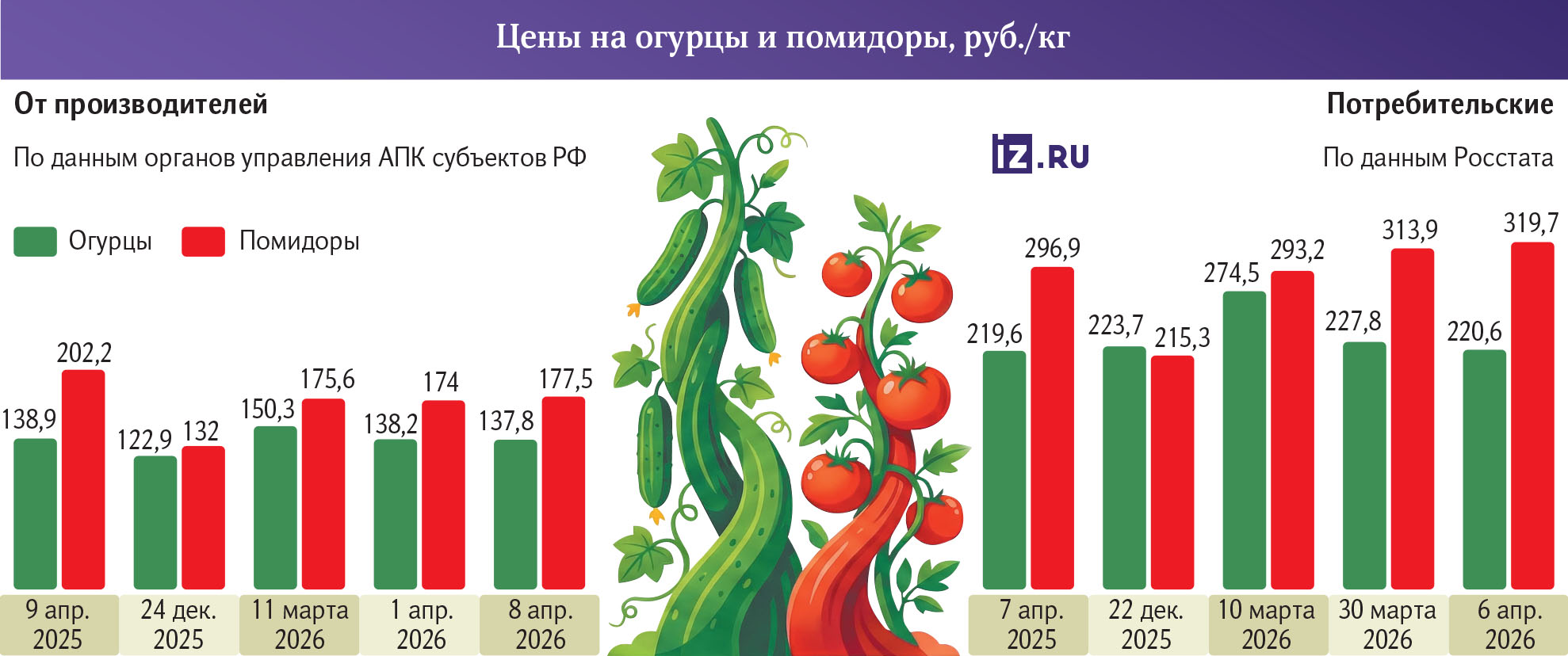
Prices for tomatoes and cucumbers for the year fell by 12.2% and 0.8% among producers, but increased by 6.8% and 6.2% for retailers, respectively, Izvestia learned. Other vegetables have fallen in price both from farmers and in stores. Potatoes in retail have lost 28.4% in price, and in producers — 27.4%. At the same time, overall food inflation accelerated in April. The main reason was the increase in the cost of vegetables and fruits, according to Rosstat. Tomatoes rose the most from March 31 to April 6 by 2%, carrots by 1.8%, potatoes and apples by 0.6%. The Ministry of Industry and Trade has scheduled a meeting with manufacturers and retailers on the price situation on April 23, market participants told Izvestia.
Which products have their prices decreased?
In Russia, prices for cucumbers and tomatoes from producers have decreased over the year, but retail prices have increased. According to the Ministry of Agriculture, reviewed by Izvestia, tomatoes fell by 12.2% year—on-year on April 9, and cucumbers by 0.8%. At the same time, during the same period, prices for these vegetables increased in retail trade: tomatoes rose in price by 6.2%, cucumbers — by 6.8%, Izvestia calculated based on Rosstat data.
A less noticeable cost gap is observed for cabbage — a decrease of 35.3% in producers, and only 29.2% in retail. The cost of other crops, according to the ministry, decreased both among farmers and in retail trade. In particular, potatoes fell in price by 27.4% among producers and by 28.4% in retail, onions — by 17.5% and 19%, beets — by 4.6% and 18.9%, respectively.

Inflation in the Russian Federation for the period from March 31 to April 6, 2026 amounted to 0.19%, according to Rosstat data. A week earlier, from March 24 to March 30, it was 0.17%. Since the beginning of April, consumer prices in Russia have increased by 0.17%, and by 3.15% since the beginning of the year. The largest contribution was made by tomatoes (2%), carrots (1.8%), white cabbage (0.9%), potatoes and apples (0.6% each), as well as beets (0.5%).
Sugar also rose in price (by 1.4%), canned fruits and berries for baby food (1.2%), vegetables (1%) and meat (0.8%). Price increases were also recorded for a number of other products: eggs (0.7%), sunflower oil, millet, noodles and salt (0.4% each), beef, sausages, margarine and black tea (0.3% each), pork, chicken, frozen fish, kefir, milk mixtures, pasta, biscuits and vodka (0.2% each), as well as mutton, sour cream, rye and wheat bread, lunches in the canteen, cafe, snack bar (except for the canteen in the organization) — 0.1%.

By the end of 2025, Russia had a high harvest of vegetables and potatoes — 7.6 million tons and 8.5 million tons, respectively, the Ministry of Agriculture told Izvestia. As a result, the country came very close to the targets of the Food Security Doctrine for self-sufficiency in vegetables (89.6% with a threshold value of 90%) and reached the threshold value for potatoes (97.9% with a threshold value of 95%), the ministry added.
— In 2026, the positive dynamics in the production of greenhouse vegetables remains. As of April 7, over 391.2 thousand tons of products were collected in the organized sector, which is 1.5% higher than in the same period of 2025. Including the harvest of greenhouse cucumbers is over 223 thousand tons, tomatoes — more than 158 thousand tons, the ministry said.

They added that high production volumes make it possible to ensure a stable price situation in the domestic market. So, despite the seasonal factor typical for this period of the year, prices for almost all vegetables are now lower than the same period last year. After the new crop enters the market, the traditional reduction in the cost of vegetable products is expected.
— At the same time, in cooperation with the Ministry of Industry and Trade, the Federal Antimonopoly Service, the Ministry of Economic Development and the deputy corps, a legislative initiative is currently being worked out to consolidate the mandatory share of long-term contracts for the supply of food products. It is assumed that this will avoid significant fluctuations in food prices, while the parties will be free to choose the tools used in their contract model, the Ministry of Agriculture said.
Izvestia sent a request to the Ministry of Industry and Trade with a request to comment on the reasons for the price difference between manufacturers and retailers.

The Potato Union told Izvestia that prices for the entire borscht set in the wholesale this year are much lower than in 2025.
— For potatoes, the market is now provided with both domestic and imported vegetables, and in this situation, farmers are forced to reduce wholesale prices for them, as it is unfortunate for producers, as they are losing their profitability, — said Alexey Krasilnikov, Executive director of the Potato and Vegetable Market Participants Union (Potato Union).
At the same time, they reported that on April 23, the Ministry of Industry and Trade is scheduled to hold a meeting with manufacturers and retailers to discuss the price situation.

The Rusprodsoyuz Association of producers and suppliers told Izvestia that producer prices for vegetables have decreased year-on-year in most categories.
— Compared to the same period in 2025, cabbage fell in price by 47.2%, potatoes — by 46.5%, beets — by 33.2%, onions — by 25.6%. In the first week of April 2026, average wholesale prices for potatoes in Russia were at 22.7 rubles/kg, for onions — 21.2 rubles/kg, for beetroot — 17.5 rubles/kg, for cabbage — 6.1 rubles/kg," said Dmitry Vostrikov, executive director of the association.

He noted that since April, the market has been receiving borscht products grown in light greenhouses and products of early soil production, which are usually slightly more expensive than last year's. In this regard, there is an annual increase in prices from April to early June. Therefore, it is correct to compare the cost year by year in order to exclude waves of seasonality, the expert said.
According to him, with the start of mass harvesting of open-field vegetables in the fields from the second half of June, the market is filled with supply every year, and prices are leveled.
— The main risk, in our opinion, is a drop in value: its decrease as a result of overproduction or oversaturation of the market leads to a decrease in production volumes in the next period and to a deterioration in the financial condition of agricultural producers. It is during such periods that the regulator should not open imports to compensate for the shortage, since domestic producers are able to increase output on their own. In a situation of overproduction, measures to develop exports and additional processing are more relevant: their potential is quite high," Konstantin Yurov, deputy chairman of the People's Farmer Association, told Izvestia.
How does rising food prices affect the acceleration of inflation
At the same time, Russian economists have a more critical assessment of the price situation.

"The inflation rate has stopped decreasing. Over the past three weeks, its level has been twice as high as in the previous two weeks: 0.55% versus 0.27%. As a result, the consumer price index, according to the trend forecast, may reach 0.6% in April, that is, about 6.4% by April 2025," according to the analytical monitoring of the Center for Macroeconomic Analysis and Short—term Forecasting "On inflation dynamics from March 17 to April 6, 2026," which was reviewed by Izvestia.

The document, prepared by Dmitry Belousov, head of the department of analysis and forecasting of macroeconomic processes, concludes that the downward trend in annual inflation has probably reversed. One of the most noticeable factors, he calls a halt in the cheapening of fruit and vegetable products. "In the last three weeks: 0.0%, including +0.2% for the week from March 31 to April 6, against minus 0.8% over the past three weeks," the document says.
According to him, it is still advisable to keep in focus the increase in the cost of cheap animal protein sources — eggs (+3.6% in three weeks, +7.8% in the previous three) and frozen fish (+0.67% and +0.91%).

At the same time, the FAS told Izvestia that the service is closely monitoring the pricing situation for vegetable products on the domestic market.
— In order to minimize the impact of the seasonal factor on pricing, the FAS recommends that regions actively conclude cost containment agreements with participants in these markets, while simultaneously taking additional comprehensive measures to stabilize them. The initiative will avoid significant price fluctuations for food products, while the parties will be free to choose the tools used in their contractual model, the regulatory authority explained.
They also noted that the service requested information from the largest federal chains on the weekly dynamics of weighted average purchase and retail prices for cucumbers, as well as on the volume of their purchase and sale. Currently, the agency is analyzing the validity of establishing the wholesale and retail value of this product, the FAS clarified.
— The dynamics of prices for vegetables in retail chains in April fits into seasonal trends: prices are already actively decreasing in some items, while in others they are still at a seasonal peak. Compared to last year, potatoes and cabbage have noticeably fallen in price: in early April 2026, compared to the same period last year, cabbage fell by 29%, to 33 rubles per 1 kg, potatoes — by 36%, to 40 rubles per 1 kg, the chairman of the Association of Omnichannel Retail Companies told Izvestia (ACORT) Stanislav Bogdanov.
 According to him, retail chains sell both items at a negative margin below the purchase price, additionally investing in the availability of socially significant products to customers.
— The cost of greenhouse vegetables in retail chains included in ACORT is typical for this time of year: cucumbers have been getting cheaper for more than four weeks in a row, and tomato prices are still at their peak — the seasonal correction usually begins in the second half of April. The minimum retail price of cucumbers in large retail chains decreased by 32% from the end of February to the beginning of April, to 182 rubles per 1 kg. The assortment has grown by 20% over the same period and reaches 17 types of cucumbers, depending on the store's format," explained Stanislav Bogdanov.
He also noted that prices for tomatoes in large retail chains are stable and start from 249 rubles per 1 kg, with an assortment of five to 53 types and packages, depending on the store format. As greenhouse heating costs decrease and supply expands due to domestic ground vegetables, prices will continue to decline in the summer season, the industry representative stressed. According to him, retail chains, for their part, are working to expand the supply of domestic and imported vegetables in order to provide a diverse and affordable assortment in different price segments.
Переведено сервисом «Яндекс Переводчик»
