
State-owned houses: What are the embassy buildings in Moscow hiding?

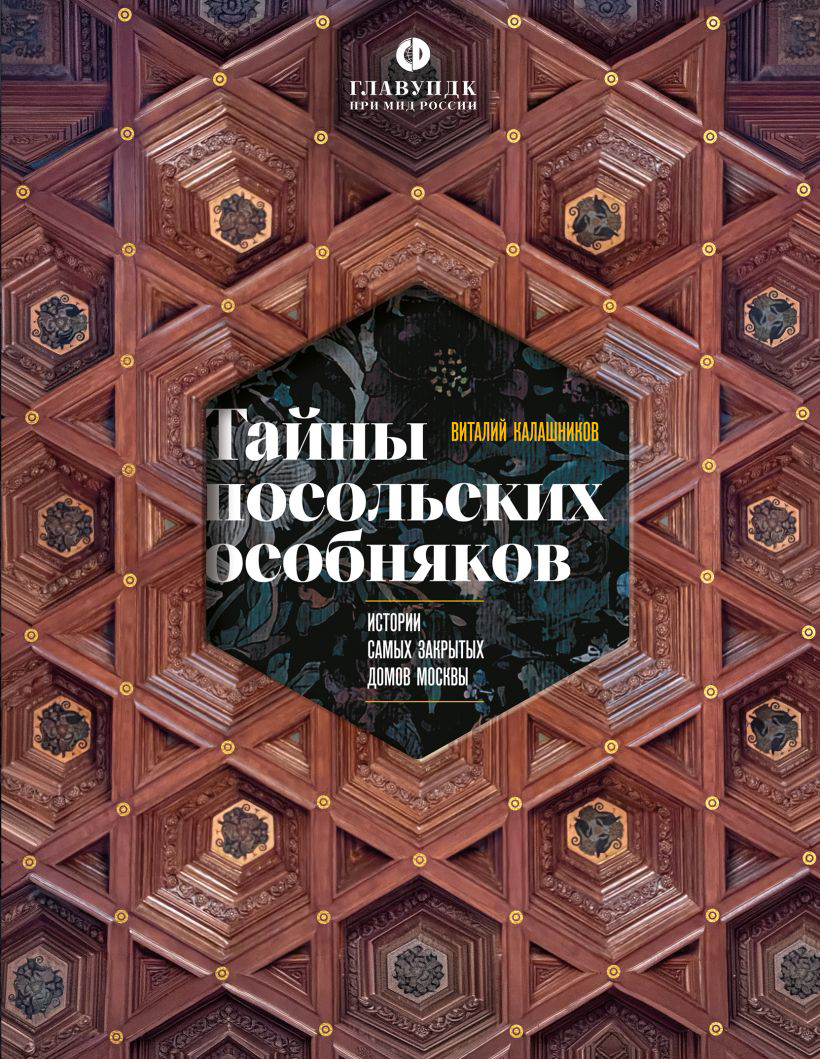
The book by the Moscow historian Vitaly Kalashnikov was written as part of a joint project with GlavUpDK at the Ministry of Foreign Affairs of Russia - the Main Production and Commercial Department for the maintenance of the diplomatic Corps, the history of which the author briefly touches on in the introduction with a somewhat fabulous intriguing title "And it all started with a royal gift ..." Meaning a solid building that hospitable Ivan IV provided He established the British diplomatic mission on the prestigious Varvarka Street and thus established the tradition of hosting foreign embassies in selected architectural masterpieces. Critic Lidia Maslova presents the book of the week specifically for Izvestia.
Vitaly Kalashnikov
"Secrets of embassy mansions"
Moscow: Eksmo, 2026. — 288 p.
A warm-hearted intonation (with warming phrases like "A couple of moments and you'll find out everything") is inherent in Kalashnikov's entire book, which describes in detail 16 unique Moscow buildings managed by GlavUpDK. In order to get used to the role of a storyteller, Kalashnikov is naturally pushed by the amazing decoration of mansions, which are not so easy for a mere mortal to penetrate - he can only admire the mythical creatures and fairy—tale characters on the facades.
Kalashnikov begins the story of what happened inside these buildings, including the stage of construction and interior decoration, with the stormy history of the mansion at 20 Prechistenka Street, where the Main Building Complex is now located, and Ivan Orlov, the hero of the era of palace coups and the favorite of Catherine II, originally lived. The chapter about this building is named after a later inhabitant — "General Ermolov's House": the legendary hero of the Patriotic War of 1812 spent the last 10 years of his life here, until 1861, and managed to advise Leo Tolstoy, who conceived a novel about the Decembrists (from which the epic "War and Peace" was later learned). In this chapter, the fabulous narrative style temporarily gives way to the serialized one. According to Kalashnikov, "the biography of this mansion draws on an epic series of several seasons," where the most dynamic episodes are associated with the post-revolutionary period, when Isadora Duncan, Sergei Yesenin, and her choreographic school briefly moved in here (the democratic American "barefoot" tried to combat imperial luxury by draping chandeliers with shawls and covering too expensive parquet carpets).
Dancers, ballerinas and other servants of Melpomene repeatedly appear on the pages of the book and decorate the lives of luxury real estate owners along with marble columns, openwork lattices and exquisite stucco. Alexandra Balashova, a ballerina at the Bolshoi Theater, managed to live in the same mansion on Prechistenka Street, because of which another landlord, merchant Alexei Ushkov, divorced his previous wife. Savva Morozov, the owner of the Gothic mansion on Spiridonovka, which was registered, as it was customary at the time, to his wife and therefore known as the Zinaida Morozova mansion, did not get a divorce due to his infatuation with the Moscow Art Theater actress Maria Andreeva. After her husband's death, the widow began to see the ghost of Savva Timofeevich, so she sold the house to Mikhail Ryabushinsky, who also soon acquired a ballerina: "he fell madly in love with Tatiana Primakova, a married Bolshoi dancer, and just like Morozov, he obtained a divorce from his lady of the heart and married her, contrary to the opinion of friends, relatives and the entire Old Believer community.".

However, it is not the dancers, actresses, writers and other bohemians who visited the merchants' mansions, but the creators of architectural masterpieces themselves that arouse more interest in Kalashnikov's book. First of all, this is the "Russian Gaudi" Fyodor Shekhtel, who illegally built Zinaida Morozova's mansion: "The day before, he was expelled from the Moscow School of Painting, Sculpture and Architecture with a ban on building houses in the city. Therefore, the documents for the Morozovsky mansion for the architect were signed by his assistant Ivan Kuznetsov." A separate chapter entitled "The House where masterpieces were born" is dedicated to Shechtel's own mansion in Ermolaevsky Lane: "Here Shechtel built not even a house, but a micro-town, or, as sometimes happened in the Middle Ages, a fortress city. Donjon tower, loophole windows, gable roof." The architect himself spoke about his multifaceted "all-Western" creation, not without self-irony, for example, in a letter to Chekhov: "He built a hut of obscene architecture, which the cabmen take either for a church or a synagogue."

Alexander Zelenko stands out among the brightest and most original followers and students of Shechtel, who first developed in Samara and then built Loskov's apartment building in Moscow. This building, which adorns Mansurovsky Lane, looked unusual even against the backdrop of the bold architectural experiments of the early twentieth century. However, unlike the Samaritans, who were proud of the architect who turned the Volga city into almost a "second Paris," the arrogant Muscovites did not understand Zelenko and called him northern Art Nouveau Chukhonsky, and the architect himself Sasha Zachukhonsky behind his back. Nikolai Faleev, the creator of more than 15 Moscow projects, was much more favored in the Mother See, "a handsome dandy with perfectly combed back hair and a mustache curled at the ends," who avoided pretentious Gothic and overly innovative Art Nouveau. Faleev's mansion in Gagarinsky Lane attracted attention with outlandish griffins, flag holders and winged lions on the roof, and in Soviet times became famous as the residence of the Stevens couple, who organized a bohemian salon here and had a reputation as spies.
One of the essential characters in the book is William Valcott, a native of the Odessa suburb who inherited his Scottish surname from his father, and an active participant in Savva Mamontov's investment project for the construction and sale of ready—made mansions. This mammoth idea is mentioned repeatedly in the book, it can be traced back to the arrest of the entrepreneur in 1899, when his Northern House-building Society "collapsed before it could give the city beautiful mansions." However, the construction banner that fell out of Mamontov's hands was picked up by another industrialist, Yakov Rekk, who ordered the same Valkota two projects at once "in one alley with the intriguingly infernal name Dead" (now Prechistensky). Both of the resulting mansions, Yakunchikova's and Gutheil's, reflect the influence of foreign architectural trends: "London and Paris have never been as close as they are here. In reality, European capitals are separated by more than three hundred kilometers and the waters of the English Channel, but here, in Prechistensky Lane, there are not even 15 meters between them."

The mansion of Karl Gutheil in Prechistensky lane, 8. Built in 1903 according to the design of William Frantsevich Valkot in the Art Nouveau style
But the most mysterious figure in Kalashnikov's architectural tour is, of course, Lev Kekushev, the luminary of Moscow Art Nouveau, who, by virtue of the name given by his parents, had good reasons, like Faleev, to decorate his house with a lion statue. The sudden disappearance of the three-meter lion statue from the pediment of the Kekushevsky mansion on Ostozhenka Street, and then its triumphant return during restoration in 2017, is described in detail in the book. But in the biography of the architect himself, many important details have long been missing. At first, the still young, but already "insanely talented" Kekushev is mentioned in the chapter about the Korobkova house on Pyatnitskaya (known as the "lavender castle"), then in connection with Moscow's first Art Nouveau building, the Liszt mansion in Glazovsky Lane.
"Kekushev's rise to professional Olympus was like a supernova explosion," Kalashnikov writes at the beginning of the chapter "The Secret of the Main Moscow Lion" about the mansion Kekushev built for his family on Ostozhenka. During the most active period of his life, Kekushev is in great demand and barely manages to deliver orders. "Lev is the king of beasts, Lev Nikolaevich is the king among the architects of his era," Kalashnikov draws an analogy, before moving on to the sad story of the mysterious disappearance of a successful and sought—after architect. One can only speculate about the finale of his life and console oneself by looking at the object of cultural heritage of federal significance that remained after him: "The date of death and the place of burial of Lev Kekushev have not yet been revealed, and this only adds to the attractiveness of his figure. There is no monument to the master either, but his buildings are better than any monuments, among which the mansion on Ostozhenka with a lion on the roof stands like a lighthouse."
Переведено сервисом «Яндекс Переводчик»
