
Degree of risk: Russians refuse to get vaccinated against rabies

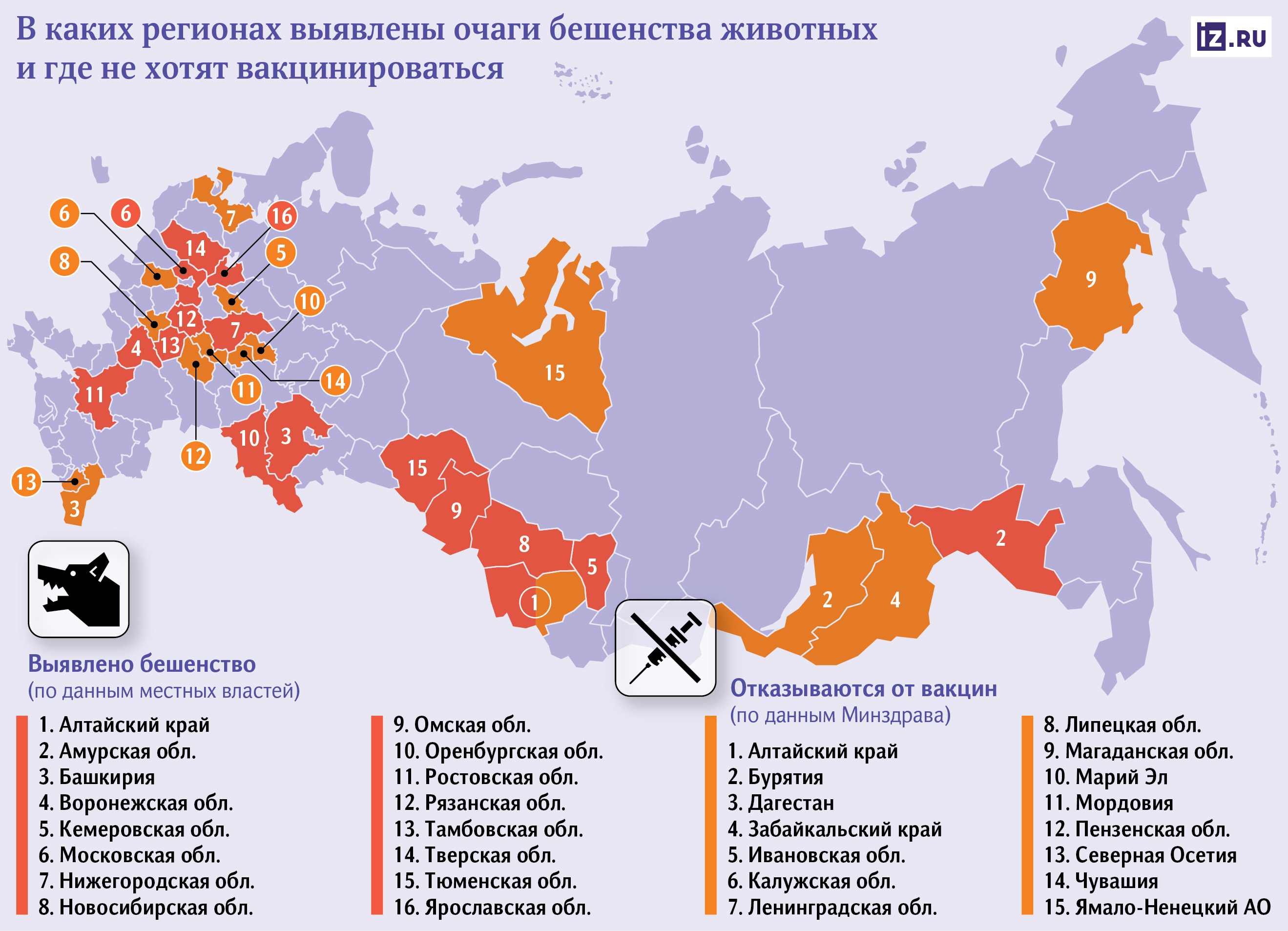
At least 16 Russian regions have active animal rabies outbreaks, Izvestia estimates. At the same time, as the editorial board found out, in many regions there are cases when people refuse to be vaccinated after an animal bite, despite the fact that this disease is fatal. For example, in the Kaluga region, this figure reaches 34%, in Buryatia — up to 20%. Among the reasons for refusals are the unwillingness to follow a strict diet, to give up alcohol for a long time and the hope that the attacked animal is still healthy.
Where they refuse to vaccinate
Doctors in Russian regions are constantly faced with refusals to be vaccinated against rabies after bites from wild and domestic animals. The periodic registration of such cases was reported to Izvestia in 15 regional ministries of health, which is almost half of those who responded to the publication's requests.
Such vaccination is voluntary, but medical professionals insist on its necessity due to the possible fatal consequences of contact with a suspicious animal.
"If we follow the trend over the past five years, we can note an increase in the number of victims of animal bites. The relative number of failures remained the same — about 34%, which indicates stable performance. This causes reasonable concern," the Ministry of Health of the Kaluga Region reported. However, in 2026, this indicator in the region is still at 21%.

Vaccination is also being refused in the Altai Territory, although there are active foci of rabies there.
"According to regional medical organizations, 1,020 people refused emergency rabies prevention in 2024 and 843 in 2025," the regional Ministry of Health said.
In Dagestan, in 2025, rabies was vaccinated 26.4% more often than a year earlier. But there are still refusals — 5.7%. And another 3.1% arbitrarily interrupted the vaccination course.
In 2026, the Lipetsk region also began to refuse vaccination more often: 120 people compared to 79 in the same period last year.

In the Magadan region, "numerous refusals to vaccinate" have been recorded for several years, but, as noted in the regional Ministry of Health, rabies has not been registered there for more than 10 years. In addition, the level of animal attacks is low relative to other regions in the region: in 2025, wild animals attacked 15 residents, 245 people suffered from dog bites.
In Buryatia, where rabies outbreaks periodically occur, the refusal of vaccination among those bitten amounted to 20% in 2025: 281 out of 1,418 people made this decision.
In the Leningrad Region, less than 1% of applicants refuse vaccination every year, the regional government told Izvestia. This region is also considered safe: the last case of rabies was registered there in 1987.

"The number of people who refused vaccinations has remained at a low level for several years: in 2025 it amounted to 41 people — 1.09%, with an average of 2.8% in the Russian Federation," the Ministry of Health of the Penza Region said.
Vaccination refusals were also recorded in the Yamalo-Nenets Autonomous District, Mordovia, Ivanovo region, Mari El and North Ossetia.
But in Khakassia, the Jewish Autonomous Region, Udmurtia, St. Petersburg, Perm Krai, Kamchatka, and in a dozen other regions from among those who responded to Izvestia's requests, vaccination refusals were not recorded.
Reasons for refusing vaccination
Russians usually refuse to get vaccinated because they are confident in the health of the animal that bit them, for example, because they have a vaccination certificate, several regional health ministries told the editorial board. They also refuse if the owner of the bitten pet is ready to send him to quarantine and provide a certificate after.

Often, the stumbling block is that people do not want to comply with restrictions for a long time, including giving up alcohol. It is difficult for some patients to follow the vaccination schedule and visit a doctor regularly.
"The reasons for refusing rabies vaccination are as follows: The patient's persistent belief that the animal is safe, fear of side effects and complications of vaccination, fear of medical procedures," the Department of Health of the Yamalo—Nenets Autonomous District told Izvestia.
Where are the foci of rabies
Currently, there are active foci of rabies in at least 16 regions of Russia, Izvestia found out. The situation in the Tyumen region is difficult. According to the local government information center, more than 40 cases of rabies were detected in the region in January-February. At the same time, local media write that at least 76 cases have been registered so far.
The veterinary department of the Novosibirsk region reported that since the beginning of 2026, "71 cases of rabies have been registered there, 49 of them are in quarantine." Foxes remain the main carriers of the disease, but the number of cases among domestic animals has increased significantly.

At least 18 more foci were registered in the Orenburg region, the local Rospotrebnadzor said. According to the agency, foxes are also the most common carriers in the region.
Selective shooting of these animals has begun in the Amur region, the Department for the Protection of wildlife in the region reported. "All captured animals will be sent to a veterinary laboratory to be tested for rabies," they said.

Rabies has also been reported in the Tver Region (three foci), Altai Territory, Omsk, Tambov, Kemerovo, Nizhny Novgorod, Voronezh, Rostov, Ryazan regions and Bashkortostan. Quarantine was also established in Rybinsk, Yaroslavl region. Sick animals are periodically registered in the Moscow region, now there are also quarantine zones there.
When should I get the vaccine?
According to clinical recommendations, all victims are vaccinated according to the 0-3-7-14-30-90 scheme — this is the order of the days on which they need to be vaccinated. According to internist and immunologist Irina Yartseva, it is necessary to start vaccination within 72 hours after the bite.
"The sooner the better, because rabies is incurable," she told Izvestia.
A wild animal that is not afraid of humans may be infected, Irina Yartseva warned. Especially those who walk crookedly, bend over, foam and saliva come out of their mouths.

— The virus is transmitted through the saliva of an animal. Infected people are salivating profusely," Irina Yartseva said.
If such saliva gets on the mucous membranes, the pathogen will enter the body, the Federal Center for Animal Health explained.
The incubation period lasts from 10 days to a year, but usually the disease manifests itself in one to three months, explained Andrey Matyukhin, chief specialist in the field of Infectious diseases at the Budzdorov clinic network.
"The closer the bite is to the head and the deeper it is, the faster the infection can develop," he added. — When the first symptoms appear — hydrophobia, seizures — it is impossible to save a person.

However, even later vaccination can help, Roman Merkulov, an epidemiologist at the UNI Clinics Medical Center, told Izvestia.
"In Russia, they vaccinate with any treatment, even if several weeks or months have passed since the bite," he noted. — This is effective if the incubation period has not passed yet.
People who work with the "street" rabies virus — for example, veterinarians, gamekeepers, hunters — are vaccinated on schedule, the Magadan region reported.
According to Roman Merkulov, Russia has chosen a strategy of emergency vaccination for each victim, rather than universal prevention. This is due to the fact that immunity after vaccination is not lifelong, and the resources of the healthcare system are limited.
Переведено сервисом «Яндекс Переводчик»
