
Tightened tires: up to a third of cheap tires may disappear from the Russian market

Up to a third of the cheapest tires may disappear from the domestic market, Izvestia has learned. The Ministry of Industry and Trade proposed to the Cabinet of Ministers to ban rubber for cars with a high content of polycyclic aromatic hydrocarbons, carcinogens that are released as toxic dust when tires wear out. The measure is aimed at protecting the health of citizens and supporting domestic producers, the department says. At the same time, experts note that it may lead to a general increase in prices and a massive transition of Russians to used products or to rarer tire replacements.
Which tires may be banned in Russia
The Ministry of Industry and Trade has sent a proposal to relevant departments to ban the use of rubber with a high content of polycyclic aromatic hydrocarbons (PAHs). This follows from a letter from the deputy head of the Ministry, Mikhail Yurin, to the Ministry of Natural Resources and Rosstandart, which was reviewed by Izvestia.
— The Ministry of Industry and Trade has initiated amendments to the technical regulations of the Customs Union "On the safety of wheeled vehicles" in terms of setting the maximum content of certain PAHs in tires at 0.25% bay protons. The capacities of Russian enterprises are fully capable of meeting Russia's domestic demand for automobile tires and have significant export potential, the ministry told Izvestia.

As a result of stricter requirements, there will be a gradual displacement of products that do not comply with the environmental and technical standards of the EAEU. This, in turn, will create additional competitive advantages for manufacturers in Russia and the countries of the Eurasian Economic Union, as well as the world's largest tire brands, which initially adhere to high standards of safety and environmental friendliness, the Ministry of Industry and Trade noted. The initiative has already been agreed with the Ministry of Natural Resources, Rosstandart and the Ministry of Economic Development, the ministry added.
— The initiative of the Ministry of Industry and Trade is an absolutely justified step aimed at protecting the health of citizens and the environment. PAHs are proven group 1 carcinogens, they are released as toxic dust when tires wear out, settle along roads, and enter the water and air. In fact, we are talking about bringing Russian requirements to international standards," Roskachestvo told Izvestia.

They also added that PAHs in tires is not directly related to the country of origin, it depends on the technologies and components used, primarily oils and fillers.

The proposed changes are in line with global trends in improving the environmental friendliness of products, the Tire Manufacturers Association told Izvestia.
— The problem of PAHs in the Russian market is concentrated precisely in the budget segment, which already occupies about a third of the market and may drop out after the introduction of restrictions. This is a systemic problem for manufacturers who save on oil purification by using cheap highly aromatic components," said Dmitry Tortev, a member of the expert council of the State Duma Committee for the Protection of Competition.

At the same time, he stressed that if the choice of rubber decreases, Russians may start buying used tires more often or driving worn ones in order to save money, so it is important that Russian manufacturers actually fill the outgoing volumes.
How is the tire market regulated in Russia
The authorities have long been systematically working to restrict potentially dangerous products on the domestic market, a government source told Izvestia. Since January 2026, GOST R 51893-2024 has been introduced, which regulates the PAH content in tire filler oil at a level of no more than 0.25%. However, compliance with this standard is voluntary.
— The flow of imported automobile tires produced using carcinogenically dangerous components that pose high risks to the safety of life and public health has increased in the territory of the Russian Federation. In connection with the above, as well as to support domestic manufacturers, it is necessary to introduce state regulation of the turnover of tires containing carcinogenically dangerous oils," Rosstandart added.

Also, on January 1, 2026, a government decree came into force, according to which, when calculating the environmental fee, a criterion was introduced that takes into account the carcinogenic hazard of materials — for such products, the eco-collection increased by 18 times compared to safe tires, the Ministry of Natural Resources and Environment told Izvestia. The rate for a ton of such tires will be 200,430 rubles, and for tires without carcinogens — 11,580 rubles, the Russian Environmental Operator (REO) reported. All funds raised will be used to create processing facilities, they added.
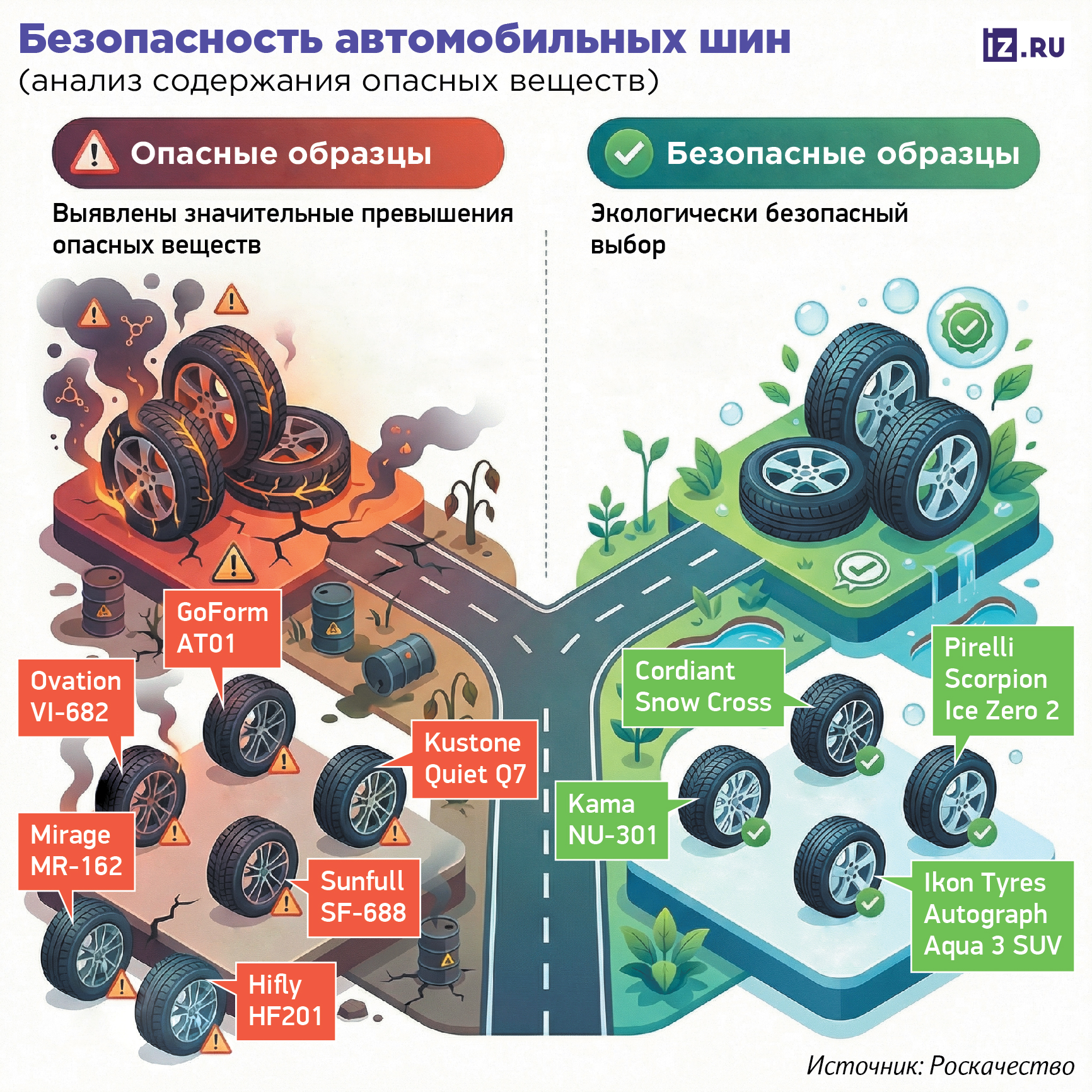
Earlier, Roskachestvo conducted a study of car tires for carcinogenic safety, and the share of highly aromatic oils became a key indicator. The results showed that all tested Russian-made tires in terms of bay proton content corresponded to the level allowed by GOST, while all tested tires from China had significant excess values, from 3.2 to 7.7 times. Exceedances were detected in GoForm AT01, Kustone Quiet Q7, Ovation VI-682, Sunfull SF-688, Mirage MR-162 and Hifly HF201. Russian models — Cordiant Snow Cross, Pirelli Scorpion Ice Zero 2, Ikon Tyres Autograph Aqua 3 SUV and Kama NU-301 — were able to meet the requirements of the national standard.
As Izvestia previously reported, only 11% of domestic tires do not meet the requirements of the new GOST in terms of carcinogenicity, but among imported tires this level is 40%.
Izvestia sent inquiries to the Ministry of Economic Development, as well as tire manufacturers.
What effect can the market expect?
The idea of limiting the use of PAHs in car tires is logical from the point of view of health and environmental protection, but it requires careful step-by-step implementation, rather than instant prohibition of their use, said Dmitry Baranov, a leading expert at Finam Management Management Company.

According to various estimates, the share of unsafe tires in the country is 10-12%, and among imported tires it is 37-40%, the expert noted.
— On average, rubber may rise in price in the budget segment due to the replacement of components, which will lead to an increase in cost and a change in the technological parameters of production, - he believes.
Any restrictions and prohibitions should be introduced after a thorough, balanced assessment and taking into account the balance of interests of the environment, business and the safety of citizens, said Dmitry Gusev, Deputy Chairman of the Supervisory Board of the Association of Consumers and Suppliers of Energy Resources Reliable Partner.

If the measure leads to a massive withdrawal of cheap tires from the market and forces car owners to use worn-out tires for longer, this may increase the risks of accidents and drifts on the roads, the expert believes. As a result, an increase in the number of accidents can become no less significant a threat factor to the health of citizens than exposure to chemical particles in the air.
If a ban is imposed in the Russian Federation, those manufacturers whose products are more expensive will remain, and the average check for tires may rise slightly within 1-2%, said Ilya Plisov, Deputy General Director of EuroAuto, member of the board of the Union of Car Services.
If the measure leads, it will lead to a point increase in prices — those items that are currently being dumped due to savings on raw materials will rise in price, Dmitry Tortev added.
Within 6-9 months after the ban, the market will regroup: at least 15-20% of the "one-day" brands will leave, and their place will be taken by either official distributors or Russian manufacturers who are ready for long-term cooperation, the expert concluded.

The initiative of the Ministry of Industry and Trade can accelerate the transition of manufacturers focused on the Russian market to safer technologies and help displace brands that do not meet environmental requirements, Ikon Tyres told Izvestia. The company noted that in order to achieve this effect, it is necessary to ensure uniform application of requirements to all market participants, taking into account differences in supply chains and sales channels.
As for the effect on the market, in the short term, it is likely to lead to a redistribution of demand in favor of tires for which there is a confirmation of compliance, and strengthen the role of transparent certification, the Association of Russian Automobile Dealers (ROAD) told Izvestia. In the medium term, this may push the market towards a better offer, but it is important for consumers that the environmental goal does not result in a sharp narrowing of choice, the organization concluded.
Переведено сервисом «Яндекс Переводчик»
