- Статьи
- Science and technology
- Easy and uplifting: Russian engineers have developed an ultra-cheap drone with the help of AI

Easy and uplifting: Russian engineers have developed an ultra-cheap drone with the help of AI

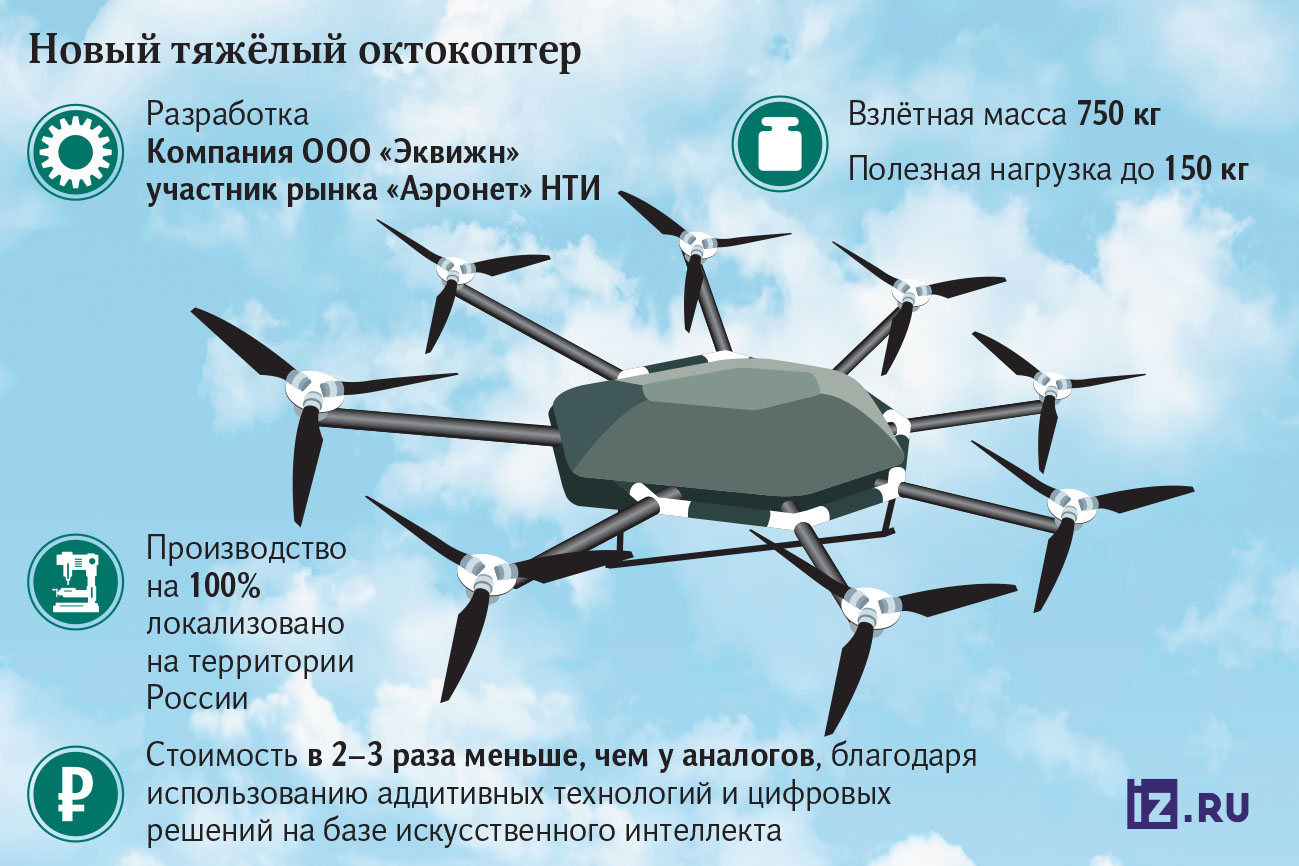
A prototype of a heavy unmanned aerial vehicle has been created in Russia, the cost of which is three times lower than existing analogues. We are talking about an octocopter with a take—off weight of 750 kg with a payload of up to 150 kg, a segment that is considered one of the most scarce in the civilian market today. Cost reduction has been achieved through the use of modern AI solutions. Experts note that the development can reduce the burden on transport infrastructure and ensure delivery to hard-to-reach areas, however, it is likely to remain a niche product for the unmanned aircraft systems industry.
A cargo transportation drone
Russian engineers have created a prototype of a heavy octocopter designed for cargo transportation, primarily in logistics, as well as when working at remote industrial facilities, including mineral deposits.
— One of the key advantages of the drone is its cost, which is reduced three times compared to its analogues due to the use of additive technologies and artificial intelligence-based solutions. These tools are used both at the development stage and in the production process," Timur Yenileev, Director of Product and Investment at the Equision development company, told Izvestia.

According to him, the project was initially created taking into account the requirements of Russian and international aviation regulators. In particular, the developers are focused on the full certification of the drone as a civil aircraft, as well as on compliance with the criteria for localization of production. The production of the device is planned to be fully deployed in Russia with the predominant use of domestic materials and components, he added.
The development of the propeller group has now been completed, and the project is at the stage of preparation for field tests. The prototypes of the power plant are planned to be presented at industry events in the II–III quarter of 2026. Certification of individual components, including the engine, is expected to be completed during the same period.
Special attention in the project is paid to digital modeling. During the development, digital twin technologies were used, as well as virtual tests of key elements — an electric motor and a main rotor using the domestic FlowVision software package.
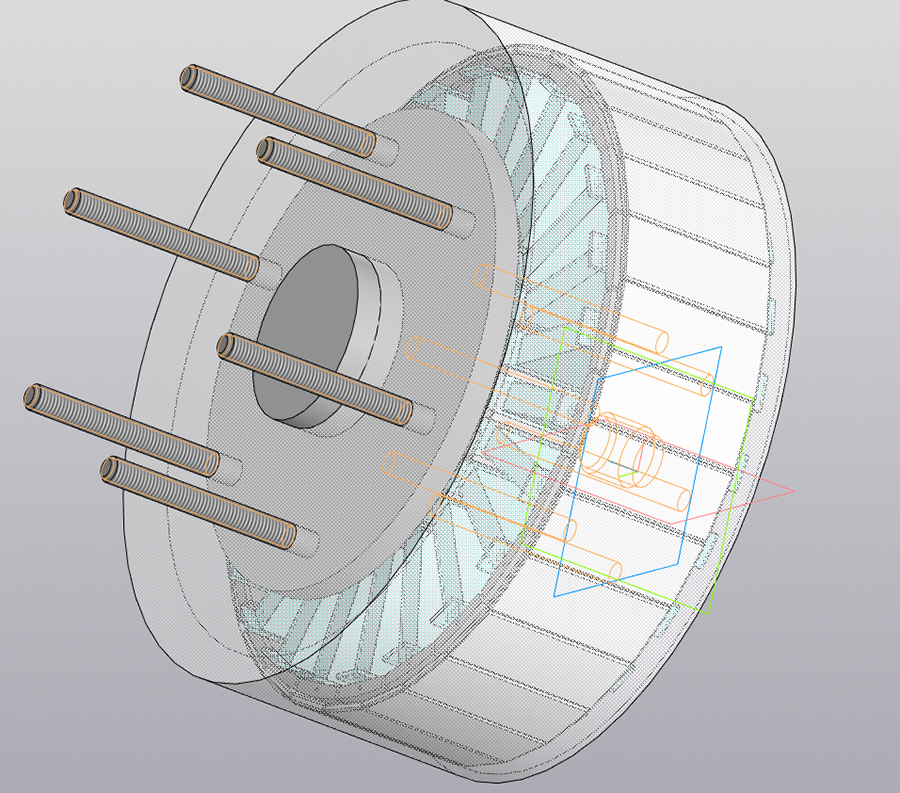
In addition, the design was initially adapted to use relatively inexpensive equipment for the production of composite elements. This approach makes it possible to speed up the refinement cycle and reduce costs during the development phase.
The developers expect to complete the full certification of the unmanned system by the end of the year. Aeronet market experts from the National Technology Initiative (NTI) are working on the project.
— The next step will be to bring our products to the global market. There are already certain agreements. In parallel, work is underway on a heavier helicopter—type vehicle with increased payload and range," said Timur Yenileev.

Where development can find application
Experts' assessments of the prospects for such solutions differ. Pavel Kamnev, Commercial director of Laboratory of the Future, considers the chosen concept to be unsuccessful.
— A take—off weight of 750 kg with a payload of 150 kg is, in general, an inefficient scheme. For such parameters, it is more optimal to use a helicopter layout with an internal combustion engine rather than a multi—rotor one," he noted.
According to him, the chosen architecture limits the project's market prospects and makes it uncompetitive.

A different point of view was expressed by Andrey Novikov, a leading engineer at the NTI Center for Digital Materials Science at the Bauman Moscow State Technical University. According to him, the cargo drone market is only in the formative stages, but it has significant potential.
— Such devices can significantly change logistics, including warehouse operations. In particular, drones are able to automate the movement of heavy loads inside large distribution centers, for example, the descent of pallets from the upper storage levels.
According to him, the key limitation remains the lack of a full-fledged regulatory framework for the mass implementation of such solutions.
— Drone delivery continues to exist solely on subsidies and PR. Today, we see a clear division of technologies into "organically viable" and "artificially supported." The latter, along with nanotechnology and some green energy projects, include, in my opinion, UAS logistics," said Dmitry Kuzyakin, Chief Designer of the Center for Integrated Unmanned Solutions.

Despite the technological feasibility of air cargo delivery, drones in the civilian sector are inferior to traditional solutions in terms of cost. The expert explained this by the high cost of operation: lithium batteries have a limited life of 300-500 cycles and require regular replacement. In addition, the cost of delivery per kilogram and kilometer, according to his assessment, exceeds the performance of light manned aircraft, and insurance risks and tariffs further limit the economic feasibility of mass use of drones in cities.

As a result, drones, according to Dmitry Kuzyakin, will retain niche applications in hard—to—reach areas and emergency medicine, but will not become a massive logistical tool without a technological breakthrough.
At the same time, some experts noted that this segment remains free in Russia. Military analyst Yuri Lyamin points to the successful experience of China, where heavy drones are already being used to deliver goods at the "last mile". According to him, such solutions can reduce the burden on the transport infrastructure and ensure delivery in difficult geographical conditions.

He also stressed that the use of digital twins and additive technologies is already becoming an industry standard, allowing for significantly faster development and lower product costs.
— The niche of heavy copters in Russia is not yet occupied, so domestic developments have a good chance. However, the decisive factor will not be the idea itself, but the quality of the implementation and implementation of technologies in the real sector," concluded Yuri Lyamin.
According to the expert, the main challenges for Russian projects remain the level of localization and the ability to move from prototypes to mass production.
The problem of the shortage of certified heavy drones has been repeatedly raised at industry venues, including the forum "Unmanned Systems: Technologies of the Future" and "Archipelago-2025".
Переведено сервисом «Яндекс Переводчик»
