Space discoveries: "factories" of materials and medicines will be built on the Russian orbital station
- Статьи
- Science and technology
- Space discoveries: "factories" of materials and medicines will be built on the Russian orbital station

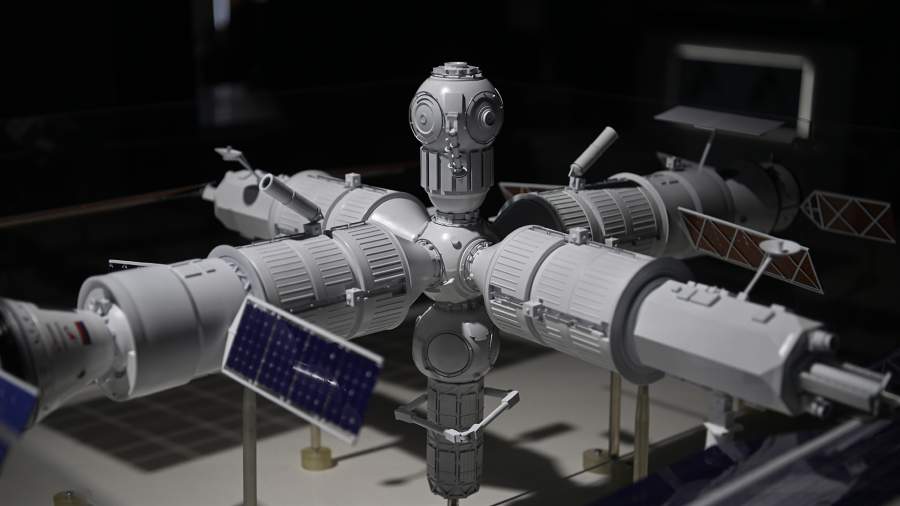
The Russian space station will house equipment for 3D production of ultrapure materials for microelectronics and protein crystals. This was stated by Mikhail Kovalchuk, President of the Kurchatov Institute Research Center. According to him, microgravity and deep vacuum will make it possible to grow crystals of an ideal structure that is unattainable on Earth. Experiments have already been conducted on the ISS's Nauka module, which tested the possibility of producing crystals in space. However, astronaut scientists are needed to conduct complex research in orbit.
How new medicines and materials will be made in space
New ultra-pure structural materials, protein structures, living tissues and highly effective medicines will be created at the Russian space station using additive technologies. To do this, workshops with 3D printing equipment will be located there. This was stated by Mikhail Kovalchuk, President of the Kurchatov Institute National Research Center, at the Science on Manned Space Stations conference at the Space Research Institute of the Russian Academy of Sciences.
The Forum was one of the events that opened the Russian Space Week, which runs from April 6 to 12. During this period, scientific, educational, creative and cultural events dedicated to space research are planned in all regions of the country. The week is dedicated to the 65th anniversary of the first human orbital flight. The decree on holding the events was signed by Vladimir Putin.
According to Mikhail Kovalchuk, the space environment provides new opportunities for the creation of materials and substances. In particular, the "launching into space" of additive technologies may be very promising.
— The creation of materials using 3D printing means the transition to nature-like production methods. Previous technologies are based on the principle of "cutting off excess". Thus, up to 80% of energy and material costs go into landfills, polluting the environment. Nature is inherently economical. She does not "cut off" the superfluous, but grows a new one. Similarly, 3D printing makes it possible to grow finished products from the initial components, using the entire volume of raw materials," said Mikhail Kovalchuk.

Now, on behalf of Russian President Vladimir Putin, the Kurchatov Institute Research Center, Rosatom State Corporation and Roscosmos have created an Additive Technology Center, which produces all types of raw powders for 3D printing. They are also developing the equipment and technologies necessary for these purposes. The issue of placing equipment for manufacturing parts and assemblies for station repairs using additive technologies is being considered separately.
According to the scientist, growing materials in space will make it possible to use conditions of high vacuum and microgravity, a state close to zero gravity, to obtain protein crystals of an ideal structure. This is important, for example, for analyzing the structure of viruses and developing drugs with purity unattainable on Earth.
Also, there is no effect of mixing layers in orbit due to temperature differences and sedimentation of particles under the influence of gravity. This makes it possible to grow ultra-pure semiconductor crystals for the electronics of the future. In particular, for new neuromorphic processors that consume minimal energy, and cryoprocessors based on superconducting logic elements.
Why do we need cosmonauts and scientists?
— A total of 162 space experiments have been completed on the Russian segment of the ISS over the entire period of operation. Currently, specialists are implementing 83 scientific studies. For 57 of them, implementation is provided on board the ISS and the results are processed. 26 experiments are at different stages of ground preparation," said Vladimir Solovyov, General Designer of RSC Energia.
Among other things, the Nauka module housed new equipment for high-temperature synthesis of materials and analysis of crystals and proteins obtained in space.
Vladimir Solovyov singled out the Mirage experiment as one of the most significant studies in this field. It is focused on the study of crystallization processes and the production of semiconductor crystals with high uniformity of structure and properties by directed crystallization in microgravity. The director of these studies was the Kurchatov Institute Research Center.
Among other significant materials science experiments, the scientist noted Ekran-M, which involves the production of ultra-high purity semiconductor materials in orbit. The main purpose of the experiment is to test the possibility of pilot production of crystals for microelectronics in space.
In order to conduct complex experiments in orbit, an astronaut-scientist must appear on the station crews, explained Alexander Kaleri, chief expert of RSC Energia, cosmonaut, participant of the last flight to the Mir space station and four expeditions to the ISS.
"Currently, the priorities are set so that the main thing is the maintenance of the station, and the preparation for scientific work is carried out according to the residual principle," he noted.

At the same time, an astronaut scientist is a professional researcher who is prepared for the creative, exploratory nature of work. Such a specialist can process data directly in orbit, analyze it and change the course of experiments if he sees something interesting.
The conditions necessary for an astronaut-scientist to appear on ROS are now laid down in the design of the station. They include large amounts of scientific equipment, powerful power supply (more than 50 kW), as well as the ability to control the station by only one person so that another crew member can do science without being distracted by routine.
Переведено сервисом «Яндекс Переводчик»
