- Статьи
- Economy
- You can drive: the price of CTP in the "red regions" has jumped 2-3 times since December

You can drive: the price of CTP in the "red regions" has jumped 2-3 times since December

The average cost of CTP policies in Ingushetia has increased 2.8 times since December, and 2.2 times in Novosibirsk, experts from an online service for motorists who analyzed data from 2.5 million users told Izvestia. In the whole country, novice drivers also began to pay more — policies for them have increased in price by about 14%. This is due to the fact that since December, the Central Bank has expanded the tariff corridor and doubled the territorial coefficient in the "red regions". In a number of regions, the rise in prices has become shock therapy — the authorities have stepped up the fight against fraud. Against this background, the Bank of Russia has already proposed to reduce the coefficients. What measures still need to be taken can be found in the Izvestia article.
Why did the CTP price rise?
The average cost of compulsory motor insurance policies has increased significantly in a number of Russian regions since December 9, 2025. Then the Central Bank expanded the tariff corridor for CTP for passenger cars by 15% in both directions and revised the territorial coefficients for many subjects. For those who entered the "red zone" — Ingushetia and the Novosibirsk region — the figure doubled. There are the largest number of unfair actions in CTP and a high level of fraud.

In Ingushetia, the cost of the policy increased 2.8 times in three months after the innovations compared to September – December, it was calculated for Izvestia in bip.ru (an online service for motorists that helps compare prices for CTP policies from licensed insurance companies) by analyzing data from 2.5 million users. In the Novosibirsk region, the average price increased 2.2 times over the same period.
In the whole country, novice drivers also began to pay more — for them, the policy increased in price by an average of 14%, the service said. This is due to the fact that insurance companies seek to attract less emergency customers and try to compensate for the risks that sloppy drivers bring, the chief analyst explained. bip.ru Ksenia Panfilova.

The sharp increase in the price of CTP in the "red regions" was also confirmed in "Compare". According to their data, in the three months after the innovation, insurance in Ingushetia increased in price by 2.5 times compared to November, and in Novosibirsk — by 1.4 times. At the same time, novice drivers in the second region of the Russian Federation began to pay 1.6 times more, said Vladislav Golovkin, Director of insurance business Development at the company.
He clarified that it is in these regions that a high level of unfair actions in the field of CTP has been observed in recent years. As for novice drivers, the rise in price for them is due to the expansion of the tariff corridor. Insurers consider them as a high-risk category and after the innovation they were able to include this risk in the price.

The Central Bank explained that the increase in cost in the regions from the "red zone" is due to the high loss-making of CTP and the insufficiency of collected premiums to cover payments in these territories. At the same time, according to AIS insurance (all information about CTP is stored there), the increase in the average price of the policy in these regions of the Russian Federation for less than three months of this year compared to the same period of the previous year was lower. In the Novosibirsk region, it was 42%, and in Ingushetia — 46%, the regulator's press service reported. The cost reached 11.87 thousand and 8.8 thousand, respectively, the National Insurance Information System (NSIS) clarified.
When there is a very high loss rate for CTP in one region due to unfair practices, the effect of them begins to affect the cost of insurance for motorists across the country. To avoid this, the Bank of Russia is forced to raise the territorial coefficient, which is taken into account when calculating the policy price, the Central Bank explained.
Ingushetia has been on the Central Bank's register as a high—risk fraud region since 2019, and the Novosibirsk Region since 2021, said Alexey Ivanov, owner of the Alliance Trucks commercial vehicle dealership network. In three years without tariff revision, the average CTP payment in the country has increased by one and a half times. This puts pressure on the unprofitability of insurers, and they are forced to raise prices. Insurers actually subsidized losses in these regions from a common pot — until the regulator intervened.

The Central Bank added: the change in the coefficient did not lead to an increase in prices for all new policies. Insurers are increasing the tariff primarily for drivers with an increased level of risk, as well as for unreliable buyers. For example, if there is a suspicion that the policies may be used in fraudulent schemes. So, in the Novosibirsk region, more than half of the CTP contracts were issued at a cost of less than 10 thousand rubles. And only 5% were worth more than 25 thousand.
The price of the policy for each individual driver depends on many factors — his accident-free history, age, length of service, as well as the region, they said in "Consent". For careful drivers, the increase turned out to be minimal or nonexistent, while for problematic segments, the price objectively increased.
How does the fight against fraud affect CTP
Since the end of last year, the Novosibirsk Region has intensified its fight against fraud. In the fourth quarter, 122 criminal cases were opened against insurers on crimes in the field of CTP, and 37 more in the first two months of this year, the press service of the Central Bank noted. Therefore, the Bank of Russia proposed to change the coefficients for this territory. Such a draft instruction was published on March 19.
For Novosibirsk, the regulator wants to reduce the value from 3.12 to 2.34, and, for example, for Berdsk — from 2.48 to 1.86. The innovation may be adopted as early as the second or third quarter of this year, Alexey Ivanov believes. According to him, this will lead to a decrease in the average CTP price in these regions by 20-25%. There are no similar plans for Ingushetia yet — apparently, the results there are worse.

In the Novosibirsk Region, the joint work of law enforcement agencies and insurers has made it possible to really curb the activity of organized criminal groups, said Sergey Yefremov, Director of Asset Protection at the Russian Union of Motor Insurers. In Ingushetia, additional work is needed — on April 6, a government meeting will be held on this issue.
The "Consent" noted that they support any measures aimed at leveling the situation. However, a reduction in the coefficient is possible only on one condition: if the level of insurance fraud in these regions really decreases and the loss rate returns to economically reasonable values. Today, the problem persists in these regions: payments continue to exceed fees, and the number of suspicious accidents remains high, the company noted.

The level of fraud in the Novosibirsk region is still at a high level, according to Sovcombank Insurance. According to them, the initiation of criminal cases does not affect the situation. Additional measures must be taken to ensure the inevitability of punishment and the seizure of cars used by fraudsters.
Currently, Russia is preparing a number of innovations to tighten control and liability for insurance fraud, Izvestia wrote. The authorities intend to create a special list of clients — "red flags" in CTP. In addition, the possibility of banning insurance fraudsters from driving cars is being discussed.

Further decisions on the adjustment of coefficients will be made taking into account the assessment of the development of the situation with the loss of CTP there, the Central Bank said.
We need systematic control at the stage of processing payments, primarily through mandatory photofixation of damages in the NSIS and automatic verification with traffic police databases, Alexey Ivanov believes. According to Vladislav Golovkin from "Compare", the introduction of CTP verification by cameras, planned from autumn 2026, may also improve the situation in the regions.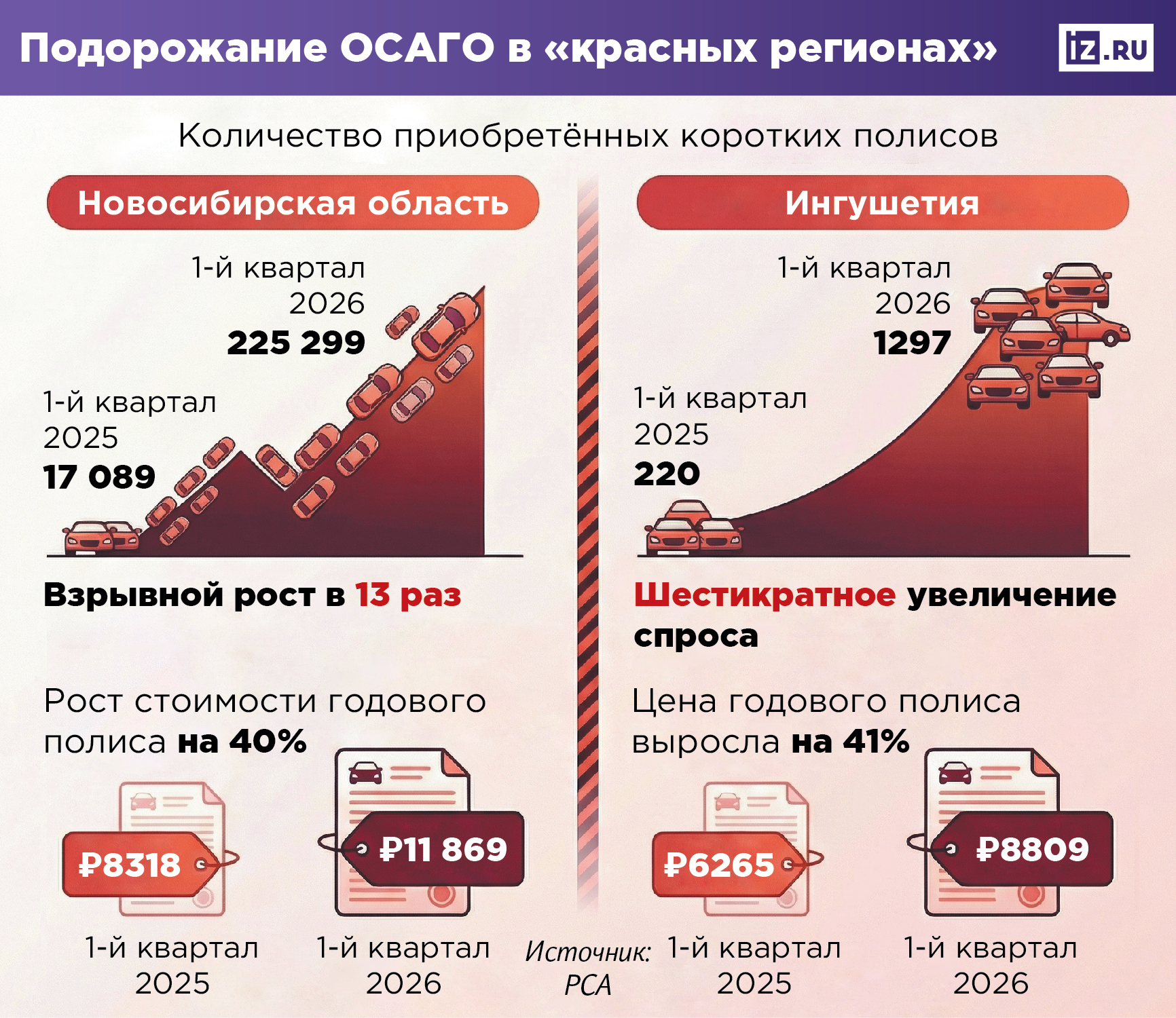
Переведено сервисом «Яндекс Переводчик»
