
Race to defeat: Iran's withdrawal from the NPT will trigger a chain reaction

Key players in the Middle East, including Saudi Arabia, Turkey and Egypt, may reconsider their approaches to their own nuclear programs in the event of Iran's withdrawal from the Treaty on the Non-Proliferation of Nuclear Weapons. Relevant initiatives are being considered at the level of the Parliament of the Islamic Republic and political circles, but officials emphasize that Iran remains committed to international obligations and does not seek to develop nuclear weapons. Nevertheless, even the very fact of the appearance of such an agenda has already increased fears that the situation could trigger a chain reaction in the region.
Tehran abides by its obligations
Tehran is discussing one of the most radical scenarios in the history of the national nuclear program — withdrawal from the Treaty on the Non-Proliferation of Nuclear Weapons (NPT). According to the Iranian media, relevant authorities, including the parliament, are "urgently" considering this step in the context of the ongoing escalation of the conflict and attacks on the country's strategic infrastructure.

There are statements from Iranian politicians about the preparation of an "emergency plan for the protection of nuclear rights." We are talking about three key areas: the official withdrawal from the NPT, the revision of legislation related to the implementation of the 2015 nuclear deal, as well as the formation of new international formats for cooperation in the field of peaceful atom— primarily with the participation of the BRICS and SCO countries. A bill on this has already been submitted to Parliament and may be considered in the near future, although it will require the approval of the Constitutional Guardian Council, a supra—parliamentary body of the republic, to enter into force.
The authorities are trying to soften the perception of what is happening. Iranian Foreign Ministry spokesman Ismail Bagai confirmed that the issue of withdrawal from the NPT is indeed being considered both in parliament and in society. At the same time, he stressed that Tehran continues to comply with its obligations and does not seek to develop nuclear weapons.
The discussion of withdrawal from the treaty has intensified due to the escalation of the conflict with Israel and the United States. Tehran is increasingly claiming that participation in the NPT has not brought practical benefits to the country, but has only limited its technological development. At the same time, the very idea of leaving the NPT was regularly raised in response to external pressure — after the United States withdrew from the nuclear deal in 2018, threats to restore sanctions or recognize the Islamic Revolutionary Guard Corps as a terrorist organization. However, the current discussions are taking place in conditions of direct military confrontation, which gives them a qualitatively different weight.

In accordance with Article X of the NPT, a country can withdraw from the agreement by notifying other states and the UN Security Council three months in advance. After this period, the obligations to abandon the development of nuclear weapons and to allow international inspections are terminated. In practice, this means the end of transparency and a drastic reduction in international control capabilities.

Iran's neighbors will follow his example.
Withdrawal from the NPT does not automatically mean a decision to create nuclear weapons: Tehran can theoretically adhere to the "nuclear threshold" strategy by developing appropriate technologies without moving to the creation of a warhead. According to Andrei Baklanov, Deputy Chairman of the Association of Russian Diplomats and Professor at the Higher School of Economics, discussing such an option would be a strategic mistake for Iran.
"Even preliminary decisions in this direction will be perceived by the international community as undermining the non—proliferation regime and will lead to increased external pressure, without giving Tehran practical benefits," the expert told Izvestia.

The expert also believes that the reaction of regional countries will be unequivocally negative and may accelerate the formation of retaliatory measures, including military technology programs.
It is this factor that makes the situation explosive for the entire region. Iran's potential move could set off a chain reaction among key powers in the Middle East. First of all, we are talking about Saudi Arabia. For many years, Riyadh has maintained a clear position: the appearance of nuclear weapons in Iran will automatically lead to a similar step on the part of the kingdom. Saudi Arabia has the necessary financial resources, a well-developed missile program and close ties with Pakistan, which has a nuclear arsenal.
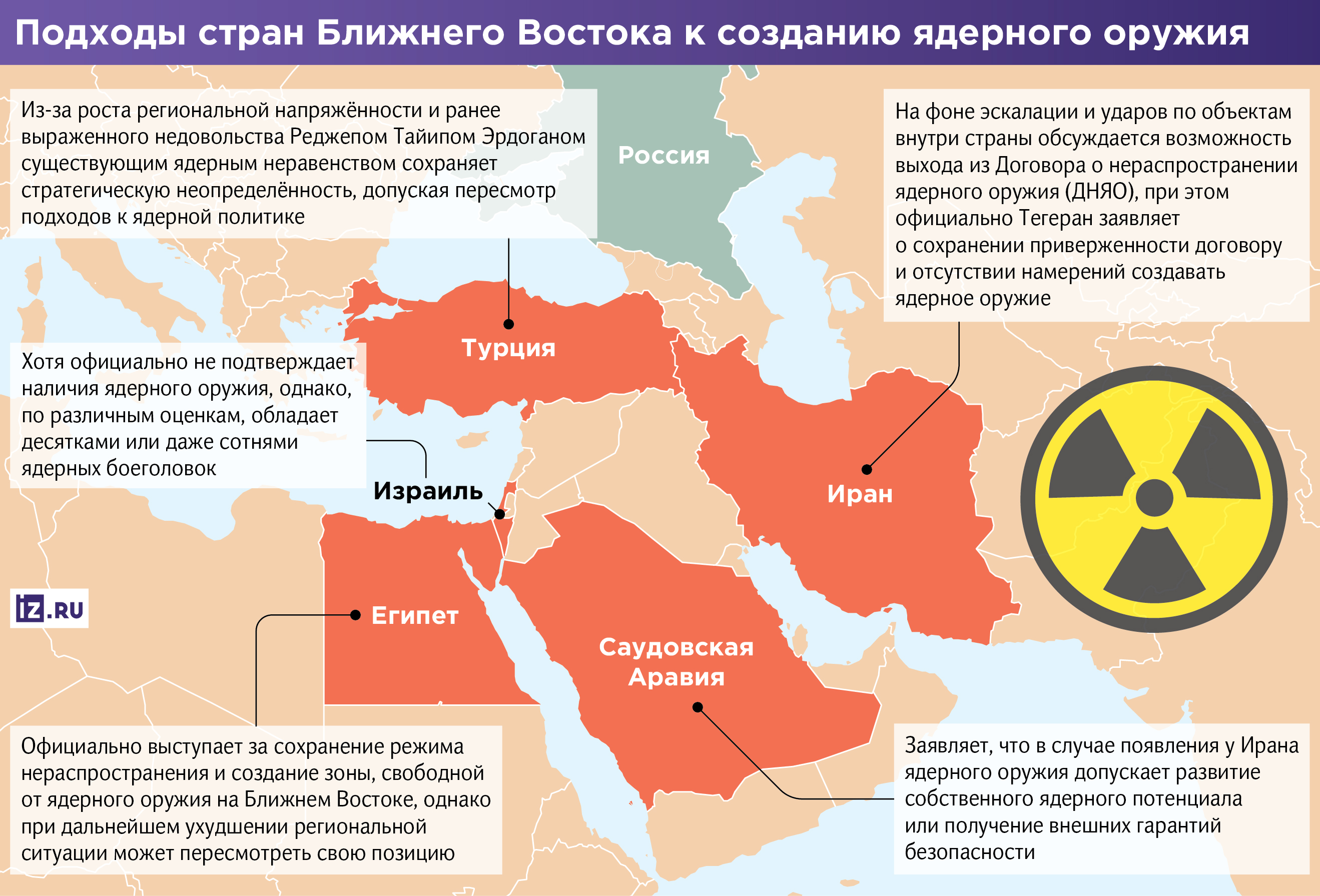
According to Bloomberg, the United States is considering the possibility of transferring uranium enrichment and processing technologies to Saudi Arabia. Such a deal would supposedly contribute to the security interests of the United States and make the kingdom's nuclear program more transparent.
Turkey is also unlikely to remain on the sidelines. Despite its membership in NATO, Ankara is demonstrating growing strategic autonomy. President Recep Tayyip Erdogan has previously openly raised the issue of the unfairness of the existing nuclear order.

— Some countries have missiles with nuclear warheads, and not just one or two. But we can't have them. I cannot accept this," the Turkish president emphasized back in September 2019. — There is not a single developed country in the world that does not have them.
Egypt, which traditionally plays a key role in the Arab world, will also face a strategic choice. Cairo has experience working with nuclear technologies and is negotiating the development of nuclear energy.
In the event of Iran's hypothetical withdrawal from the NPT, the most likely scenario would not be the instant proliferation of nuclear weapons, but the formation of so-called latent nuclear capabilities, said Umar Abdel Ali, editor of the Egyptian newspaper Al-Akhbar.

— Cairo has traditionally advocated the preservation of the non-proliferation regime and the promotion of the idea of creating a nuclear-weapon-free zone in the Middle East. The development of civil nuclear infrastructure in itself creates a certain strategic potential, but it does not automatically mean a transition to the military component," he told Izvestia.
According to him, we are talking about the development of a scientific, technical and industrial base, which does not involve the immediate creation of warheads, but allows for a quick transition to tougher forms of deterrence when the political situation changes.
According to the expert, a decision on such a transformation is possible in the event of a deterioration in regional security, which would call into question the existing guarantees of deterrence.

How will this affect the military confrontation
A separate dimension is the reaction of Israel, which has an undeclared nuclear arsenal. His leadership is likely to strengthen the policy of preventive action and the doctrine of "nuclear uncertainty." This could lead to an expansion of military operations against the Iranian infrastructure and an increase in tension in all directions.

In the United States and Israel, statements from Tehran are already being perceived as a signal for a possible acceleration of the Iranian nuclear program. The United States has repeatedly condemned such rhetoric, calling it destabilizing, and in 2020, American representatives explicitly stated that the threat of Iran's withdrawal from the NPT was "unacceptable" and would only lead to increased isolation of Tehran. In response, Washington has traditionally increased sanctions pressure and increased its military presence in the Persian Gulf region.
Israeli Prime Minister Benjamin Netanyahu has repeatedly stressed that Iran should not acquire nuclear weapons, and in the event of a failure of diplomacy, his country reserves the right to act independently. Israel views Tehran's possible withdrawal from the NPT as a de facto signal to move to tougher scenarios, including preventive actions against key Iranian nuclear infrastructure facilities, primarily deeply protected underground uranium enrichment facilities.
At the same time, the question of the actual timing of Iran's creation of nuclear weapons remains debatable. According to military expert Alexei Leonkov, Tehran already has a well-developed missile program and is theoretically capable of maintaining carriers even in the face of strikes on infrastructure. However, the key problem is the creation of the warheads themselves.

The expert notes that it may take years to develop a full-fledged nuclear charge and bring it to a combat-ready state. As an example, he cites North Korea, which took about 10 years between the first tests and the creation of thermonuclear technologies. In conditions of war, constant strikes and pressure on scientific personnel, this process will be significantly complicated for Iran.
Resources and political factors remain an additional limitation, from the shortage of uranium base to the current religious ban on the creation of weapons of mass destruction.
Переведено сервисом «Яндекс Переводчик»
