
Engine room: only 7% of taxis meet localization requirements

Only 7% of taxi cars meet the localization requirements that entered into force on March 1, 2026, market participants estimated. These data are confirmed by the State Duma and the association of self-employed taxi drivers, noting that in some regions this level is even lower. At the same time, drivers registered in the registry before the introduction of new regulations will not experience problems with the law. The association (which includes more than 300,000 private carriers) believes that many current drivers and new participants with non-localized cars will not be able to legalize in taxis, and therefore their outflow from the legal market is likely.
Which cars can work in a taxi
Most of the localized cars in taxis are represented by Lada models — their share reaches 6.8%. The remaining brands are represented by significantly smaller volumes.: Moskvich — 0.17%, Evolve — 0.02%, Voyah — 0.004%. There are virtually no Sollers and UMO cars in the current fleet, according to an analysis of the Maxim taxi service conducted on the structure of the partners' fleet and the list of localized models.

According to the study, Lada Granta (52%) and Lada Vesta (30%) occupy the largest share among such cars. The share of new models is minimal: Lada Iskra — 0.3%, Lada Aura — 0.13%.
According to the decision of the Ministry of Industry and Trade, 22 models of Lada, Sollers, Evolute, Voyah, Moskvich and UMO brands are included in the list of localized cars.
The law on localization of taxi cars was adopted in the spring of 2025. Its goal is to support the domestic automotive industry, create jobs and reduce dependence on foreign spare parts. The document encourages the localization of foreign production in the Russian Federation: taxis should use vehicles with a high proportion of Russian components or manufactured under special investment contracts (SPIC). The new rules came into force on March 1, 2026. Prior to this date, drivers could register all the car brands they work for in regional registries. A delay is provided for some regions: the Kaliningrad Region and the subjects of the Siberian Federal District — until March 1, 2028, the regions of the Far Eastern Federal District — until March 1, 2030.
"These data reflect the current market practice. Drivers traditionally choose cars based on the ratio of price, reliability and performance. In previous years, this niche was occupied by mass-produced models of foreign brands that have proven themselves well in the field of passenger transportation. Under the current conditions, the economy is becoming a key constraint," the study says.

It also notes that in the regions, the recoupable cost of a car for working in a taxi, as a rule, does not exceed 1.5 million rubles. Today, only individual models meet this criterion. At the same time, the cost of more comfortable cars, including Lada Vesta, is approaching 2 million, and a significant part of the cars from the list is in the range of 2.5–4 million rubles and above.

"In fact, the entire localized taxi segment today is provided by a limited number of available models. This creates a gap between regulatory requirements and the real structure of the market and holds back the renewal of the fleet, the authors of the study note. — The availability of cars directly affects the accessibility of trips for passengers. The rising cost of purchasing and operating cars inevitably affects the cost of travel."
— The current fleet structure of the service's carrier partners in the Russian Federation shows that the market is not yet ready for a large-scale transition to localized vehicles. Especially considering that there are no funds for these purposes, especially in the regions. The economics of working in a taxi require quite strict requirements for the cost of a car," explained Maxim service.

The Association of the Self-employed of Russia agrees with such figures (it has more than 300 thousand people, mostly drivers). They noted that the indicator varies significantly from region to region, for example, in Primorsky Krai for localized cars it is 0.3%.
— The gap between the localization norm and the real structure of the market was obvious even at the stage of the discussion of the law. This means that many current drivers and new carriers with non-localized cars will not be able to legalize taxi driving and enter this market. Stabilization may occur for some time, after which an outflow of participants from the legal market is likely," the press service of the association said.
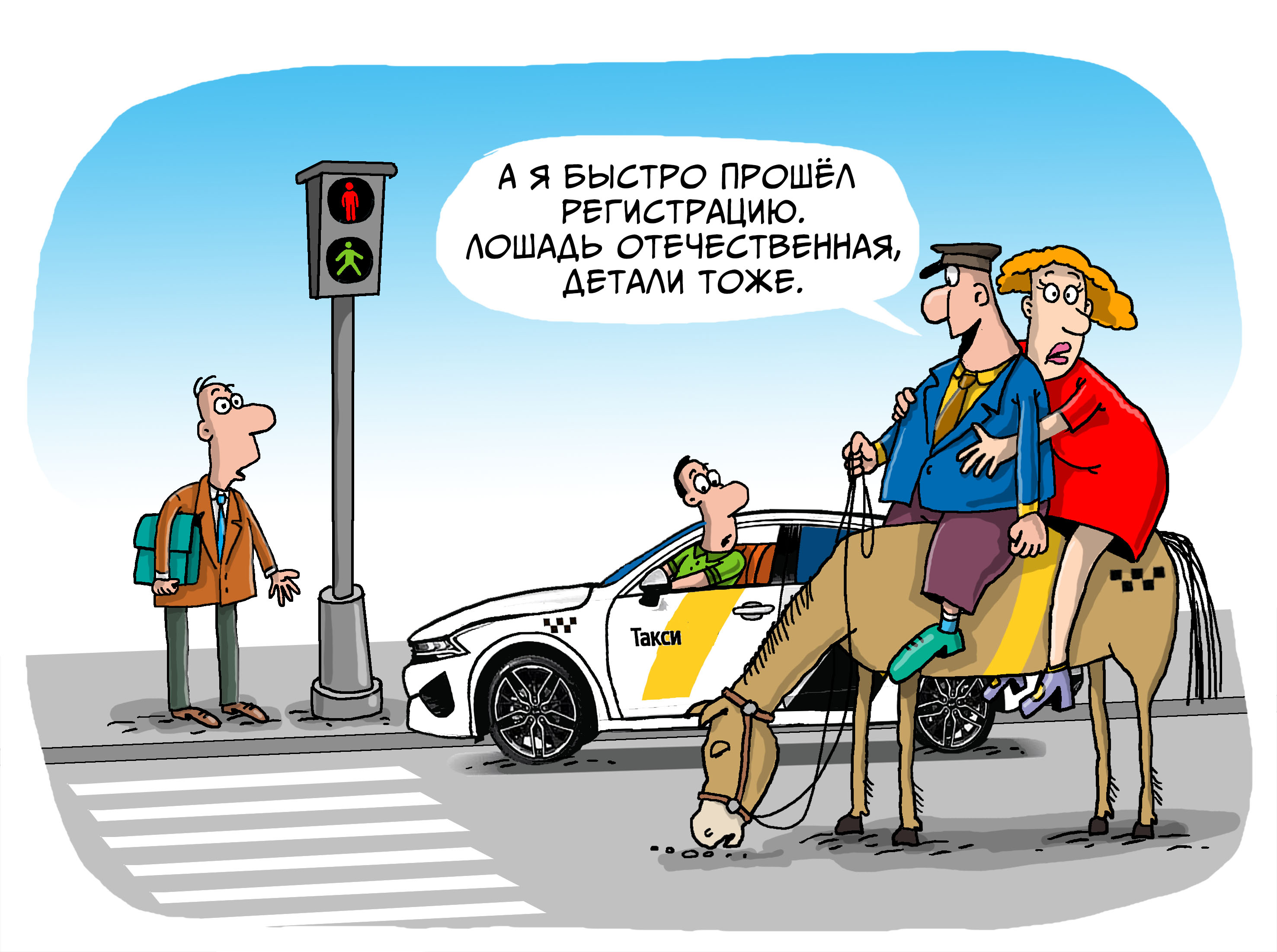
They added that the 25% quota for non-localized cars for self-employed drivers in the regions, which was introduced at the end of 2025, has already been exhausted. At the same time, there is no transparent mechanism for its distribution at the regional level, which creates additional uncertainty for market participants.

— The issue of localization remains extremely sensitive from an economic point of view. Self—employed drivers do not have the financial tools to upgrade their cars, in particular, access to leasing and other forms of preferential financing. At the same time, for the majority of the self—employed, a car is a personal vehicle used primarily for everyday needs and family trips. Even for household use, it is difficult to buy a car today due to high prices and loan rates, not to mention updating the car to meet localization requirements, the association said.
Izvestia sent requests to the Ministry of Industry and Trade and the Ministry of Transport with a request to comment on the situation with the localization of cars. Izvestia also sent a request to the largest carrier service in Russia, Yandex.Taxi."

How the State Duma proposes to solve the localization problem
The State Duma Committee for the Protection of Competition agrees with the taxi drivers' estimates. At the same time, they stressed that cars that were registered in registries before the new regulations came into force could be modified, even if they did not meet these requirements.

— At the same time, we believe that localization should be left only for professional drivers, for whom this activity is the main means of earning. But for private part—timers, it needs to be cleaned, because it is unrealistic for them to fulfill these requirements," Sergei Lisovsky, deputy chairman of the State Duma Committee, explained to Izvestia.
According to him, these drivers will continue to work, which may lead to the formation of a "gray market" and a shortfall in tax revenues to the budget. In addition, it increases the risks to the safety of both passengers and drivers themselves.
He recalled that the Ministry of Transport supported the introduction of a separate legislative regulation of the activities of self-employed taxi drivers. As Izvestia wrote, this follows from the department's response to the deputy's bill, signed by Deputy Minister Alexei Shilo.

— Since localization has just begun, it is unlikely that its level will be high. But if we look at the regions of the Caucasus or the Samara region, the indicators there will be higher than the national average. That is, where there is production, the situation is somewhat different, although in general, the level of localization is still far from necessary," Ilya Zotov, chairman of the All—Russian Passenger Association, told Izvestia.
In his opinion, over time — in two or three years — the situation will change in favor of the growth of localized machines.
The localization law is correct and fair, but it is necessary to take into account the economic situation — this is both a state of uncertainty and increased pressure on private business through taxes, Georgy Ostapkovich, research director of the HSE Center for Market Research, told Izvestia. According to him, it is worth taking a break now and giving taxi drivers more time, given that this measure will not lead to a significant increase in sales of domestic cars, but will create difficulties in the market, including the transition to the gray market, the expert noted.
Переведено сервисом «Яндекс Переводчик»
