
"I got such injuries that I didn't dance for two years, I walked on crutches"

Modern ballet dancers have significantly raised the technical level of dance, but they have become less likely to pay attention to deep work on the image, said Boris Akimov, People's Artist of the USSR, an outstanding teacher. He has worked in the world's leading theaters, from London's Covent Garden and Milan's La Scala to the Paris Opera, the Vienna and Bavarian State Operas, the Danish Royal Ballet and the Asami Maki Troupe in Tokyo. In an interview with Izvestia, a Bolshoi Theater teacher talked about how ballet is changing, why the Russian school has become a universal language for artists around the world, and how, at the age of 79, he manages to work alongside young dancers.
"I don't lecture. I demand discipline, attention, but without pressure"
— Boris Borisovich, at the age of almost 80, you are not just conducting a class, but are fully engaged with artists. It's an incredible sight. Where do you get the strength to lead a galaxy of young dancers?
— There is something special about this theater. When I open the door in the morning and enter the Bolshoi Theater, something inexplicable happens to me. It is this energy that feeds me, and then I pass it on to my students. When I was an artist, she also gave me strength, helped me dance on stage. Now I'm giving it to the pedagogy department.
I must say, the theater gave me everything. This year is my 60th theater season at the Bolshoi. It's hard to believe, but those years flew by like one day. I have taught in many theaters around the world: London's Covent Garden, Milan's La Scala, Tokyo, Denmark, Vienna, Munich, but I have always returned here.

I am happy that I still have the strength to open this door every morning. For me, theater is a simple and at the same time a high truth of creativity. My whole life takes place here: from morning to evening.
— How often do you teach classes?
— Every day. I have been officially teaching at the Bolshoi Theatre since 1988, when I was offered to combine the stage and teaching work. I had already taught lessons before, and they told me: "You're doing it well—start teaching." I replied: "It doesn't mean that I stop dancing." And indeed, he still continued to go on stage.
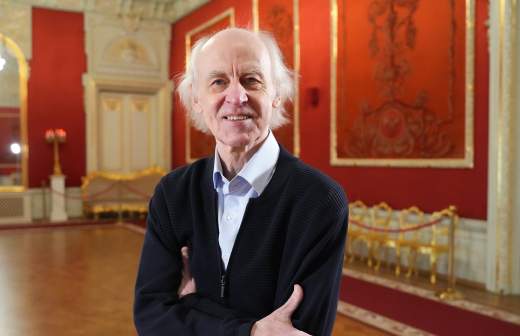
I graduated from college in 1965 and studied for six years. Since then, every morning I enter the gym. But now my task is not just to give combinations to the guys, but to awaken them. They come in sleepy, tired after the previous day. We need to warm them up and set them up for the whole day. Prepare physically and emotionally. To untie those knots that have accumulated overnight in the body. But the main thing is to find a contact. It's a great art. Wherever I worked — in Holland, Italy, I always thought: how to enter the hall, how to win over the artists? You need to feel them, unite them, and lead them. That's the most important thing.
— What kind of guidance do you give to students?
— I want them to leave the classroom in a good mood, full of strength and inspiration. My teachers didn't say much, they showed me. I don't lecture. I demand discipline and attention, but without pressure. If something doesn't work out, it's okay. Sometimes I come up and correct them, especially those who really need it. I like it when there is artistry in the combination. So that it was not just a set of movements, but a small dance. Because it's not just the performer who is interesting on stage, but the artist who found the intonation, felt the image. And in class, I strive for the same thing. A theater teacher is, in a sense, an artisan. Every day he creates small choreographic forms. And that's a huge value.

— What is the difference between today's generation of artists?
"It's different, of course. The technique has grown enormously, and the average level of artists is very high. Complex, almost acrobatic elements appeared. It's all the influence of time. But there is a downside. Modern artists have begun to pay less attention to deep work on the image. It requires an internal state. We used to have a lot of plays with a strong literary foundation, with bright roles. We built images, lived them. Today, there is a lot of modern choreography, where the emphasis is on technique and composition. It's interesting, but sometimes there's not enough depth because there's no literary foundation.
— Do your predictions about young artists often come true?
— In different ways. There are very capable guys, but you need concentration to achieve results, and there are too many distractions today. Our art requires total immersion.
"There are many good artists and few personalities on stage"
— You have worked as a choreographer all over the world, taught at the best theaters. What observations have you made during this time?
— At first I thought: I'll come to one theater, then to another, and everything will be completely different there. But over time, I realized that the problems were the same everywhere. Young people today are brilliant, very physically strong, technical, energetic — they spin, spin, jump incredibly. But at the same time, you know, there are a lot of good artists and few personalities on stage.
In our time, there were personalities — bright, powerful. We looked up to them, we reached out to them. They fascinated us with their work, and we grew up with them. It's less common now. And not only here, it's the same in other theaters around the world.

When I came to work abroad, of course, I was worried: How will they receive me when I enter the classroom? But you come in and you realize: the movements are the same, the school is basically the same. There are, of course, differences in style and manner, but the base is the same. After all, classical dance came from Italy and France — this is their history, and Russia has developed and systematized it.
The Russian pedagogical school has reached such a level that it has spread all over the world. She was accepted everywhere. I felt this especially when I started working abroad. We have a clear methodology, a huge number of textbooks, starting with the system of Agrippina Yakovlevna Vaganova. I studied using this system myself, and then it developed on a scientific basis.

When I visited different theaters, I was amazed that the artists understood me perfectly. I received my first invitation abroad when I was still dancing at the Bolshoi Theatre, but at that time I was already teaching. The Royal Ballet of Great Britain has arrived in Moscow on tour. Their artists came to my class. And I was still in shape then, I showed it myself, jumped. And suddenly the director of the troupe, the great dancer Anthony Dowell, comes up to me and says: "I want you to come teach with us."

In those years, Soviet teachers practically did not work in such theaters. It was a huge event for me. After a while, I was called to the Ministry of Culture. They informed me that an official invitation had arrived. And I became one of the first Soviet teachers who went to work at the Royal Ballet.
— Do you remember your feelings?
- of course. I was very worried: another country, another school. But as soon as I entered the classroom, everything immediately fell into place. I felt accepted. And since then, wherever I have worked, I have always understood: I represent not only myself, but also the Russian pedagogical school. And, to be honest, I checked everywhere how it was perceived. And I saw it everywhere: it organically enters any theater.
I have worked at the Royal Danish Ballet in Copenhagen, at Monte Carlo with Jean-Christophe Maillot, at La Scala, at the Vienna Opera, at the Bavarian Ballet in Munich, in Switzerland, in Japan. And I felt the same thing everywhere: the language of ballet is universal, but our school provides special depth and clarity.
In Monte Carlo, for example, I worked in the very halls where the artists of the "Russian Seasons" danced - Vaclav Nijinsky, Tamara Karsavina, Anna Pavlova, Leonid Myasin. Can you imagine what a thrill it was? You walk through the same corridors, enter the same hall where Mikhail Fokin's masterpieces were created. These halls have preserved the atmosphere of that time. And you feel the connection of generations, traditions.

Choreographer Boris Akimov
— Are there any figures of this scale today?
— There are strong artists. But I would like to see more such personalities as before. It is important that our time also leaves behind a significant artistic history.

— What is the difference between Russian and foreign artists?
— A Russian person feels everything differently. Everything goes through the soul and the heart. That's why there is so much inner strength in painting and art. It seems to me that our dancers are also different in this way. The talent of our artists has always been celebrated in the West. We were told that you are interesting because you combine high technology with a powerful emotional side, with a special sincerity, cordiality. You put emotion into every appearance on stage. It doesn't come through a dry, naked technique — you give your heart and soul to the viewer. That's why the perception is so strong. The viewer feels it. Although, of course, there are those who come out empty, with only one technique.

It's like a piano player. One comes out, and you immediately realize that he only has technique. And the other one just put his hands on the keys, and already from the first chords something incredible appears. It's like he's passing it through himself, through his hands, and it's being passed on. A few chords are enough, and you're already dissolving with it. So it is in ballet. It is important not just to fulfill, but to fill. If we talk about the Russian ballet dancer, it is precisely this emotional fullness that distinguishes him.
— When was the last time you went on stage?
— I danced for almost 25 years, from 1965 to the end of the 1980s. And ten years ago, on his 70th birthday, he returned to the stage. We did a small class concert, and the guys invited me to participate. I was hesitant at first, but I agreed. I figured out how to do it and went out with them. And it was a real success. An unforgettable feeling.
"Men have a huge workload: supporting their partner, jumping — everything goes to the spine"
— There has been not only fantastic success in your ballet history, but also tragedies. And for dancers, it's always an injury.
— I got such injuries that I didn't dance for two years, I walked on crutches. It was about the transition to disability. And suddenly the director called me — then there was Yuri Muromtsev, he did not work in the theater for long. He hardly knew me, but he says: "I know you've been offered a disability. There can be no question of any disability. You helped out the theater on tour in Italy. Thanks to you, we have preserved our dignity. As long as you need to be treated, that's how long you will be treated."

And I was really treated, I went to the doctors, I was with the academics. I remember visiting Vishnevsky, who had cages with parrots in his office. I showed him the pictures, and he said, "What can I tell you? You can't dance. Finish it, do something else."

— When is the retirement age for men in ballet?
— Somewhere around the age of 38-40 is already the limit. Women leave later — after 40. Men have a huge workload: supporting their partner, jumping — everything goes to the spine. It's not surprising that many people have problems later. I remember when I finished dancing, I thought, what a blessing it is to be able to teach in peace. A month passed, and I felt that something was wrong with me. Everything hurt.
We have huge workloads. You can change two T-shirts for a rehearsal, but you can lose up to 3 kg for a performance. For example, after Spartak. Then the body recovers. But then it didn't happen — and the body reacted. There was a heavy, unpleasant feeling. And I realized: we need to move. I've been moving all my life. So you can't stop. The car has to go. I started studying with the guys again, and everything returned to its place.

— Do all teachers work like this?
— No, I'm the only one left.
— And your students?
— They tried to take an example, but eventually gave up. Although many people continue to show and move during rehearsals. But not like me. After all, I teach the lesson with them, I do everything myself. I am conducting an experiment on myself — how long the human body can work.
Переведено сервисом «Яндекс Переводчик»
