
Bottleneck: The Middle East is pushing the US into recession

President Trump is "not worried" about high oil prices, and the US is already calculating the future profits from the hydrocarbon rally. However, as Moody's warned, the prospects are not rosy at all. Due to the conflict in the Middle East, the risks of recession in America have significantly increased. Izvestia has found out why the protracted conflict in the Middle East risks sending the US economy into the "red zone."
"We feel good"
Oil exceeded $100 per barrel. Wood Macckenzie promises 150 if the Strait of Hormuz is not unblocked. However, as the US president stated, there is nothing to worry about.

The United States receives great financial benefits from rising oil prices, as the country is the largest producer in the world, he recalled.
Expensive oil really promises windfall profits for oil companies. According to the calculations of the Financial Times, American oil companies in 2026 may receive windfall profits of more than $60 billion if oil prices remain at the same level as they have been since the beginning of the Iranian war.

According to estimates by Jefferies investment bank, in March alone, American producers will receive additional money in the amount of $ 5 billion after an increase in oil prices of about 47% since the beginning of the conflict in the Middle East.
"Recession ahead"
However, there will be broader consequences. A recession in the United States will become almost inevitable if energy prices remain high for several more weeks, warned Mark Zandi, chief analyst at Moody's.

"If oil prices remain high for much longer (weeks rather than months), a recession will be difficult to avoid...> The recession has become a serious threat again," he wrote on his page on the social network X (ex. Twitter).
Zandi recalled that every recession (two consecutive quarters of GDP decline) in the United States, since the Second World War, was preceded by an increase in oil prices.
A powerful trigger
Even before the start of the Israeli-American military operation in the Middle East, which caused prices to soar, Moody's model of leading economic indicators estimated the likelihood of a recession in the country at an "inconvenient 49%."
By the end of 2025, the US economy had noticeably lost momentum: GDP growth in the fourth quarter was about 0.7% amid slowing consumption, declining exports and weak investments. At the same time, the labor market sank: on average, in 2025, the economy added less than 10,000 jobs per month, which means that the employment margin turned out to be minimal, said Evgeny Shatov, partner at Capital Lab.

Now the prospects have worsened. And, according to the analyst, it is the conflict in the Middle East that risks becoming the external shock that will transfer the already weakening economy from a slowdown to a full-fledged recession.
Acceleration of inflation
The obvious consequence of the escalation in the Middle East is the acceleration of inflation. Gasoline prices have skyrocketed in the United States by more than 17% since the start of the operation. Fuel costs almost $4.
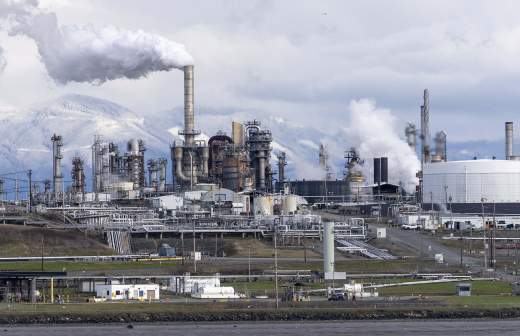
"Even despite the growth of domestic production and the relative energy independence of the United States, expensive oil immediately affects retail fuel prices, and then the inflationary effect is transferred along the chain to transport, logistics, and food products," Shatov points out.
And, as Olga Gogaladze, an economist and financial markets expert, points out, the 49% threshold from Moody's is a signal that the US economy has already been overheated by efforts to combat inflation.

The high key interest rate of the Federal Reserve System (FRS) made loans expensive, consumers began to spend savings more slowly, and businesses began to scale back investments. These were the classic prerequisites for a recession: cooling demand while still having a high cost of money, the analyst explains.
Now, the second inflationary wave risks putting the Federal Reserve in front of a difficult choice: to continue lowering the rate to save the labor market, or to tighten the screws again to curb price increases.
Decline in consumption
And the situation with domestic demand has already worsened. Expensive fuel in the "land of cars" has sharply reduced the amount of free money for the rest of consumption, which inevitably affects GDP growth.

— The American economy is super—dependent on consumer spending, which accounts for 70% of American GDP. For a recession to set in, it's enough for the American consumer to start spending less," says Jan Pinchuk, deputy head of WhiteBird's stock trading department.
Rising unemployment
For industry, oil and gas are not only fuels, but also raw materials.
An increase in the cost of production with already declining demand, due to high rates, means a drop in company profits. And when profits fall, businesses start saving money and freeze hiring or lay off employees, Gogaladze explains.

Rising unemployment is the final stage of entering a recession. The unemployment rate in the United States rose to 4.4% in February 2026 and is projected to reach 4.5% by the end of the first quarter. The conflict in the Middle East in February alone led to the loss of 92,000 jobs in February. This is twice as much as the American economy lost in the entire second half of 2025 (45 thousand jobs).

At the same time, according to the Bureau of Labor Statistics, the U.S. economy has created virtually no new jobs since April last year, when Trump announced the introduction of numerous trade duties.
Explosive debt growth
A protracted conflict will, of course, undermine fiscal sustainability. "Epic Fury" requires enormous expenses, ranging from $1 billion to $3 billion per day, according to various estimates. This puts a heavy burden on the US budget.
During the first 12 days of the conflict, the US national debt immediately jumped by $133 billion — on March 18, it broke the $39 trillion mark for the first time. That is, about $800 of debt was added to each American taxpayer.

If the operation lasts 100 days (as the Pentagon admits), the debt could exceed $40 trillion. And the cost of its maintenance risks becoming simply unaffordable. As early as fiscal year 2025, the U.S. federal government spent up to 3.9% of its GDP on net interest payments on debt.
The risk of recession has increased significantly, but we have not yet reached this level, the RSM consulting company stated. They identified three thresholds for the start of a recession in the United States: a jump in oil prices to $125 per barrel, an increase in gasoline prices to $4.25 per gallon and an increase in inflation to 4% per year.
According to most analysts, the targets will be reached very soon if the conflict does not end as soon as possible.
Переведено сервисом «Яндекс Переводчик»
