- Статьи
- Science and technology
- Learn from fruit trees: data on "jumping genes" contribute to the treatment of rare diseases and schizophrenia

Learn from fruit trees: data on "jumping genes" contribute to the treatment of rare diseases and schizophrenia

Using the example of fruit flies, scientists have found out that "jumping genes" can affect the work of DNA. As they move through the genome, these elements spread special tags around them that suppress the activity of neighboring regions. In the future, these data will pave the way for new areas of medicine, from disease diagnosis to the development of gene therapy methods and control of genome activity. The activity of some of these genetic parasites is associated with oncological diseases, neurodegenerative processes, aging, schizophrenia, the development of rare diseases and other ailments, doctors told Izvestia. In addition, the results of the study will help to better understand the evolutionary processes taking place in living organisms.
Why do we need "jumping genes"?
Most living organisms have many mobile elements in their genome-transposons, or "jumping genes." These are sequences that can create a copy of themselves at almost any time and insert it at a random location in the genome. They increase the genetic diversity of species necessary for their survival. But, on the other hand, uncontrolled movement of such elements can disrupt the work of important genes and lead to the formation of mutations. Therefore, scientists are striving to better understand the functions of "jumping genes" and their effect on various living organisms, including humans.
Scientists from the V.A. Engelhardt Institute of Molecular Biology of the Russian Academy of Sciences and colleagues have for the first time compiled a map of the distribution of mobile elements in the genomes of fruit flies Drosophila virilis. This species of drosophila is characterized by a wide variety of repetitive sequences that have arisen due to copying and "jumping" genes.

Co-authors of the study: researchers and students of the Laboratory of Molecular Mechanisms of Biological Adaptation
By analyzing the sequences and arrangement of mobile elements in five different drosophila lineages, the scientists showed that these insects acquired different groups of "jumping genes" three times during their evolution, and their set turned out to be individual for different fly lineages. The authors also found out that similar species of drosophila can exchange mobile elements with each other.: they repeatedly appear in insect genomes, then disappear and come back again. This can occur as a result of the crossing of two individuals belonging to different closely related species, or due to the bites of parasitic ticks migrating from an individual of one species to an individual of another species.

To understand how mobile elements affect the work of the genes surrounding them, scientists have identified where specific molecular tags are located in DNA — chemical modifications of histone proteins on which DNA is "wound" like a thread on a spool. Such molecular tags can switch genes on or off like switches.
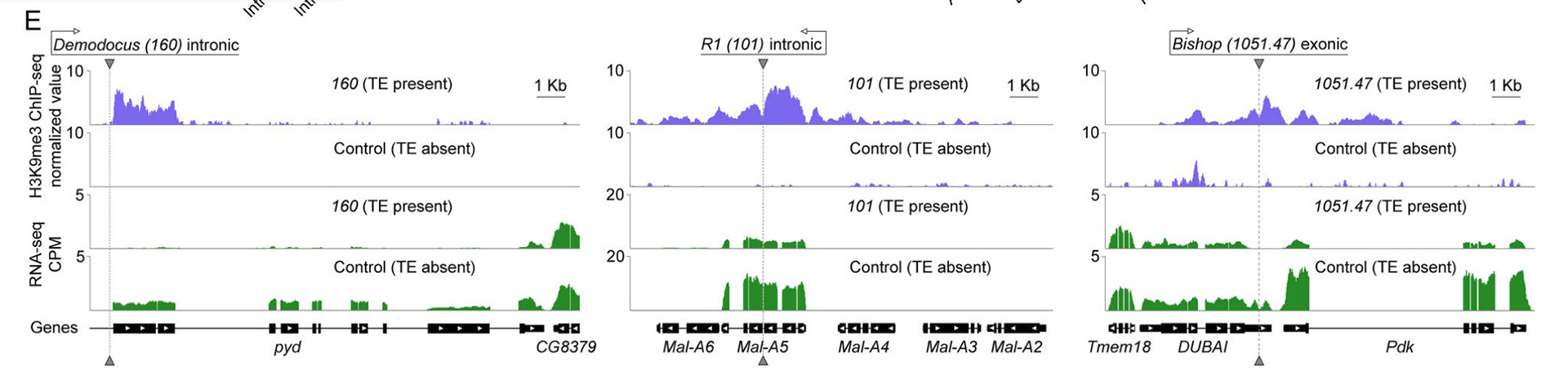
They are able to silence up to 35% of the genes in the neighborhood. However, in some cases, the insertion of a mobile element does not affect the activity of nearby DNA at all, the scientists found. This suggests that evolution uses mobile elements to fine-tune genetic activity.
As Sergey Funikov, senior researcher at the Laboratory of Molecular Mechanisms of Biological Adaptation at the V.A. Engelhardt Institute of Molecular Biology of the Russian Academy of Sciences, told Izvestia, studies on Drosophila virilis flies, as well as numerous works on the human genome, unequivocally confirm that mobile elements, or "jumping genes", play an important role in human health.
— For example, there is evidence of the accumulation of mobile elements in Alzheimer's disease and amyotrophic lateral sclerosis. Although it is not yet clear whether they are the cause or the effect, their activity exacerbates the damage to neurons. There is often massive activation of "jumping genes" in cancer cells. This makes them both a risk factor and a potential target for therapy. In addition, cases have been described where new inserts of mobile elements led to the development of muscular dystrophy and other hereditary syndromes," the scientist told Izvestia.

Bioinformatician Alexander Rezvykh analyzes gene expression data from fruit flies
On the other hand, in the course of evolution, the body has learned not only to suppress the harmful activity of these elements, but also to use them for its own benefit, the scientist said. In the human genome, "jumping genes" have become an important tool for regulating immunity. In addition, one of the key DNA elements for the formation of the placenta in mammals, including humans, originated from the envelope gene of an ancient retrovirus related to retrotransposons that scientists are studying in flies. This clearly shows how the "genetic parasite" has become critically important for our reproduction, said Sergey Funikov.

Thus, the data on how flies control "jumping genes" directly reflect what is happening in human cells.
— Previously, it was believed that mobile DNA elements are a kind of genetic ballast, sequences that are not needed at all. However, using the example of fruit flies, we have shown that mobile elements are extremely important for regulating the work of genes," he noted.
"Jumping genes" and medicine
The fruit fly, or fruit fly, is a classic model object of genetics, emphasized Sergey Funikov. At first glance, the connection with human medicine may not seem obvious, but it is extremely strong. Using flies allows us to do things that are impossible when working with human cells or populations. For example, to conduct large-scale, controlled and ethically safe experiments on the evolution and regulation of the genome.
Transposons can activate proto-oncogenes (normal genes that can mutate and stimulate tumor growth) or disrupt tumor suppressors, whose proteins prevent tumors, thus leading to the development of cancer, Irina Kolesnikova, chairman of the expert council of the National Center for Genetic Research MyGenetics, told Izvestia.

The selection process of Drosophila virilis for scientific research. The picture was taken during the work of researcher Dina Kulikova
— In addition to oncology, the activity of transposons is also associated with diseases such as hemophilia, muscular dystrophy, autism spectrum disorders and schizophrenia, as well as neurodegenerative diseases (Alzheimer's disease, amyotrophic lateral sclerosis), inflammatory (transposons can activate inflammatory processes) and autoimmune diseases (systemic lupus erythematosus, rheumatoid arthritis), age-related macular degeneration," the expert said.
A new study on fruit flies clarifies an already well-known principle: mobile elements are able to spread "silent" epigenetic tags around themselves and suppress the activity of neighboring genes, sometimes affecting a significant part of the local genomic environment, said Albert Rizvanov, head of the Center for Excellence "Personalized Medicine" at Kazan Federal University.
"The authors have shown that such effects can spread to thousands of nucleotides and turn off up to a third of nearby genes, which demonstrates how strongly these elements are able to rearrange the regulation of the genome," he said.
Researchers from the N.K. Koltsov Institute of Developmental Biology of the Russian Academy of Sciences (Moscow), the Moscow Institute of Physics and Technology (Moscow) and the University of Kansas (USA) participated in the study. The results of the study, supported by a grant from the Russian Science Foundation (RSF), are published in the journal Nucleic Acids Research.
Переведено сервисом «Яндекс Переводчик»
