- Статьи
- Science and technology
- Flow to consciousness: a non-contact pulse meter will assess the risk of a heart attack in emergency patients

Flow to consciousness: a non-contact pulse meter will assess the risk of a heart attack in emergency patients

Russian scientists have developed an algorithm that allows non-contact measurement of blood flow velocity in patients who cannot have wearable sensors installed, for example, with extensive burns. This indicator is used in emergency patients to assess the risk of heart attacks and strokes. Previously, optical methods were considered insufficiently accurate, but doctors managed to solve this problem thanks to the parallel processing of data from a video camera and an electrocardiograph. According to experts, the technology will find application in intensive care, in the treatment of children from the first days of life and telemedicine.
Non-contact measurement of blood flow velocity
Scientists from the Institute of Automation and Control Processes of the Far Eastern Branch of the Russian Academy of Sciences, together with colleagues, have developed an improved algorithm for processing optical device data for non-contact estimation of pulse wave velocity. This indicator helps doctors assess the risk of heart attack and stroke during surgery and in other emergency situations. Wearable sensors are usually used to monitor it, but for some patients — for example, with extensive burns — it is impossible to install them. Visual measurement methods without contact have remained insufficiently accurate until recently. To increase their reliability, the researchers began analyzing the video camera data in parallel with the electrocardiograph readings.
— The proposed method allows an adequate assessment of the rate of propagation of the pulse wave from the heart to any point of the body without contact with the patient. This opens up the possibility of using it where contact sensors cannot be used, for example, during surgical operations. Our main task is to turn this experimental tool into an effective clinical method," said Alexey Kamshilin, project manager, Chief Researcher at the Laboratory of Functional Materials and Photonics Systems at the Institute of Automation and Control Processes of the Far Eastern Branch of the Russian Academy of Sciences.
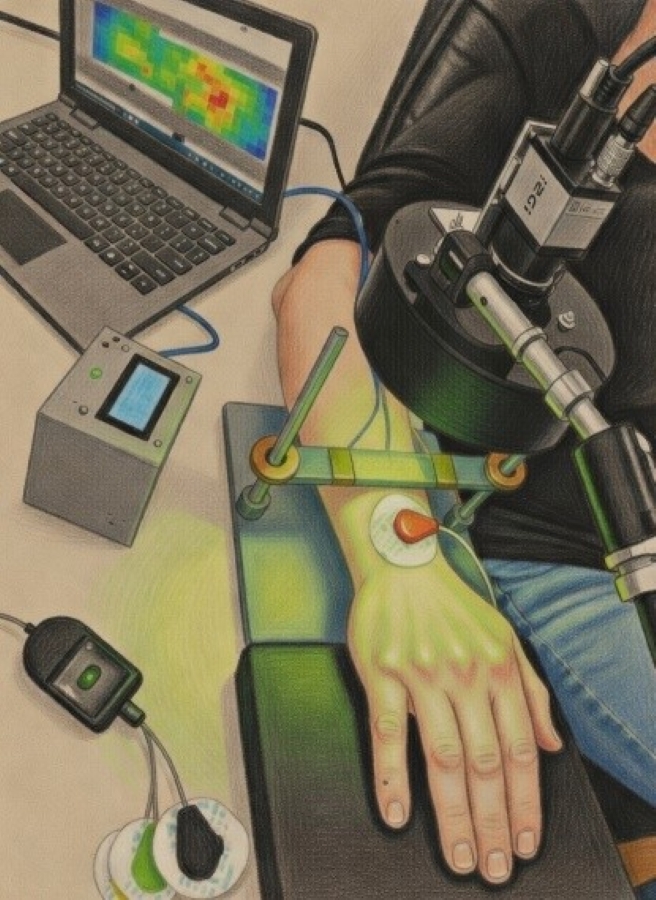
During routine medical examinations and during operations, doctors measure not only the pulse and blood pressure, but also the pulse wave velocity — an indicator of the speed at which the pulse of blood pressure, which occurs during the contraction of the heart, spreads through the vessels. The harder their walls are, the faster such a wave propagates. Therefore, this parameter helps to assess the risk of heart attack and stroke: rigid vessels adapt less well to pressure fluctuations and create additional stress on the heart.
Non-contact optical methods remained inaccurate for a long time, as breathing and even small body movements interfered with the signal.

The authors of the development used a standard installation for measuring blood flow velocity: a camera with a green light that fixed a patch of skin on the patient's forearm. Green light is well absorbed by hemoglobin, the red pigment of the blood, so changes in blood pressure can be monitored by its intensity. When the pulse wave reaches the small vessels under the skin, the capillary network contracts, becomes denser and absorbs more green light. The reflected signal recorded by the camera weakens at the same time. Thus, changing the brightness allows you to register a pulse wave.
To know exactly the moment of each heartbeat and assess the accuracy of non—contact measurement, the scientists simultaneously used an electrocardiograph, a device for reading the heart rate, and synchronized the signals from it and from a video camera in time.
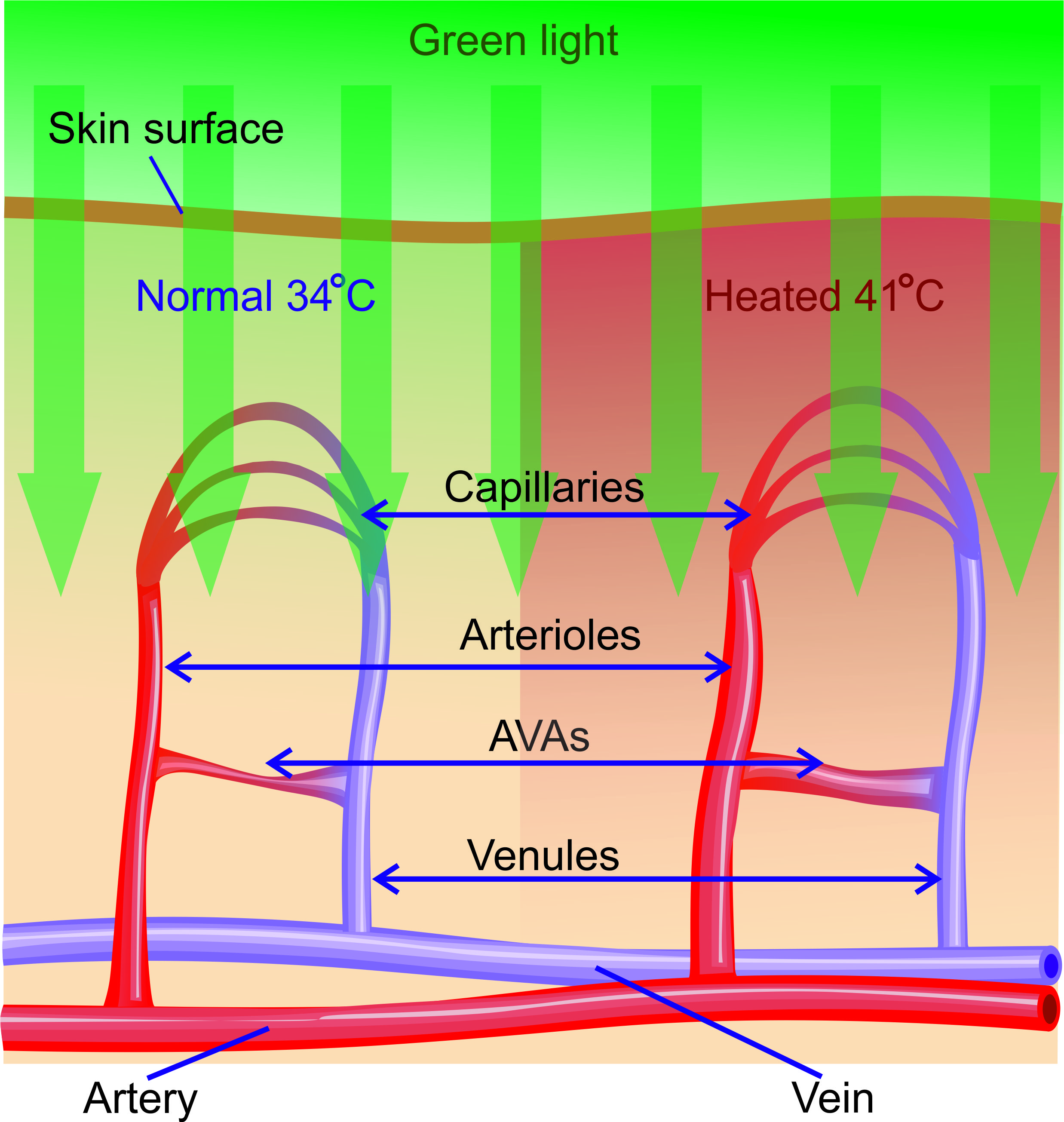
The main challenge was to separate the real signals of blood movement from the interference caused by the patient's movement and breathing. This was achieved thanks to a new camera image processing algorithm that uses correlation processing of electrocardiograph and video frame signals. In addition, he divided each frame into many small fragments and tracked the displacement of each of them over time. This approach made it possible to measure with high accuracy the amplitude of the pulse wave and the time of its arrival — the delay between the heartbeat and the moment when the pulse reaches the observation point.
The developers tested the algorithm by successfully measuring the pulse wave velocity in 47 healthy volunteers.
Use in intensive care
One of the key limitations of contactless optical methods has always been the low reproducibility of measurements. The slightest movements of the patient, breathing, or changes in lighting greatly distorted the signal. Today, the situation is changing due to the development of digital image processing methods and artificial intelligence algorithms that make it possible to isolate a physiologically significant signal from a large volume of "noise," Albert Rizvanov, head of the Personalized Medicine Center of Excellence, explained to Izvestia.

— If such technologies are successfully confirmed, they can occupy an important place in monitoring medicine. However, real implementation will require several stages: large clinical trials on different patient groups, comparison of results with existing standard methods for assessing vascular stiffness and pulse wave velocity, as well as the development of certified medical devices based on this technology," he noted.
Such systems can become especially in demand in intensive care, in the treatment of children from the first days of life, and in telemedicine, where continuous and maximally gentle monitoring of the patient's condition is extremely important, the specialist believes.

Recording of the blood supply response to local heating of the forearm
The timing of the technology's introduction into clinical practice will depend on the speed of creating devices based on it. In some cases, it will allow more accurate monitoring of the condition of critically ill patients and improve the selection of hemodynamically active vasopressor therapy, for example, for shock conditions, says Dmitry Duplyakov, market expert at NTI Helsnet, head of the Department of propaedeutic therapy with a course in cardiology at SamSMU.
— In my opinion, it is important not only to obtain data from healthy volunteers, but also to conduct research in patients in a state of shock, since the centralization of blood circulation at critical moments can affect the operation of the device. I hope my colleagues will continue to study this issue," the doctor added.
The research was supported by a grant from the Russian Science Foundation.
Переведено сервисом «Яндекс Переводчик»
