- Статьи
- Society
- I'll give you a tooth: the cost of dental appointments has increased by one and a half times

I'll give you a tooth: the cost of dental appointments has increased by one and a half times

Since June 2025, the cost of dental appointments in Moscow has increased by 48%. The upward trend is noticeable in many of Russia's largest cities — prices have increased in 27 of the 35 cities with a population of more than 500,000 people. Experts expect a further increase in the cost of dental services by 10-20%. This is the level of medical inflation, they specify. Izvestia found out what the situation is in the dentistry market.
How prices at dentists have increased
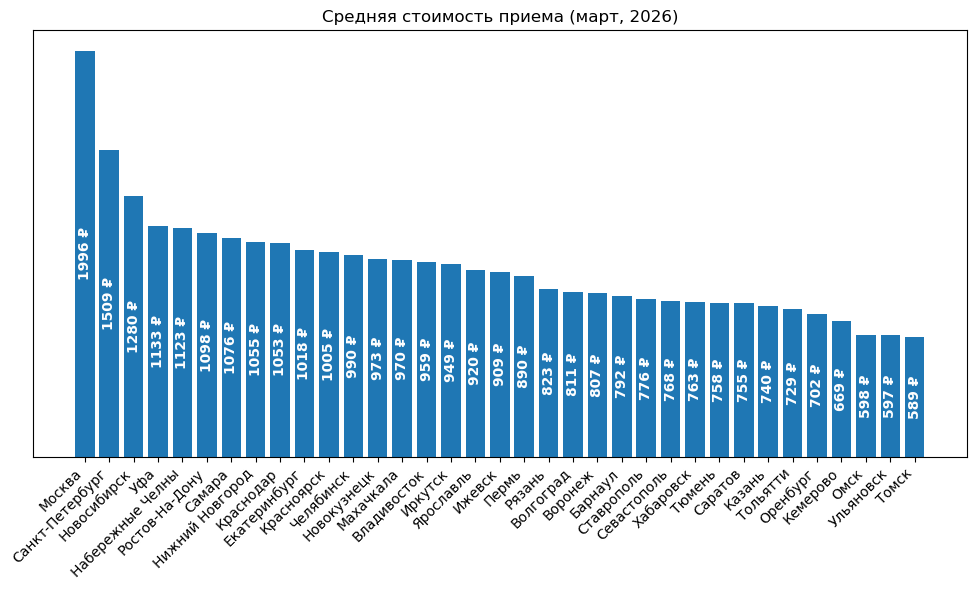
The research center of the Progress communication group analyzed the open data of services for the search and selection of doctors in 35 cities of Russia with a population of more than 500 thousand people. The study (available to Izvestia) showed that since June 2025, the cost of dental appointments (both private clinics and paid services from public health institutions were assessed) has already increased significantly. In Moscow, according to the company, by March 2026, it had grown by 48%, from 1,352 rubles on average to 1,969 rubles. Prices in St. Petersburg also showed a significant increase, increasing by 27% from 1,182 to 1,509 rubles.

Novosibirsk (+37.6%), Ufa (+22%) and Naberezhnye Chelny (+27.6%) also entered the top 5. In June 2025, Rostov-on-Don occupied a place in the top three in terms of the cost of services, but now it has been replaced by the sixth place. The increase in prices in this city was only 8.9%.
Omsk, Ulyanovsk and Tomsk complete the list, where the average cost of admission is below 600 rubles. Moreover, in Ulyanovsk the price decreased by 11.9%, and in Omsk — by 16.4%. In total, analysts noticed a decrease in the average cost of admission in eight out of 35 cities.
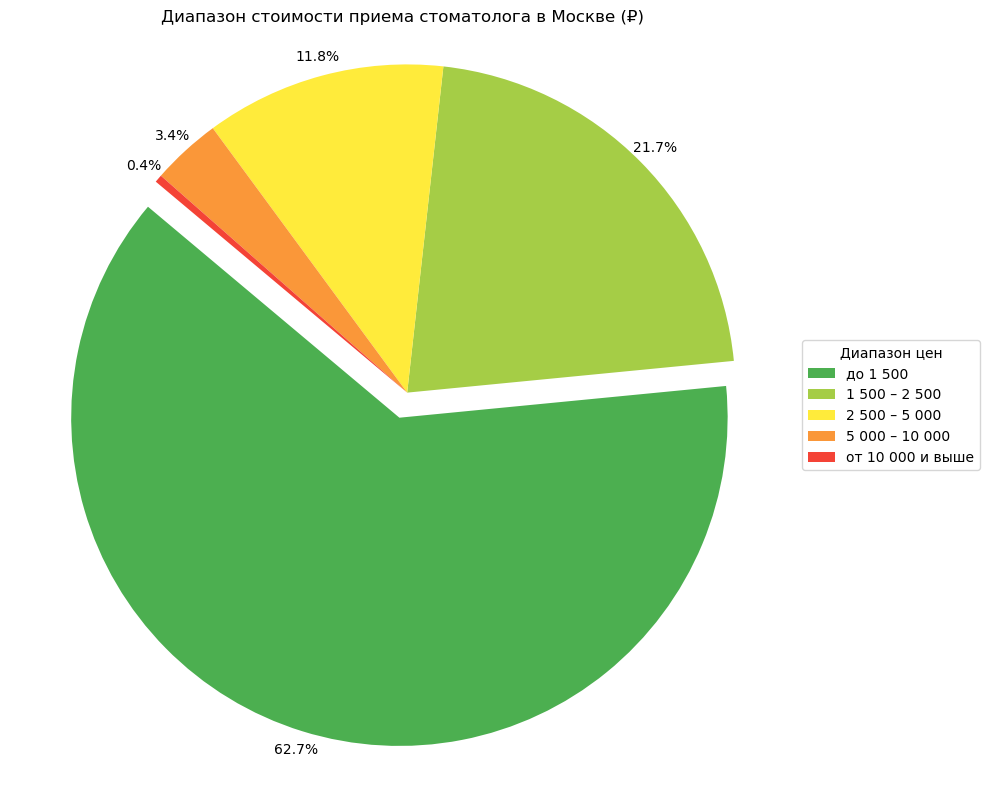
However, most of the dentists in the cities studied work in the lower price segment: for example, in Moscow, 63% of specialists receive appointments for up to 1.5 thousand rubles, in the range from 5 thousand to 10 thousand, only 3.4% of doctors work, and from 10 thousand and above — 0.4%. A similar situation is observed in other cities, with the only difference being that the high-price segment usually starts not from 10 thousand, but from 3.5 thousand or 5 thousand rubles.
At the same time, the average cost of admission now exceeds 1 thousand rubles in 11 cities. In June 2025, this level was typical only for Moscow and St. Petersburg.
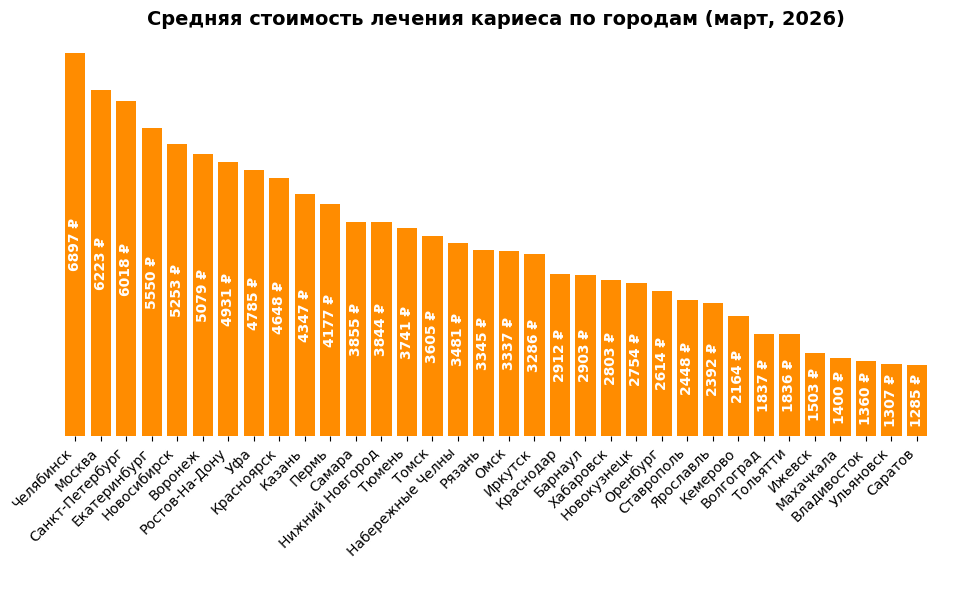
Caries treatment is most expensive in the largest cities. Chelyabinsk is in the lead, where on average you will have to pay 6897 rubles for this procedure. Moscow (6,223 rubles), St. Petersburg (6,018 rubles), Yekaterinburg (5,550 rubles) and Novosibirsk (5,253 rubles) are also in the top five.
In the average group of cities, the cost of the service is in the range of 3-4.5 thousand rubles. The cheapest places to treat caries are in Saratov (1,285 rubles), Ulyanovsk (1,307 rubles) and Vladivostok (1,360 rubles). The difference between the "most expensive" and the "cheapest" cities is more than five times.
A similar situation is observed in the case of pulpitis, the treatment of which in Chelyabinsk will cost an average of 14,855 rubles in March 2026, in Novosibirsk — 14,072 rubles, in St. Petersburg - 13,876 rubles, in Yekaterinburg — 12,948 rubles, in Moscow — 10,548 rubles. At the same time, in Vladivostok, according to the study, the average price of such a service is only 2,384 rubles. In a significant part of cities, the cost of pulpitis treatment is in the range of 6-9 thousand rubles.
Prices are higher in the largest cities, but there are also many more dentists there. For example, there are more than 30.5 thousand of them in Moscow, and more than 15.5 thousand in St. Petersburg. After the two capitals, there is a sharp decrease in the number of specialists: Yekaterinburg is in third place, with only 4.4 thousand dentists. Novokuznetsk (518) and Sevastopol (482) complete the table.

At the same time, as in June 2025, in most cities, the majority of dentists are specialists without a category, while doctors with official categories occupy a smaller market share. Dental experience is usually higher in regional centers, rather than in the largest cities of Russia. There are more young professionals in Moscow, Novosibirsk, Krasnodar and Kazan than anywhere else, analysts say.
How prices will change over the year
The Dental Association of Russia does not expect an increase in the cost of services by the end of the year, unless there are "any force majeure conditions." According to the president of the association, Professor Rinat Saleev, the pricing policy of dental medical organizations will remain at the same level.
"But inflationary processes, the complexities of global logistics, an unpredictable increase in the cost of raw materials and energy resources, and changes in tax policy may negatively affect the pricing mechanism,— the Izvestia source warned.

In general, the surveyed dental market players admitted the possibility of price increases, but differed on which areas this would affect first. Oleg Zinov, a member of the National Association of Healthcare Managers (NAUZ), managing director of the association of clinics "President", said that the price increase would be moderate: by 10-20%, which is close to medical inflation. Maxim Khyshov, a member of the Board of NAUZ, chief physician and founder of the Reformat clinic, also expects growth within these limits.
— It is unlikely that prices will rise for orthopedics and surgery in dentistry. The market is too overheated, everyone is having recessions, everyone is experiencing a drop in the average check and clinic workload, so in such situations, many clinics probably won't dare to raise prices," he noted.
Nowadays, medical organizations often dump and keep prices at the expense of imported materials or switch to a fixed salary for a dentist, rather than a percentage of the receipt, explained Kurban Rashidov, an orthopedic dentist and medical supervisor at Rashidov clinic. However, in some cases, there is a sharp increase.
— According to my observations of working in three clinics, prices have increased by an average of 15%. In one of the clinics, the head literally banned the use of the terminal, because the bank charges the highest commission, and increased the price list by 15% day by day," the expert said.
In turn, Tigran Shmavonian, a dentist and surgeon at the Dentistry on the 22nd Floor clinic, called the increase in prices for dental services in Russia in 2026 almost inevitable. According to him, the industry is heavily dependent on imported materials and equipment.
— Most of the composites, implantation systems, orthodontic elements, instruments and consumables are manufactured abroad. Any fluctuations in currencies, logistics, and supplies directly affect the cost of treatment. At the same time, clinic expenses for rental of premises, utilities, equipment maintenance and specialist salaries are increasing. In sum, this creates an objective pressure on the cost of services," he told Izvestia.
According to the dentist, the most noticeable price increase is likely to be in areas where the share of imported materials and technologies is maximum. These are primarily implantation, orthopedics and orthodontics. And basic therapeutic services — caries treatment, prevention, hygiene — are likely to increase in price more moderately. In these segments, clinics usually try to maintain accessibility in order to form a long-term relationship between the patient and the clinic.

Oleg Zinov agrees with this assessment. The areas of implantation, orthopedics and orthodontics are the most sensitive to cost increases, he said. Basic services usually increase in price more slowly due to the high competition between clinics and the ability to control costs.
How the dental services market will change
The dental market in Russia is growing today, its volume is estimated at more than 700 billion rubles, but profitability is gradually decreasing due to rising costs, Oleg Zinov noted.

Small medical businesses are now "one of the most fragile substances", as there is huge competition on the market, a large list of regulations that need to be followed, and at the same time a very high cost of error, Kurban Rashidov added. In such conditions, a large number of ineffective clinics may close in the near future, Maxim Khyshov did not rule out.
—Up to 10% of the total number of clinics may close due to the fact that margins have dropped significantly, and those who have not established effective processes will only be able to leave at zero and a slight minus with the current workload," he told Izvestia.
At the same time, the doctor did not see any opportunities for an increase in the cost of services, explaining that patients would simply "make a decision with their feet" and switch to competitors who did not raise prices.
This was also stated by Rinat Saleev, who warned that in conditions of intense competition in the market, unjustified price increases could lead to an outflow of potential patients.

— Margins in dentistry are one of the lowest in similar business sectors. The very high share of the wage fund, the huge costs of bringing premises and staff in line with strict regulations, and high rental prices lead to lower margins, especially for small clinics. And, accordingly, to the emergence of large network players, which largely determine the market profile," explained the President of the Dental Association of Russia.
Переведено сервисом «Яндекс Переводчик»
