
Range period: what is known about Israel's nuclear weapons

Despite the lack of an official status as a nuclear power, Israel, according to experts, has dozens or even hundreds of nuclear warheads. Their carriers are capable of hitting targets throughout the Middle East. Against the background of the direct confrontation with Tehran, the issue of the capabilities of Israeli delivery vehicles is of key importance for the security of the region. What kind of weapons does the IDF actually have and where is the red line beyond which nuclear—tipped missiles can be used, is in the author's material of the Izvestia military expert.
How Israel's nuclear project developed
Israel's "nuclear history" has no official confirmation, such as the American Manhattan Project or the history of the Soviet atom. The Israeli atom has its roots in the first post—war years, during the years of the formation of the state. The nuclear weapons program was launched as a response to the threat from Arab neighbors and the desire to ensure the strategic survival of the young country. And, of course, it developed in the strictest secrecy.
After Israel's declaration of independence in 1948, Prime Minister David Ben-Gurion launched research efforts to independently use atomic energy for military purposes. In 1956, after the Suez crisis, the decision to create its own atomic bomb became a priority. In 1957, Israel signed a secret agreement with France on the construction of a research nuclear reactor in Dimona with a thermal capacity of 24-70 MW and its own plutonium separation plant (construction was completed by 1964). In 1959, heavy water was obtained by agreement with Norway. LACAM's own special service was created to collect technologies and components for future nuclear weapons.
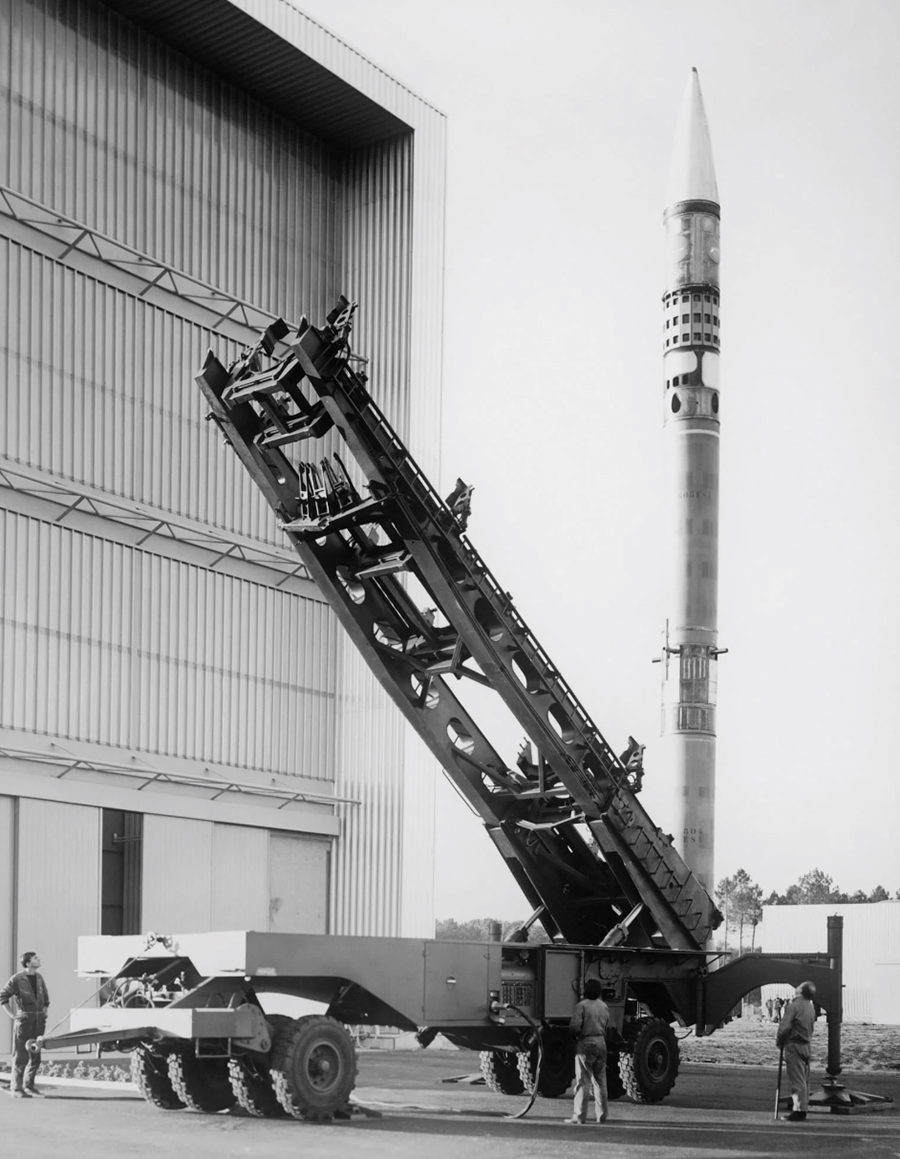
By 1960, Israel had launched its own nuclear fuel reprocessing, which produced several tens of kilograms of plutonium per year. In 1965, the first weapons-grade plutonium was probably obtained. And just before the Six-Day War (June 1967), the first few nuclear charges were assembled, and since 1965, the MD-620 missile, which was created jointly with France and eventually became the Jericho-1 missile, was tested.
In 1968, the US CIA confirmed for the first time that Israel was mass-producing nuclear warheads. It was believed that by 1973, Israel already possessed 20 warheads that could be used against Arab countries in the Yom Kippur War. At the same time, the policy of "nuclear ambiguity" was consolidated: Israel has not confirmed or denied the existence of nuclear weapons and has not given any comments to questions or press reports.

An Israeli APC drives past a destroyed Egyptian tank during the Yom Kippur War
Then there was the 1979 Vela incident, the discovery by the American Vela 6911 satellite of a double flare in the Prince Edward Islands in the Indian Ocean. Usually such an outbreak accompanies an atomic explosion, the islands were under the jurisdiction of South Africa, but South Africa conducted military-technical cooperation with Israel. Experts concluded that the incident was connected with a real test of an Israeli nuclear charge.

Assembly of the MD-620 rocket
Later, in 1986, Israeli nuclear engineer Mordechai Vanunu submitted his materials on the Israeli nuclear program to the Sunday Times. He reported that the Jewish state is armed with about 100-200 warheads, thermonuclear charges, is working on uranium enrichment and has established the production of tritium for thermonuclear charges. Vanunu was later captured by Mossad intelligence and convicted of treason in Israel. He was released on April 21, 2004 and was even nominated for the Nobel Peace Prize in 2015.

What kind of nuclear arsenal can Israel have today
It is likely that even today Israel has a fairly serious nuclear arsenal, which may contain both free-falling bombs and warheads of cruise or ballistic missiles. Including air—based weapons, which makes such weapons very long-range. For example, Blue Sparrow aeroballistic missiles, having their own range of about 2 thousand km, can be launched from F-15 aircraft, which, taking into account air refueling, can carry out an operation to hit targets at a range of up to 3 thousand km and even more. In fact, this means the possibility of launching a nuclear strike on any country in the region and even further away — all Arab countries of the Middle East and North Africa may be within the radius of destruction.
How many warheads can Israel have? Given that they do not become obsolete by themselves, there should be at least 100 units. Over the decades, they could easily have changed electronics, some parts that have their own warranty period. And if necessary, they can be applied.

Dimona Research Center
What can Israel's nuclear industry be like today? The research reactor in Dimona (Negev Nuclear Research Center) can produce weapons-grade plutonium without international control. There is also an industrial uranium enrichment complex, which, according to Vanunu, has been operating since 1979-1980. Gas centrifuges and enriched uranium purification complexes are located here. Ore mining is carried out in the Negev Desert. It is believed that in the 1960s and 1970s, Israel could have obtained fissile materials from the United States and in the form of ore from South Africa - technically this is possible, although there is no exact confirmation of this.

Of course, the country's scientists have the highest level of relevant competencies. Nevertheless, it is believed that Israel may well be the sixth nuclear power in the world. Therefore, there are no technological secrets for developers here, either on atomic or thermonuclear munitions.

Israeli Air Force F-15 fighter jet
Earlier, former CIA analyst Ray McGovern admitted in an interview with Izvestia that Israel could use nuclear weapons. In his opinion, if this state is, conditionally, destroyed by Iranian missiles, then as a last resort, its leader will not shy away from using nuclear weapons. "Israel will not be stopped by any protests from the United States or anyone else. They do what they want, and they usually expect the United States to follow their example," Ray McGovern said.
Israel is not a party to the Treaty on the Non-Proliferation of Nuclear Weapons and has been pursuing a policy of nuclear ambiguity since the late 1960s: it does not confirm or deny the existence of its own nuclear weapons. It is believed that the use of lethal warheads is possible only if the existence of the State of Israel proper is threatened. It is clear that in the current situation, Iran's retaliatory attacks do not pose such a threat, but where is the guarantee that the Islamic Republic's strikes will be interpreted correctly?
No one can give such a guarantee, and the only protection against the transition of the confrontation into a qualitatively new phase could be its cessation. And it is precisely the cessation of the exchange of strikes that is not yet visible — both sides still have stocks of missiles, and so far the politicians are only encouraging each other with bellicose statements.
Переведено сервисом «Яндекс Переводчик»
