
"A person is more likely to live to be 40 than a rock band"

Not everyone can afford to give up a prestigious career as a diplomat with a baby in their arms for the sake of a dream of music, and not every rock band can live to the age of 40. But Alexander F. Sklyar went all-in and did not lose. In an exclusive interview with Izvestia, the musician spoke about the reasons for his departure from the Ministry of Foreign Affairs, plans for Chaliapin's work, his attitude to the modern history of Russia and the recording of the song "Samsara" with Basta.
"Everyone thinks: kicked out means unreliable"
— Alexander Feliksovich, congratulations on the anniversary of the band. There is a superstition that 40 years are not celebrated. It's more related to a personal birthday, but since you're all in as a child, how do you feel about this event?
— To put it bluntly, I did not have the feeling that the 40th anniversary of the band should not be celebrated. Maybe because a human cub is much more likely to live to be 40 years old than a rock band. Although it consists of people, it is still a slightly different education. And years are counted differently here. And even more so if we are talking about Russia, where, as they say, sometimes a year counts for two. I think the 40th anniversary of any band is still a date.
We want to play a good anniversary concert so that everyone who came to it could see the history of the band firsthand, starting from the first steps and ending with the current state. And to make it clear that this is not some kind of relict creative unit, but a living organism that breathes, exists and creates. It seems to me that two anniversary concerts — one on March 6 in Moscow, in Gorbushka, and the other on March 15 in St. Petersburg, at the Jagger Club — are quite a correct and good format.

Musicians Garik Sukachev and Alexander F. Sklyar perform in Moscow at a concert dedicated to the 30th anniversary of the album "I recognize a cute guy by his gait"
— You compare the age of the group with the age of the son.
— It happened by itself, I didn't do it on purpose. The fact is that my son Peter was born on March 4, 1986. And I remember perfectly well that it was on this day that the two first members of the band "All-In" (and we were a trio then) They called me and said they agreed to my offer to play in a new band. So I'm not artificially connecting the birth of my son and the founding of the band — that's how life turned out.
— Does the responsibility of an artist change over the years in the same way as the responsibility of a father?
- of course. No matter how much you love your band, your brainchild is still a very small act compared to the great mystery of the birth of a child. Especially if it's a long-awaited son. And doubly so if this is the first and only son. The responsibility for the child, at least in my case, is many times greater than the responsibility for the group.
I was very worried about how Va-Bank was developing. He was painfully aware of the inevitable failures — and there were many of them — and rejoiced at success, whether it was a successful performance at a festival or a serious challenge. For example, when we went to Warsaw for the Rób reggae festival, we didn't have time to get a passport for our guitarist. So instead of a group of four, we went with three people.

And just imagine: the stage of a huge festival for 30 thousand people and an unknown band from Russia. We had to prove that we had not come in vain. Moreover, the Poles at that time judged our rock and roll by the performance of the band "Time Machine", which came to the same festival a year before us. And the guys didn't like the court so much that people booed them.
And now, a year later, another team arrives. Also without the main guitarist. The vocalist plays the guitar, let's say, on average, the set is 40 minutes, and during that time you have to prove that you didn't come in vain. We succeeded, and I consider it a victory.
But all these victories and defeats are incommensurable with the steps that a little person takes when they are just born, and with the responsibility that falls on you as a father. In his early years, you must at least ensure the basic financial existence of the family. And that was exactly my Achilles' heel — I left the Ministry of Foreign Affairs, I had no money, it ran out very quickly after returning from North Korea. My parents helped me as much as they could, but I had to tear myself apart so that the family could exist with dignity during that period.

Musician Alexander F. Sklyar at the Red Square Book Festival in Moscow
— It is symbolic that in 1985 you gave up your career as a diplomat and decided to take a risk by going into music, to bet on everything, that is, to go all-in.
— The main thing was to prove to yourself that you didn't burn all the bridges in vain. After leaving the Ministry of Foreign Affairs, I found myself in a real void. You only realize this later, when you try to get an honest job somewhere, but they don't take you. Because who would believe that a person himself left such a "bread" position, from such a tasty ministry, where people are sleeping and trying to get there? Everyone thinks they've been kicked out, which means they're unreliable.
I realized this after I was fired. There was no one to warn me in advance. Yes, the personnel officer at the Ministry of Foreign Affairs cautiously asked if I understood where I was going. But I kept my face straight: I had a legend that I was going to the conservatory for the vocal department without exams. Everyone knew I was singing, but no one checked. And I was a kid then, and I didn't fully understand what he meant. It was real maximalism and all-in.

Musician Alexander F. Sklyar takes part in the recording of the online concert "Songs of Victory"
"People who are not interested in history take a lot away from themselves"
— You still play songs that are already 10, 15, 20 years old. How has their perception changed now for you and the audience?
— Some songs really sound different now. What was put into them then and what they are filled with today are different things. For example, the song "We are sitting in the kitchen and smoking Pegasus." Back then, the kitchen was one of the main forms of communication: a small apartment, tea, a glass, a guitar — the kitchen was like a club. And now almost no one is sitting in the kitchen. And the Pegasus has been gone for a long time, and we don't smoke.
When a young man hears this song, I catch puzzled glances: he theoretically understands what a kitchen is, but does not feel the context. And older people have a warm sparkle in their eyes — nostalgia. Back then, everything was clear without explanation, but now these meanings have to be read anew.

Alexander F. Sklyar during the afternoon performance of the XV International Military Music Festival "Spasskaya Tower" on the Cathedral Square of the Main Temple of the Armed Forces of the Russian Federation
— Now it would be possible to sing: "We are sitting in the kitchen and smoking an ico."
— Well, yes, up to that point. But we'll stay true to ourselves — we'll sing about Pegasus.
— During your career you have performed Vysotsky, Utesov, Vertinsky. Is there an artist you would like to cover today?
— After the album of Vysotsky's songs for his 80th birthday and for my 60th birthday, I said that, perhaps, I sang everyone I wanted. Vertinsky is mastered, I learned Alyosha Dmitrievich by heart back in Korea — there were few official duties, but, on the contrary, a lot of time. I read more books then than I've probably read in my entire life. Therefore, when Garik Sukachev and I made "The Bosun and the Tramp", it was a natural bow to Alyosha.

I honestly thought that I had already sung all my predecessors whom I wanted. But while working on the album "Blood and Gold", I remembered another person — Fyodor Chaliapin. I've never dared to sing it, but I've known one song since I was a kid. This is a "Cudgel". And it surprisingly coincided with the present time. It says everything very bluntly. Therefore— Chaliapin. But I can't guess any further.

Musician Alexander F. Sklyar at the Vladimir Vysotsky Award ceremony "Own Track" at the State Kremlin Palace in Moscow
— I thought you would name Bulat Okudzhava. It's interesting that you're looking for inspiration in the past, not in the future.
— It turns out that way. Our modern times, oddly enough, turned me to the Patriotic War of 1812. A lot of things become clearer today if you study the history of your country. The surge of patriotism, courage, the Battle of Borodino — all this explains a lot about how our guys are fighting today. Where the roots come from is what is important to understand.
People who are not interested in history take away a lot from themselves. Besides, it's largely a family issue. Teach children to love their history, not because it is necessary for school, but because it will help future young people to better understand the country in which they live. We have an incredible story, different and tragic in the 20th century, but this is also our story. Without this knowledge, it is impossible to understand culture: where did the Pushkins, Lermontov, Tolstoy, Chekhov, Gogol, Gorky come from.
— But this is also important for good music.
— Absolutely. That's why I included "Dubinushka" in a modern album, rather than making a separate record of folk songs. We are not a retro band, we are relevant. And the same song, "Let's go, Friends, let's go." This is not the most famous composition. I heard her in a feature film starring Inna Churikova. She listened to this song on the record. Then I tried to find it and saw that it was only available in choral performances. But there is a deep story hidden in it. This song also fits very neatly into our time. Because this is exactly the blood that our fighters shed on their own, which is then melted into the gold of the spirit. Hence the name of the album "Blood and Gold".

Concert of Alexander F. Sklyar and the band "Va-Bank" at the International Exhibition-Forum "Russia"
"Rap has replaced rock, but that doesn't mean rock has to go away"
— If we talk about modern music and young performers, who are you interested in?
— I don't listen to young people as much as I used to, but something gets through. One of the discoveries is the Drummatix band, which I saw on the Salt program. Great music, strong lyrics, amazing frontwoman. I think they have a great future.
I really like St. Petersburg's "Affinage" — deep, serious musicians going their own way. I love Branemir, an honest, uncompromising artist who goes out to the public alone with a guitar. This is the highest level of difficulty. He travels a lot, plays a lot, grows as an artist, sees Russia from the inside and melts it into creativity. I would like to mention Rich, for me he is also a young artist working in the modern rap genre. But he is a very deep artist, performer and person. And, of course, Artem Sagrada is powerful, sharp, uncompromising, charismatic, with strong lyrics and presentation.

Alexander F. Sklyar during an interview with Izvestia
— How do you feel about rap in general? Do you have a feeling that rappers in Russia today are as socially charged as rockers in the late 1980s?
— I agree with that. It is an actual art that meets the demands of the time. Music develops in waves: each genre has its own peaks and troughs. In a sense, rap has replaced rock, but that doesn't mean rock has to go. There is always an audience that has grown up with this music.

Although Sasha Branemir proves a different point of view. He is, in fact, performing bard music. But not like those guitar singers we were talking about. A bard of a new formation. It's a dark country, but in Russian.
— Moreover, it looks quite risky when songs generated by artificial intelligence get to the top of the charts.
— And then a "naked" artist comes out: just him and a guitar.

Musician Alexander F. Sklyar at the ZOV poetry evening dedicated to the special operation in Ukraine
— Apparently, people have a need for something simple and real.
— You're absolutely right. There will always be a piece performer who will go against the fashion trends and make you listen to yourself. Apparently, Sasha is from this series.
— Do you use AI?
— No, not at all. As long as I'm an acting, writing artist, that's unacceptable to me. The algorithm will not replace the soul. In popular culture, yes, many things are possible there. But you can't replace Vitya Sukhorukov or Petya Mamonov with artificial intelligence — it will be immediately readable. It is impossible to replace real, deep cultural figures.
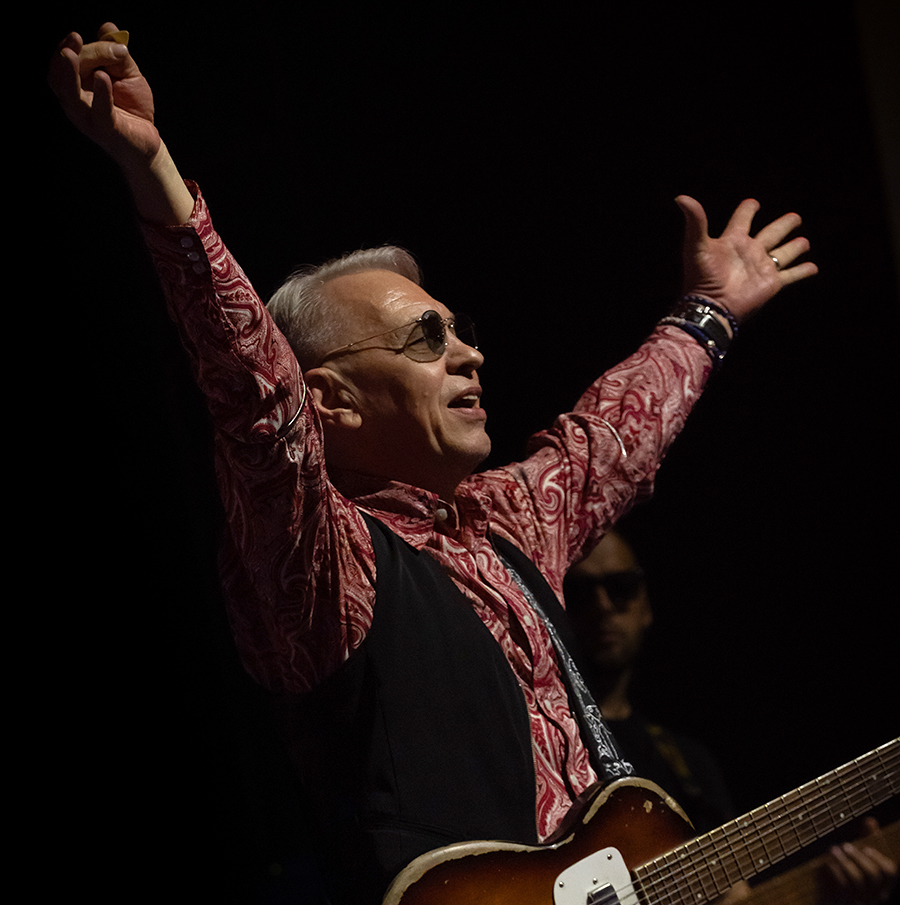
— About the rap. Would you like to record a duet with someone or offer hip-hopers the song "All in"?
— Rich and I just made the song "Black Candle" in the Salt project. We just knew that the show was ending with our performance, so we composed this song. Then Artyom Sagrada asked me for permission to use the chorus from the song "Routes of Moscow", making a completely different and, by the way, excellent composition.
I am always open to suggestions, I really like experiments and consider them a necessary part of the development of a musician. Therefore, if any artist from any genre, including rap, offers me something, I will be only glad.
By the way, that's exactly how it turned out with Vasya Basta. I went to his concert once, and, of course, I liked his work. But I was absolutely not ready for a call from his management offering cooperation. And suddenly: "Alexander, Vasily wrote the song "Samsara". It seems to us that it is very successful, and he really asks you to listen to it and sing along in the chorus."
I really think it's a very good song. It's a very good one. And on New Year's Eve, I received a call from an old friend, an active surgeon who works, so to speak, at the front line. He is a father of many children. He calls and says: "Alexander Felixovich, I ask you, if you communicate with Vasya, be sure to tell him: This is the anthem of all parents with many children." And he's right. "Samsara" is the anthem of families. I would like to take this opportunity to thank Vasily in my interview on behalf of my surgeon friend and all fathers with many children.
Переведено сервисом «Яндекс Переводчик»
