- Статьи
- World
- The East is a big deal: Iran's response has upset the plans of the United States and Israel

The East is a big deal: Iran's response has upset the plans of the United States and Israel

The sudden attack by the United States and Israel on Iran failed to crush the government in Tehran: Iran was not only able to recover, but also began to successfully counterattack. Moreover, the resumption of attacks was announced by pro-Iranian forces in Yemen, Lebanon and Iraq. The calculation of the American-Israeli coalition for a rapid internal paralysis of the Iranian political system has not been justified, experts say. At the same time, the consequences of another round of military escalation in the region are already manifesting themselves — both in world oil prices and in the cessation of air transportation. For Russian citizens, the most noticeable consequence was transport paralysis: thousands of tourists were blocked at airports in the UAE and other Gulf countries with no clear prospects of returning home. About how the new war in the Middle East is developing and which countries are already involved in it and why, see the Izvestia article.
Iran's retaliatory strike
In just two days, the US and Israeli military operation against Iran transformed from a declared "targeted action to curb nuclear ambitions" into a full-scale regional conflict. The Jewish state justifies its actions with "preventive self-defense," stating that the strikes are designed only to stop direct threats to the country's security. Washington, in turn, interprets the attack as the elimination of "imminent risks" for the American contingent in the region. So, on March 1, President Donald Trump announced that the Americans had "destroyed and sunk" nine Iranian naval ships. The Israeli army said it had attacked the headquarters of the IRGC, the Iranian intelligence Service, the Iranian Air Force and a number of command centers in Tehran. Trump spoke with the leaders of Israel, Bahrain and the United Arab Emirates, the White House said.
— There is full coordination between the IDF and CENTCOM (the Central Command of the US Army. — Izvestia). In turn, the Americans are coordinating a number of actions with their allies in the Middle East," Yevgeny Sova, deputy speaker of the Knesset and a member of the Our Home Israel party, told Izvestia. — After the signing of the Avraham agreements, there are full—fledged diplomatic relations between Israel and a number of Gulf countries, but it is not for the media to talk about a joint response to Iran.

In response to the coalition operation launched on February 28, Tehran launched massive missile strikes. Tasnim news agency reported that six high-ranking CIA officers were killed and two others were injured as a result of Tehran's attacks. It is noted that the missile hit one of the complexes in Dubai, where employees of the departments lived. Fars, citing the Islamic Revolutionary Guard Corps (IRGC), noted on the evening of March 1 that the United States had already lost 560 soldiers killed and wounded. In addition, the IRGC said it had hit three US and British oil tankers with missiles in the Persian Gulf and the Strait of Hormuz. The IRGC announced the beginning of the ninth stage of the operation against Israeli and American targets in the Middle East.
At the same time, pro-Iranian forces are intensifying in the region: the Yemeni Houthis have resumed attacks on Israel and civilian shipping, and the Iraqi groups Kataib Hezbollah, Harakat al-Nujaba and Kataib Sayyid al-Shuhada have announced operations against US troops. A particular threat is posed by the Lebanese Hezbollah, whose actions may become critical for the security of Israel's northern borders. In these circumstances, the role of the UN Interim Force in Lebanon, UNIFIL, is increasing.
— Amid unprecedented regional developments, UNIFIL peacekeepers continue to carry out their mandated tasks in southern Lebanon and along the Blue Line. Round—the-clock interaction and coordination with the parties continue, helping to avoid any misunderstandings and miscalculations in these uncertain times, the press service of the Provisional Forces told Izvestia.

Despite the assassination of part of the Iranian leadership, the calculation of the United States and Israel on the "lightning-fast paralysis" of power in Iran did not materialize.
— It is impossible to overthrow the government with airstrikes. That's not how it works. I am convinced that Trump and Netanyahu understand this. Most likely, they expect that protests will resume in Iran, riots will resume, and something like this will happen against the background of a weakened state," Alexander Kargin, an expert on the Middle East, told Izvestia. — The Venezuelan scenario is still possible. This is when a part of the local elites — in this case, the Iranian ones — will start cooperating with Trump. But I think this option is less likely.
However, there is no need to talk about effective military deterrence from Iran now, according to the program manager of the Russian International Affairs Council (RIAC) Ivan Bocharov. The scale of the destruction and losses among the country's top management attest to the deep vulnerability of the defense system.
— Iran has been preparing for a conflict, but this is an asymmetric confrontation where the parties are initially only formally equal. Iran has a large land army, but in modern warfare, aviation and precision-guided weapons decide everything. Here, the technological superiority of Israel and the United States is almost unconditional," the expert emphasized in an interview with Izvestia.
Unable to respond with parity in the air, Iran launched attacks on Arab monarchies hosting American forces. The consequences in the UAE were the most resonant: the airport infrastructure in Dubai was seriously damaged, and rocket debris fell near the Burj Al Arab hotel. The American Al-Udeid airbase in Qatar and the Crowne Plaza Hotel in Bahrain were also attacked.

Despite the damage done, the direct entry of the Gulf monarchies into the war is not worth waiting for. According to Ivan Bocharov, these countries are extremely limited in military resources and are unlikely to be exposed to new attacks. For them, the priority remains economic development and modernization, in which the great war does not fit in any way.
International reaction to the attacks by the United States and Israel
In the very first days, the official position of the Arab capitals was confronted with the reaction of the "streets". While Saudi Arabia, Qatar, Kuwait and the United Arab Emirates condemned Iran's retaliatory actions, the Shiite population of the region responded with mass protests outside the US diplomatic missions. The situation is most acute in Karachi, Pakistan, where an attempt to storm the American consulate escalated into violent clashes with police. The use of tear gas and, according to media reports, firearms resulted in the deaths of 10 people. It was also tense in Baghdad, Iraq: There, the protesters tried to break through the fortified "green zone" to the US Embassy.
At the diplomatic level, the coalition's actions have caused a wide wave of criticism. The attacks on Iranian territory were condemned by China, Turkey, Pakistan, South Africa, North Korea, as well as Iraq, Oman, Cuba and Malaysia. Moscow took a tough stance: the Russian Foreign Ministry described the operation by the United States and Israel as an "unacceptable act of armed aggression" against a sovereign state and a gross violation of international law, warning of the risk of destabilization of the entire region.

The UN Security Council has become the main platform for expressing polar opinions. UN Secretary General Antonio Guterres strongly condemned the military scenario and called for an immediate ceasefire to avoid a global catastrophe. However, during the emergency meeting, the parties did not reach a consensus: representatives of the United States and Israel insisted on the legitimacy of "preventive measures," while Tehran claimed the illegality of the attack and civilian casualties.
Regional associations — the League of Arab States (LAS) and the African Union (AU) — have taken a difficult, ambivalent position. The Arab League noted that escalation is fraught with a major war, and directly pointed to the double standards of the international community.: Israel demands harsh measures against Iran, while not allowing inspections at its nuclear facilities. At the same time, the Arab League condemned Iran's missile strikes on Arab countries, calling them a violation of sovereignty. A similar concern was expressed by the Chairman of the African Union Commission, Mahmoud Ali Yussuf. Calling on the United States and Israel to de-escalate, he also "strongly condemned" the Iranian attacks on the territories of Bahrain, Qatar, the United Arab Emirates and Kuwait.

Aircraft carrier Charles de Gaulle
The US actions have caused a split in the Western camp. Even the United States' NATO allies, Spain and Norway, opposed military action, emphasizing the need to comply with international law. Traditional Euro heavyweights France and the United Kingdom preferred more cautious formulations, expressing "deep concern" about the development of the conflict. Against this background, it was reported that the French aircraft carrier Charles de Gaulle and its strike group intend to relocate to the Eastern Mediterranean. Later, France, Germany and Britain threatened Iran with "military measures" if they continued attacks on their allies. The statement of Eurotroika was distributed by the Cabinet of Ministers of Germany.
Prospects for conflict resolution
At the moment, Israel and the United States are not demonstrating readiness for de-escalation. Donald Trump explicitly states that the ultimate goal of the operation is to change the political regime in Tehran, but the implementation of this scenario has reached a diplomatic impasse. After the death of Ayatollah Ali Khamenei, there is virtually no figure left in Iran with whom Washington could have a constructive dialogue on a peace agreement, says Cornell University professor Richard Bensel.
"Trump and the Israeli leadership are not too interested in establishing a democratic government in Iran — they need an entity to which they can impose a workable deal on their own terms," the expert explained in an interview with Izvestia. — It can be assumed that the bombing will continue until Tehran's ability to respond is completely suppressed, after which the power in the country will have to pass into someone else's hands.

According to media reports, the White House is dominated by the principle of "bombing, not talking." At the same time, the Iranian side claims that a diplomatic solution was as close as possible before the strikes began: the Tehran delegation left Geneva on February 27 with confidence that the deal would be completed at the next meeting — new contacts were to take place in Vienna on March 2.
The "nuclear threat" was only a formal reason to launch the campaign, according to American political analyst Peter Kuznik. The Iranian nuclear program was significantly weakened, and there was no real evidence of Tehran's desire to build a bomb in the near future. According to him, the Trump administration's allegations have become a pretext for the coveted "war of choice."
However, abandoning diplomacy carries serious risks for Trump himself in the run-up to the congressional elections. According to Ipsos, only one in four Americans supports the military operation, and the president's overall approval rating barely reaches a third of the population. If the conflict drags on, and the death of the US military or a spike in gasoline prices due to the blockade of the Strait of Hormuz hit the economy, this could turn even his party colleagues against Trump, Kuznik believes.

— Some Republicans are already opposing this attack and may join the Democrats' efforts to launch impeachment proceedings. The party's prospects in the midterm elections already looked bleak, and now they can become catastrophic," the expert emphasized.
Iran's main lever of pressure remains the Strait of Hormuz, a key artery through which about 20% of global oil flows and a comparable volume of LNG trade pass. The complete blocking of this zone will inevitably cause a global energy shock. Iran has already warned that it may block the strait, but has not officially published a separate decision. At the same time, on March 1, several ships were already attacked in the Strait, one of which sank.
The UN called on the parties to immediately de-escalate, and Russia and China warned of the risk of "oil suffocation" for the global economy. The United States, realizing the seriousness of the situation, has already advised its ships through the Maritime Administration (MARAD) to avoid the area due to the threat of attacks.
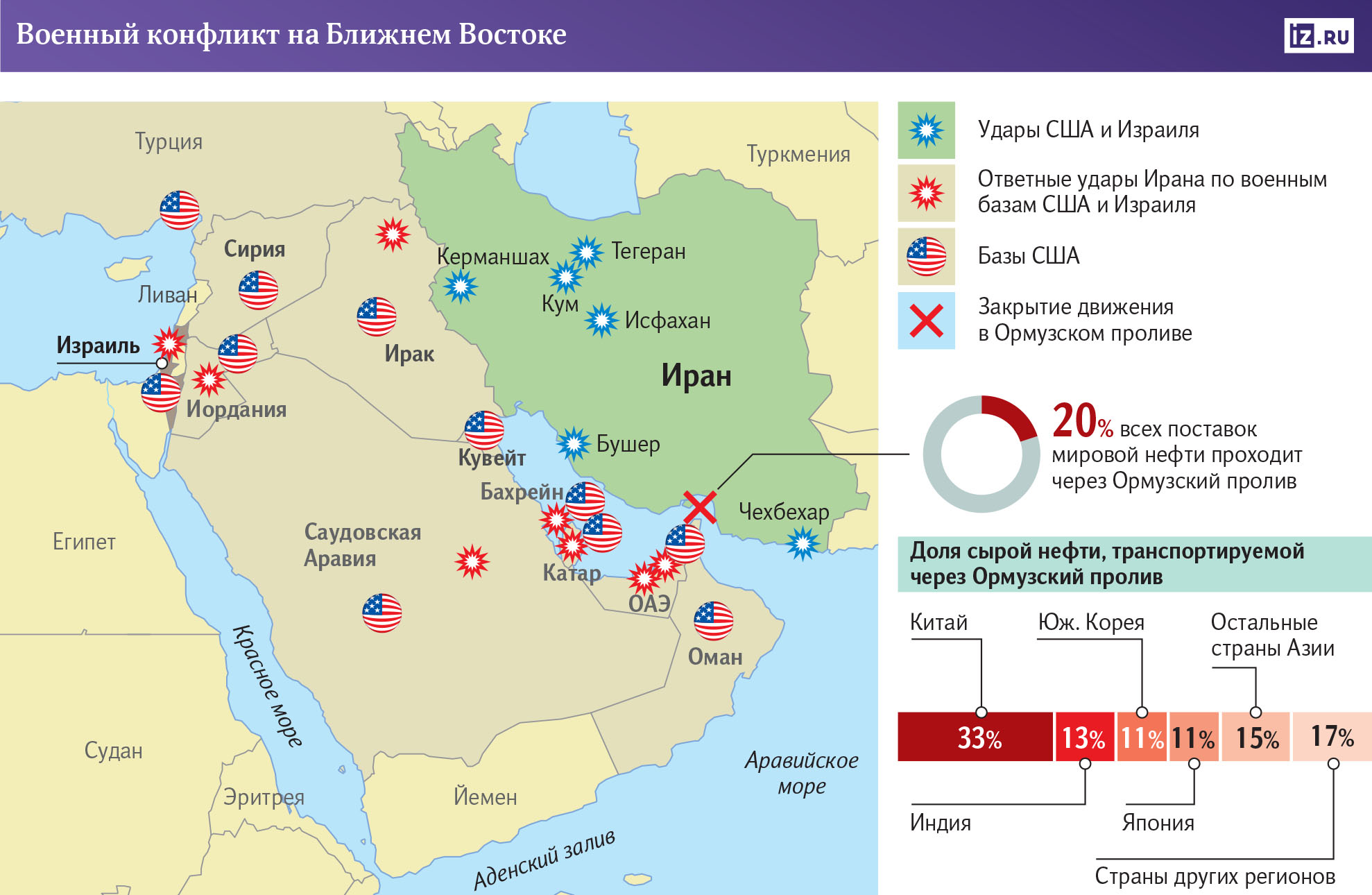
Meanwhile, the main transport hubs of the Gulf, through which a significant share of the world's passenger traffic passes, have already been emptied. The closure and severe restriction of airspace over Iran, Iraq, Kuwait, Israel, Bahrain, the United Arab Emirates and Qatar have led to massive flight cancellations and delays. An "empty sky" has actually formed over the region, which has paralyzed international traffic between Europe, Asia and Africa.
This has especially affected the citizens of the Russian Federation. The Association of Tour Operators of Russia estimated the number of Russians with tickets for connecting flights through the Gulf countries who cannot return home at 8 thousand people: some of them are stuck in third countries, some are forced to extend their accommodation. At the same time, there are about 20 thousand Russian tourists with cancelled and missed flights in the UAE alone.
Переведено сервисом «Яндекс Переводчик»
